Lee Jia En, 25, a distinction graduate from the Singapore University of Social Sciences, enrolled in the government's Graduate Readiness Internship Programme (GRIT) after graduation. This program is often seen as a temporary solution, helping graduates gain experience in public agencies or private companies.
However, the monthly stipend ranges from only 1,800 to 2,400 SGD (approximately 1,400-1,850 USD). The lower end of this range is less than half the average starting salary for a university graduate, and only about two-thirds the income of a management trainee at McDonald's, which typically requires only a college diploma.
"It felt terrible. Four years of university just to get a job that pays half of what my friends earn," Lee exclaimed when she first started. Despite this, she chose to put her pride aside.
 |
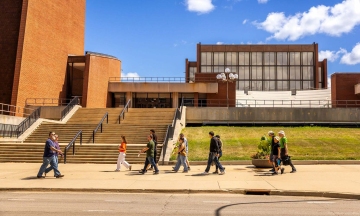
A view of the Singapore Management University campus. Photo: *EducationWorld* |
Like Lee, many unemployed young people in Singapore are turning to GRIT as a lifeline. Experts suggest that the increasing adoption of artificial intelligence, tighter hiring policies, and the economic fallout from global conflicts have significantly impacted Singapore, a nation reliant on trade and energy imports.
In Quarter I, the wave of layoffs reached its highest point in nearly three years. Surveys reveal that the proportion of graduates securing full-time employment in business, arts, and science fields from all six public universities decreased by about 10% between 2023 and 2025.
In response to this situation, Singapore's Ministry of Manpower relaunched the internship program, similar to the model implemented during the Covid-19 pandemic. They stated that the low stipend was intentionally set to "ensure interns prioritize seeking permanent employment."
Even so, the GRIT program has only filled just over half of its target positions. The Minister of Manpower suggests that candidates have declined offers in favor of better opportunities. However, experts like Associate Professor Kelvin Seah from the National University of Singapore note that many remain hesitant due to the low remuneration and the perception that the program is only for those who cannot find other jobs.
Lee recalls the "shame" she felt initially, participating in the program while her friends avoided it. Her superiors assigned only menial tasks, such as printing documents, to "match the salary" she received.
For others, it has been a series of precarious days waiting for employment, which has eroded their morale. Ng Hui, 26, an information systems graduate from Singapore Management University, states that the GRIT stipend of 2,400 SGD is "insufficient" to cover his 50,000 SGD tuition debt. After his internship hours at a government agency, he tutors secondary school students to earn additional income.
Ng only stays home during his free time to cut expenses, dedicating entire weekends to interview preparation. After months of pushing himself, Ng feels "helpless" because there is no guarantee of securing a permanent position.
Phang Jun, 24, submitted over 100 applications before finally securing an internship at a technology company. Sensing limited opportunities for permanent employment there, she actively networked with colleagues to explore other prospects, willing to work outside her field to compete with thousands of other graduates entering the job market next month.
"Now, whatever job comes my way, I'll take it," Phang said.
Khanh Linh (According to Bloomberg, Fortune, SCMP)