According to the Ministry's draft guidelines on 23/11, the pilot program will run until 5/2026 in selected schools, with details yet to be announced. Following this, the Ministry will summarize, evaluate the results, and finalize the content framework for widespread implementation in subsequent academic years.
The AI education framework for students is developed based on 4 main knowledge streams: human-centered thinking, AI ethics, AI techniques and applications, and AI system design.
This knowledge will be differentiated by age group across two stages: basic education (primary and lower secondary school) and career orientation (upper secondary school).
At the primary level, students will be introduced to AI through visual applications (images, voice) and begin to develop an awareness of personal data protection. Subsequently, at the lower secondary level, they will learn about operating principles (data, algorithms), practice using AI to solve academic problems, and identify AI risks and biases.
In upper secondary school, students will learn to design simple AI systems, develop complex problem-solving skills, and explore career paths in technology.
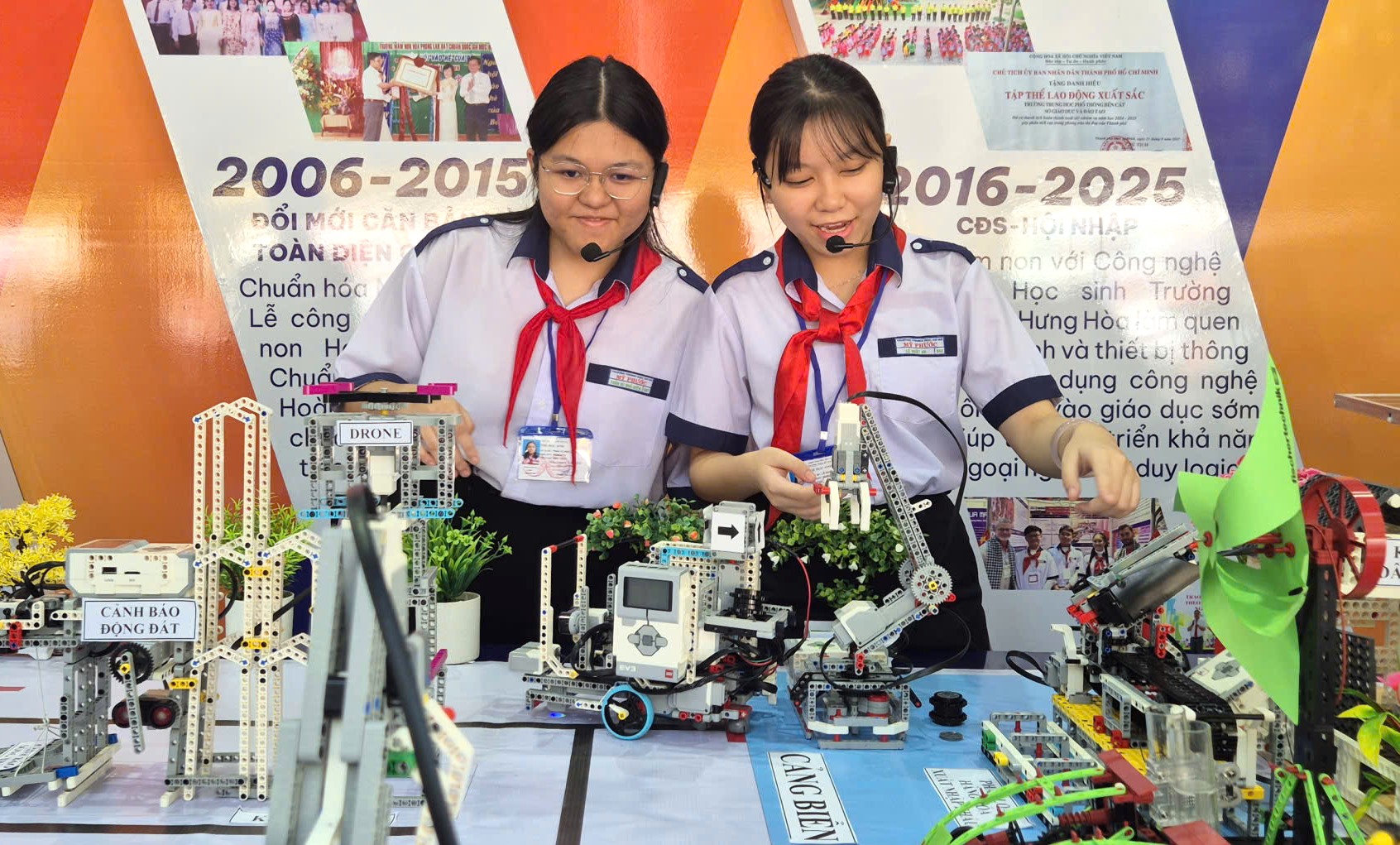 |
Students presented a Lego model of merged TP HCM at an exhibition celebrating 50 years of education on 18/11. Photo: Chan Phuc.
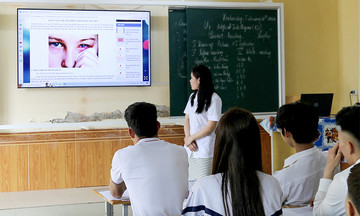
According to the Ministry, integrating AI into general education will not alter or overload the existing curriculum. Instead, schools should align AI content with the learning objectives of each subject and educational activity to suit different student groups. This can be achieved through specialized topics, project-based learning, or clubs.
For teachers, the Ministry will pilot AI applications in management, supporting them with lesson preparation and innovating assessment methods.
Politburo Resolution 71 on educational breakthroughs outlines the task of comprehensive digital transformation and the widespread application of digital technology and artificial intelligence in managing and organizing educational activities at all levels nationwide.
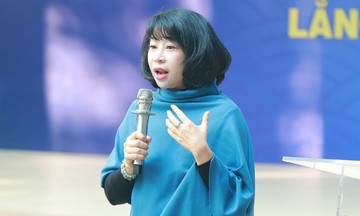
Experts consider integrating AI into primary education necessary but emphasize the need for an appropriate, cautious, and safe approach.
Le Nguyen