Tai graduated with a grade point average (GPA) of 9,2/10, one of the eleven outstanding students to receive the All-Rounder Cup from Ho Chi Minh City University of Technology, Vietnam National University Ho Chi Minh City, this year.
"I am enjoying this moment because my efforts over five years have been recognized," Tai said.
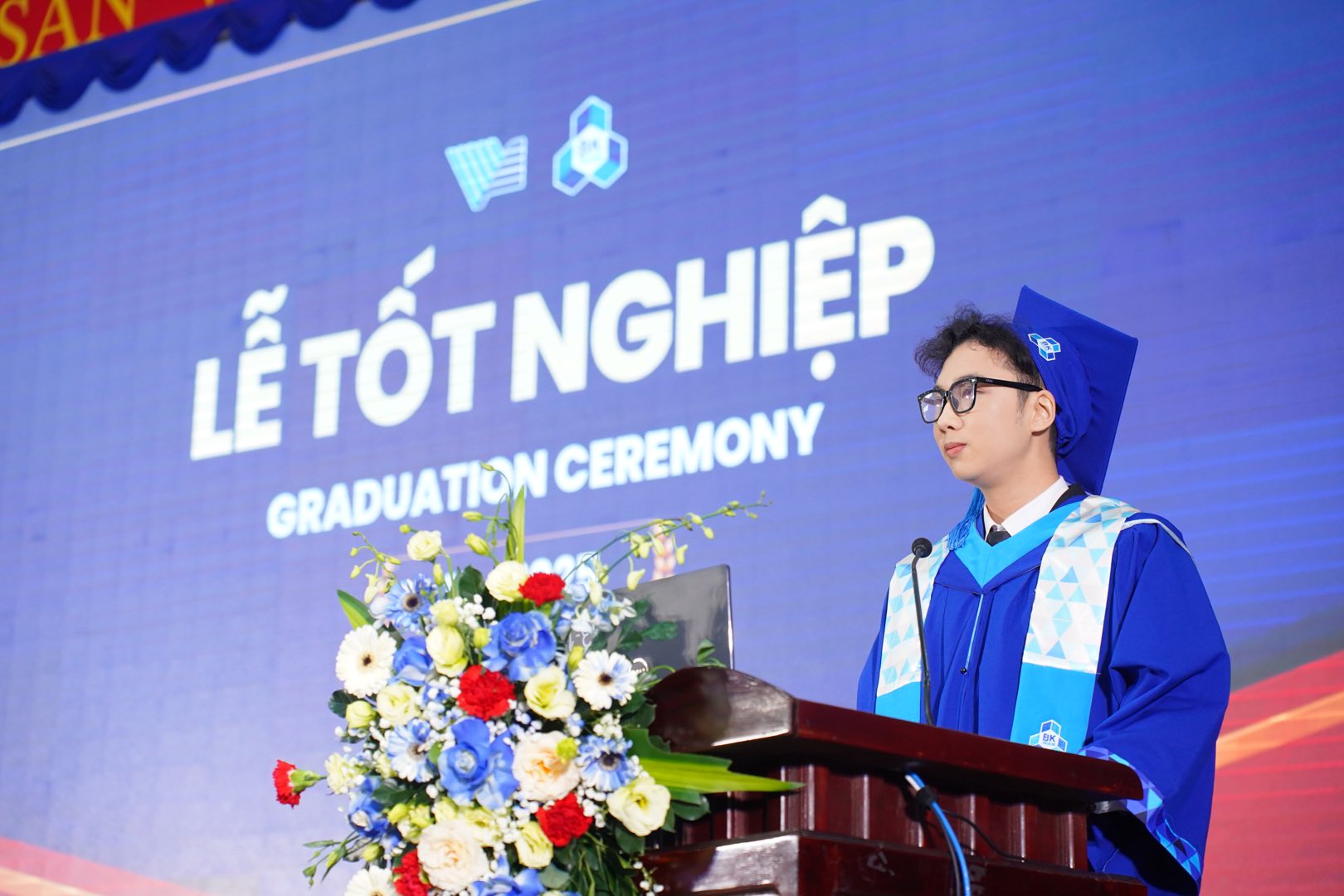 |
Le Thanh Tai speaks at the Ho Chi Minh City University of Technology graduation ceremony, 28/11. Photo: University fanpage
Tai shared that his mother is a tailor and his father is a carpenter in Ho Chi Minh City. As a child, he enjoyed disassembling toys and "explaining" to his mother how they worked. For Tai, this was an innate desire to understand how things operate.
Later, in the advanced math and physics class at Nguyen Huu Cau High School, his curiosity gradually aligned with an interest in energy. "I realized everything around us runs on energy, and I wanted to develop or harness a new source," Tai stated.
Therefore, when preparing for university entrance exams, Tai considered nuclear energy. During a recruitment consultation day at Ho Chi Minh City University of Technology, he met lecturer Vu Vinh Dat, who suggested exploring advanced materials. This would allow him to analyze structures and progress further in nuclear and new energy research. Inspired by this suggestion, Tai chose to enroll in the material and energy engineering program, a Vietnamese-French joint initiative.
The program, structured according to the French system, includes a significantly higher number of general subjects compared to standard curricula. For example, while other students take two modules of Calculus, students in the Vietnamese-French program complete three.
Tai's learning philosophy, "learn to apply," formed early on. With this approach, Tai actively connected knowledge across various subjects to create "small projects."
For instance, while studying renewable energy, he sought applications in solar energy research. This led Tai to develop a project for building an artificial island that uses solar energy to stimulate coral growth. This project helped him gain deeper insights into renewable energy materials, including their properties, limitations, challenges in real-world deployment, and new potential for exploitation.
Similarly, in computer systems and programming language courses, Tai designed a solar energy system capable of tracking light. This project simultaneously applied knowledge from algorithms, calculus, physics, and renewable energy.
"By combining multiple fields, I understood the knowledge more deeply and retained it longer," Tai explained.
Tai also viewed academic competitions like the Olympiads as a "shortcut" to solidifying his knowledge. The broad, challenging problems requiring synthetic thinking helped him delve deeper, expand his foundation, and identify areas for improvement.
Alongside his studies, Tai rigorously developed time management skills. Each week, he planned his tasks, set milestones, and allocated free time for contingencies. At the end of the week, Tai reviewed everything for adjustments.
Tai's international exchange trips began in 2023. He proactively sought scholarships from the Office of External Relations or international scholarship websites, categorizing them by program type: summer schools, workshops, long-term exchanges, and then submitted applications.
His journey started with a workshop in Taiwan (China), followed by an impressive series of experiences: advanced training in sustainable development and data analysis at UNDP, Thailand; an engineering internship at NanoLab, Chung Cheng National University, Taiwan; an Erasmus+ exchange at the University of Trento, Italy; along with numerous other workshops and summer camps on materials in Indonesia, Myanmar, South Korea, and the Netherlands.
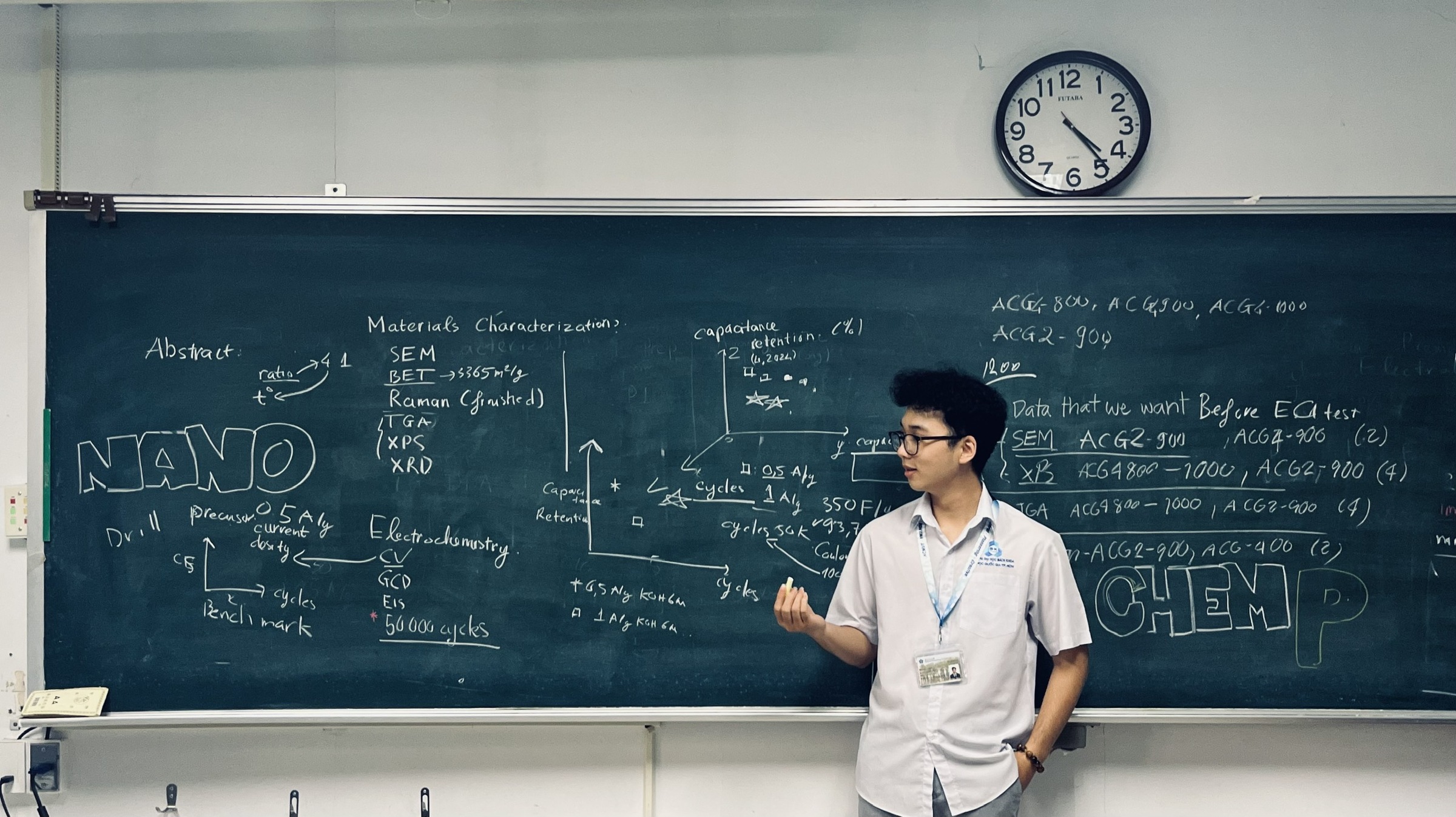 |
Le Thanh Tai during an exchange trip in Taiwan, 9/2023. Photo: Provided by interviewee
These extensive travels provided Tai with many valuable lessons, especially living alone for over half a year in Italy and then seven months in France during cold weather. With support from his family and teachers, Tai became more independent, learning to organize his studies and daily life efficiently.
The research topic Tai is most proud of is his graduation thesis. Collaborating with his supervising professors and domestic and international colleagues, Tai developed materials for electric double-layer supercapacitor (EDLCs) electrodes. The results achieved 353 F/g, among the highest levels currently.
The challenging part was electrode fabrication. The initial synthesized material was in powder form, but for testing, it needed to be compressed into smooth pieces. Tai experimented with many methods, spending nearly half a month working continuously to find a suitable approach. Despite the difficulty, he never felt discouraged, only thinking, "I haven't tried hard enough," and continued to seek new directions.
As Tai's supervisor and thesis advisor, Doctor Vu Anh Quang noted that Tai's achievements stem not only from his ability but also from his discipline and seriousness.
"Tai has a spirit of venturing into new fields, always listening to feedback and making changes for the better," his advisor said.
Doctor Quang recalled being impressed with Tai from his first year when he volunteered to lead a student scientific research group in the Introduction to Engineering course. The idea for an artificial island that Tai and his team developed was considered bold and won first prize at that year's Engineering Festival.
Beyond research, Tai also managed the material technology faculty's music club, participated in youth union and association activities, volunteer campaigns, and tutored students, including those in part-time study programs.
Before his graduation ceremony, Tai received news of his acceptance into the PhD research program at the University of Bordeaux (France), with tuition waived and a salary provided. His intended research topic focuses on applying MOF materials in semiconductors for treating urea-containing wastewater and producing hydrogen, a fuel for fuel cells.
For Tai, this is an important step. It not only builds upon his previous foundation in nanocarbon materials and electrochemistry but also opens opportunities to contribute to sustainable energy solutions with significant practical implications for the future.
Reflecting on his journey, Tai expressed pride in choosing the right path, achieving his goals, and seeing his efforts yield results. In January next year, the valedictorian will depart for France, continuing his research career with the spirit of "nothing is impossible."
Khanh Linh