At 35 years old, Dr. La Hoang Anh is currently a post-doctoral researcher at the Sophia Agrobiotech Institute in France, a prestigious institution jointly managed by the French National Research Institute for Agriculture, Food and Environment (INRAE), Universite Cote d'Azur, and the French National Centre for Scientific Research (CNRS).
He moved to France nearly one year ago on a scholarship from the French government's "Initiative of Excellence" program, designed to attract young global scientists. Before this, Hoang Anh earned his PhD in Agriculture with distinction from Hiroshima University, Japan.
His dissertation focused on the anti-leukemia potential of natural compounds extracted from invasive weeds and rice plants. Supervised by Professor Tran Dang Xuan, a renowned Vietnamese scientist in Japan, his research attracted attention by opening new avenues for scientific inquiry.
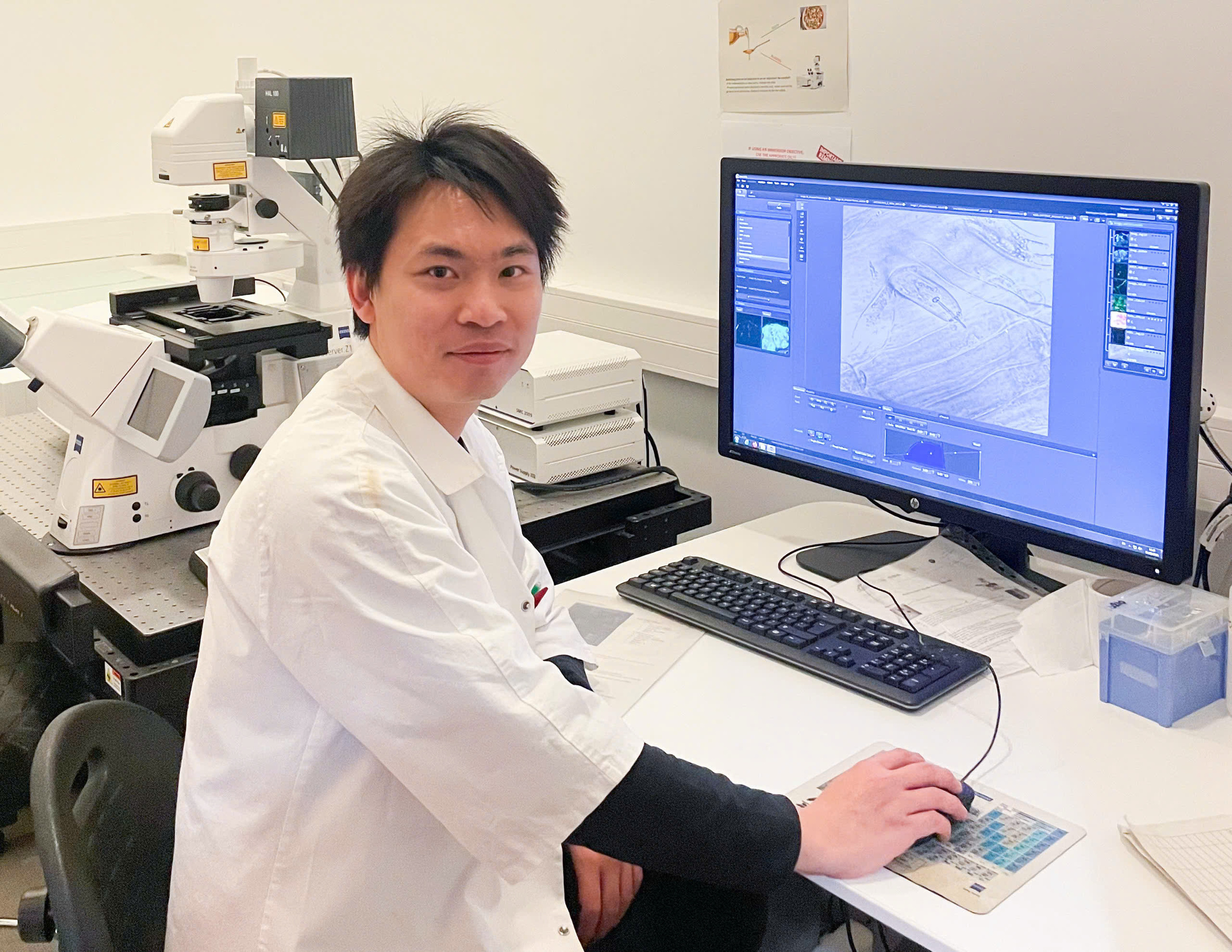 |
Dr. La Hoang Anh in the laboratory in Japan. Photo: Supplied |
Hoang Anh began his Master's in Agriculture at Hiroshima University in 2015, after graduating from the Vietnam National University of Agriculture. Within two years, he published 11 papers in ISI and Scopus journals, graduated with distinction with a GPA of 2,94/3, and secured PhD scholarships from both the Japanese and French governments.
He chose to remain in Japan to further develop his Master's research on Momilactone A and B compounds found in rice. According to a prominent UK biochemical company, these compounds are 30,000 times more valuable than gold.
Hoang Anh concentrated on proving that these compounds can promote apoptosis in leukemia cells and inhibit their proliferation. He benefited from earlier work by his team, who had successfully isolated Momilactone A and B from rice husks and white rice, also demonstrating their ability to inhibit diabetes and obesity.
Despite this, Hoang Anh faced a deadlock for about one year, struggling to find suitable experimental methods. At one point, he stayed in the lab for 2-3 days straight to monitor chemical reactions, repeating experiments hundreds of times without success.
"For the first time, I thought I might have to fail a year and wouldn't be able to complete my PhD program in 3 years," Hoang Anh recalled. "More importantly, I feared I might have to abandon a promising research direction."
Amidst this challenge, he remembered Vu Quang Lam, a friend from High School for Gifted Students, Hanoi National University of Education, who was pursuing a PhD at Aichi Medical University, Japan.
His friend connected him for a one-month internship at the university's lab, where Hoang Anh resolved all his initial difficulties. He gained a clear understanding of cancer mechanisms, enabling him to devise appropriate research methods.
Together with his research team, he successfully demonstrated the anti-leukemia potential of Momilactone A and B compounds in rice. The compounds, both individually and in combination, showed superior ability to inhibit cancer cell growth compared to common cancer drugs like doxorubicin and arsenic trioxide (ATO).
In 2022, this research was published in Cancers, a Q1 medical journal specializing in oncology. It is anticipated to serve as a premise for the research and development of effective cancer therapies based on Momilactone.
The team also initiated a new research direction involving invasive weeds, specifically cogon grass, which negatively impacts agriculture worldwide.
Using advanced high-tech extraction methods, Hoang Anh and his collaborators isolated several groups of compounds from these plants that exhibit antioxidant properties and inhibit tyrosinase enzyme and leukemia cells. The research findings were first published in late 2020 in Plants, a Q1 journal dedicated to plant science.
This work made a significant impact and was highlighted by many health journals, as it was the first study to discover new potential in invasive weeds.
Hoang Anh was the lead author for both publications. As a result, he was awarded the outstanding student prize two times by the Hiroshima University President. Subsequently, he became a post-doctoral researcher at the university, and later a lecturer and assistant professor.
Since then, he has supervised 10 PhD students and 7 Master's students.
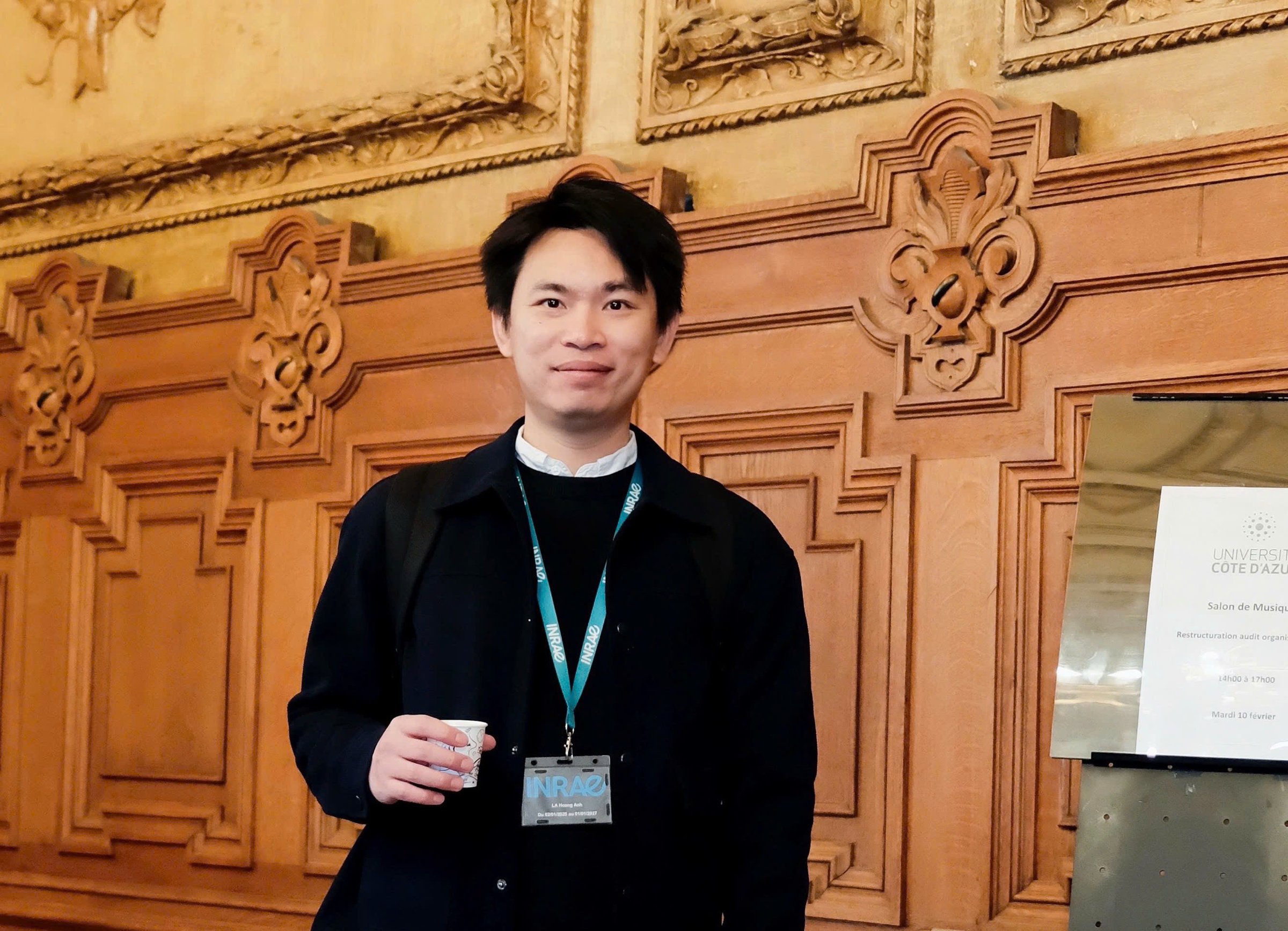 |
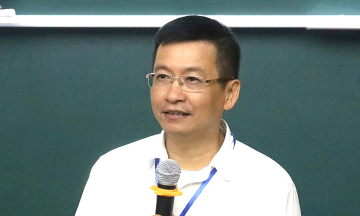
Dr. La Hoang Anh at a conference in France. Photo: Supplied |
During his time in Japan, Hoang Anh considered himself fortunate to be part of Professor Tran Dang Xuan's research group. He recalled his mentor's words from the first days of his studies: "Regardless of talent, the most important qualities for a student are discipline, diligence, and determination."
Witnessing his professor work until 3-4 a.m., never taking a day off even when sick, further motivated him.
Dr. Vu Quang Lam, a post-doctoral researcher in Hematology, Department of Internal Medicine, Aichi Medical University, described Hoang Anh as passionate and eager to learn. He recounted that when Hoang Anh came for his internship, the Covid-19 pandemic was raging. Nevertheless, Hoang Anh completed all necessary procedures, vaccinations, and quarantine to be present as planned.
"He is always responsible and ensures work progress, no matter the difficulties he faces," Dr. Lam stated.
To date, Hoang Anh has nearly 40 papers published in international journals, with 35 listed in "Web of Science"—the world's largest academic system—totaling over 600 citations. He is also the author of a book chapter published by the world's number one scientific publisher, Springer Nature, and has presented numerous scientific reports at prestigious conferences.
Dr. Hoang Anh also participates in many activities contributing to his homeland through the Vietnamese-Japanese Expert Association (VJS) and the Vietnamese Intellectuals Association in Japan (VANJ). He received a certificate of merit from the Vietnamese Consul General in Fukuoka in 2023 for his outstanding contributions to the community.
Hoang Anh wishes to return to Vietnam at an opportune time, as he believes the country holds great potential for agricultural research development.
"I want to contribute to public health and the nation's agriculture by developing applied research to create valuable products," he said, citing examples like developing functional foods or medicines based on his research into the cancer-healing potential from rice and weeds.
Duong Tam