Here are five common mistakes people often make, along with recommendations from physical therapy and sports medicine specialists:
Increasing intensity too quickly when starting
Many people, when first adopting a walking routine, often feel overly enthusiastic, leading them to walk too far or for too long right from the start.
According to associate professor Brian Eckenrode of Arcadia University, USA, accelerating progress too quickly can easily lead to pain and injury. He advises exercisers not to increase their distance by more than 10% per week. Instead, utilize step-tracking applications on phones or smartwatches to adjust exercise time appropriately.
Taking overly long strides
When rushing or trying to increase speed, many people tend to lengthen their strides. According to physical therapist Karena Wu of ActiveCare Physical Therapy, New York, USA, excessively wide strides cause the foot to land too far in front of the body's center of gravity, increasing pressure on the knee joint.
A study of approximately 2,300 elderly individuals showed that the group with long strides often had an increased risk of worsening knee pain after two years. The advice for exercisers is to maintain a natural, comfortable gait: swing the foot gently forward, land on the heel, roll through the sole, and push off with the toes.
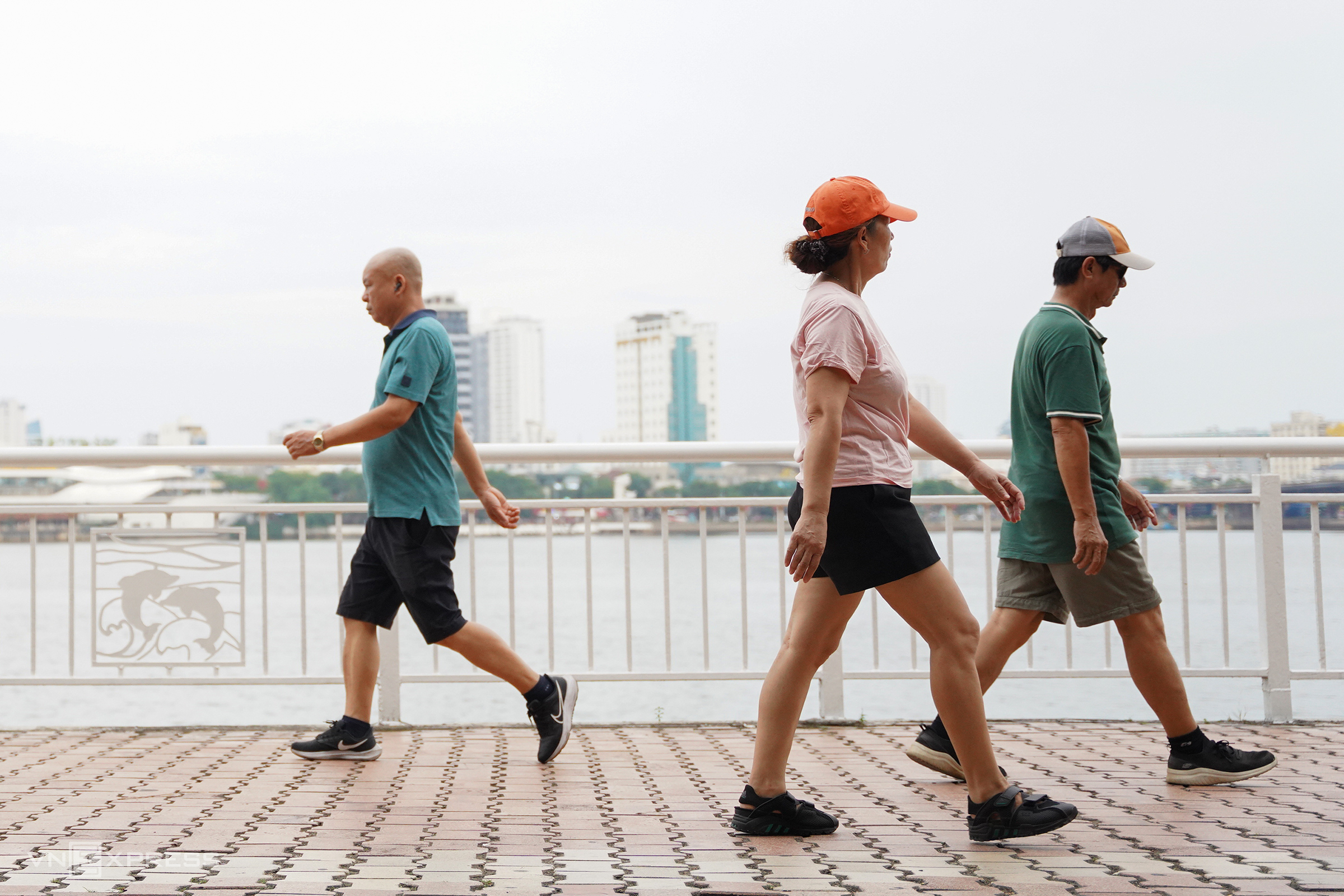 |
Walking is a simple exercise, beneficial for cardiovascular health and bones. Photo: Nguyen Dong
Asymmetrical or unbalanced gait
The long-term habit of unevenly distributing force between the two feet or between the heel and forefoot will harm the knee joints.
Doctor Rodante Saballa, a sports chiropractor in Los Angeles, USA, states that individuals who habitually walk on their toes or drag their feet will place the entire load on the anterior leg muscle chain, creating significant pressure on the knees. Furthermore, a discrepancy in leg length or the habit of leaning to one side can also misalign the kinetic chain.
How to identify:
Check shoe soles: If the sole is worn unevenly to one side or more at the toe than the heel, your gait is abnormal.
Self-check at home: Walk in front of a large mirror or ask someone to record your gait to detect limping, uneven steps, or pronated feet.
Corrective exercises: Incorporate banded side steps three times per week to strengthen hip muscles, helping to stabilize and reduce load on the knees.
Incorrect downhill walking technique
When walking downhill, the body drops deeper with each step, forcing the quadriceps (front thigh muscles) to work 2,5 to 3 times harder than on flat ground to brake the force. This significantly increases pressure on cartilage and knee joints.
To protect joints when walking downhill, exercisers should note:
Slow down and consciously shorten your strides to reduce the body's drop distance.
Never lean backward to brake; instead, slightly lean forward from the hips to alleviate pressure on the thigh muscles.
Use trekking poles. Studies show that supportive poles can help reduce impact forces on the knees by 12-25%.
Wearing unsuitable footwear
There is no one-size-fits-all shoe. Shoes that are too soft or have excessive cushioning can destabilize the ankle, forcing the knees to overcompensate. Conversely, shoes that are too thin will not adequately absorb impact, transmitting ground reaction forces directly to the knees.
Exercisers should choose shoes appropriate for their purpose: trail walking requires shoes with good grip and support, while treadmill use only needs lightweight and flexible types. It is advisable to try shoes carefully before purchasing and buy from retailers with flexible return policies.
Footwear cannot replace medical treatment. Exercisers should consult a doctor or physical therapist immediately if knee pain persists for over one week, exceeds a pain level of 5/10, or interferes with daily activities.
My Y (According to Yahoo)