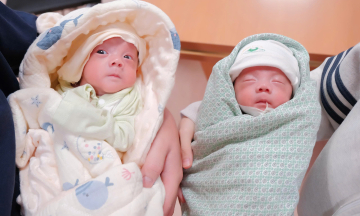
Quoc was born prematurely at 33 weeks and received 3 weeks of intensive care after birth. He later developed normal motor and cognitive skills. Recently, the bulge on his forehead became more noticeable when he lay down or cried.
Doctor Do Tien Son, a pediatrician at Tam Anh General Hospital Hanoi, stated that the child has midfacial hypoplasia and slightly protruding eyeballs. When sitting, only the supratrochlear vein appears blue under the skin on his forehead, without abnormal dilation. However, when he lies down with his head low, a soft, blue bulge appears on his forehead, which visibly increases in size. Doctors diagnosed him with sinus pericranii, a vascular malformation.
"According to international medical literature, sinus pericranii is a rare venous malformation, with approximately 200 cases recorded worldwide to date," Doctor Son said. The condition is characterized by an abnormal connection between the intracranial venous system (dural venous sinuses) and the extracranial venous system via transosseous emissary veins. The lesion typically presents as a soft, painless mass under the scalp that changes size with posture. When a child lies down, cries, strains, or coughs, increased intracranial pressure causes blood to rush to the area, making the bulge larger. When sitting or standing, the pressure decreases, and the mass subsides.
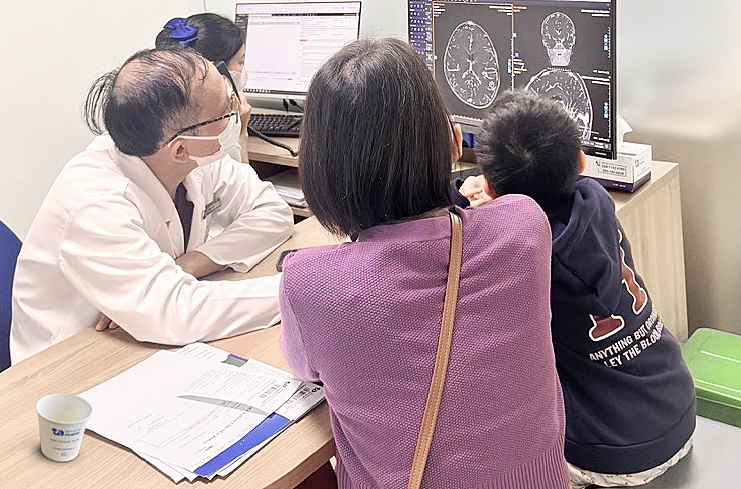 |
Doctors at Tam Anh General Hospital Hanoi examining Quoc. *Photo: Dinh Hue*
The condition's cause can be congenital, stemming from a developmental disorder of the venous system during the embryonic stage, or acquired after a head injury. Congenital forms are sometimes associated with craniofacial abnormalities, such as premature craniosynostosis, or genetic syndromes related to skull bone malformations, including Crouzon syndrome and Apert syndrome.
Most children with this condition have a good prognosis and do not experience neurological symptoms. The most common concern is cosmetic impact. However, the condition still carries potential risks of complications, such as hemorrhage from severe impact to the affected area, venous thrombosis, infection, or, less commonly, air embolism if not managed properly.
Treatment depends on the lesion's size and symptoms. If the mass is small and asymptomatic, the child will receive regular monitoring. If the large bulge significantly affects appearance or poses a high risk of complications, doctors may consider surgery.
Currently, Quoc shows no neurological symptoms, and the lesion size is stable. Therefore, doctors are guiding his family on care and how to prevent injury that could cause bleeding. The family has been advised to consider advanced genetic testing using next-generation sequencing (NGS) to detect and rule out related genetic abnormalities.
Doctor Son advises parents not to be complacent if their child develops soft scalp masses that change with posture, abnormal prominent veins, or red or bluish birthmarks. Parents should not attempt to puncture or massage the area themselves, as this can lead to dangerous complications. Instead, they should seek early examination at a specialized medical facility for an accurate diagnosis and to minimize risks.
Trinh Mai
*Patient's name has been changed.
| Readers can submit questions about neonatal pediatrics here for doctors to answer. |