Sang had never been diagnosed with a refractive error. It was only when he started learning to read that he experienced difficulty seeing and misread words despite repeated guidance. Refraction measurements revealed that his left eye had 0,75 diopters of farsightedness, while his right eye had 5 diopters—a severe level of farsightedness for a child. Even with corrective lenses, the maximum vision in his right eye only reached 1/10, whereas his left eye achieved 10/10.
Doctor of First-Degree Specialization Doan Thi Phuong Nhi, from the High-Tech Eye Center, Tam Anh General Clinic District 7, diagnosed Sang with farsightedness complicated by amblyopia (reduced vision due to abnormal visual development).
Doctor Nhi noted that many parents often focus on nearsightedness and astigmatism when their children start school, but rarely consider farsightedness. Because farsightedness presents with blurred near vision and eye strain while distant objects remain clear—similar to presbyopia in individuals over 40 years old—it is easily overlooked in children.
Farsightedness is common in young children, often being physiological farsightedness where the eyes have not fully developed. The degree of farsightedness is typically below two diopters and may decrease with age. If the degree of farsightedness is higher than normal for the child's age, if there is a significant difference between the two eyes, or if it is accompanied by esotropia (inward squint), it is considered pathological farsightedness requiring treatment to reduce the risk of amblyopia. Many people only discover farsightedness after age 40 when their accommodative ability declines, while children and young adults often find it difficult to detect due to their eyes' good accommodative power.
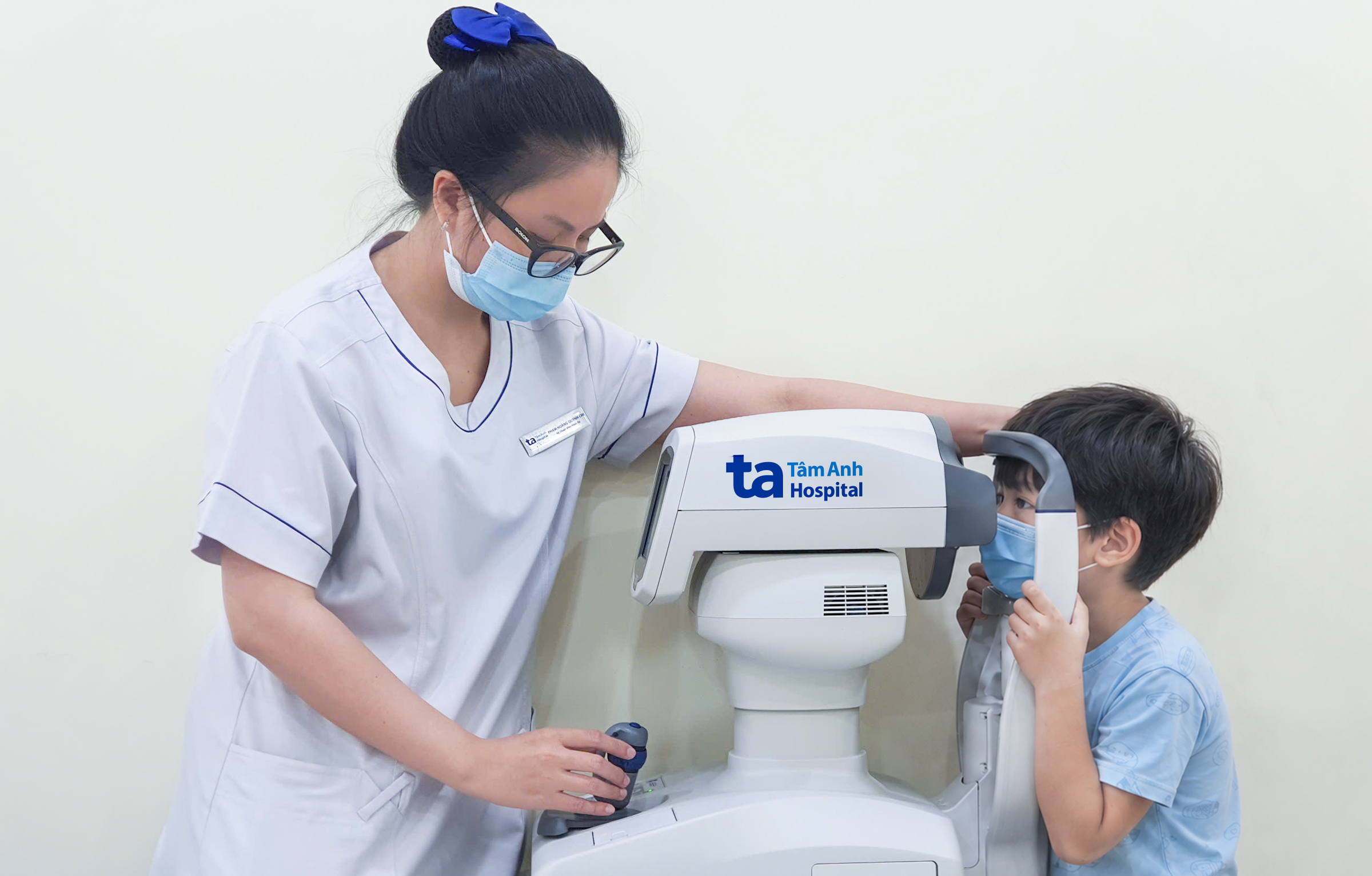 |
Sang undergoing an eye examination with an automatic refractometer. Photo: Tam Anh General Hospital |
In Sang's case, farsightedness affected both eyes, but his left eye had a mild condition, while his right eye had a high degree of farsightedness and a large difference compared to his left eye. As a result, his eyes self-accommodated to maintain clear vision, and his brain prioritized images from the stronger eye, gradually neglecting signals from the weaker eye, leading to amblyopia.
Amblyopia is a condition of reduced vision caused by the brain not using images from one eye during the visual development stage. If left untreated, vision loss can become permanent.
Sang was prescribed corrective glasses and instructed to patch his left eye for 3-4 hours daily, combined with visual rehabilitation exercises at home. After one month of wearing glasses, patching his left eye, and performing visual rehabilitation, the vision in his right eye improved from 1/10 to 3/10.
Doctor Nhi stated that amblyopia has the best chance of recovery if detected and treated before six years of age, when the visual system is still developing. For older children like Sang, treatment can still be effective, but the response is often slower and requires persistent monitoring. The chance of recovering 10/10 vision is lower. Without intervention or with improper intervention, children may suffer permanent vision loss, impacting their long-term future.
In Vietnam, the prevalence of refractive errors in school environments is increasing. According to data reported by the Ho Chi Minh City Department of Health in early 2025, based on approximately 495,000 students in schools across the city, over 58% were found to have refractive errors, with nearly 25% detected for the first time during health check-ups.
Doctor Nhi advises parents to take their children for eye exams every six months, before kindergarten or first grade, even if the child has not complained of blurred vision. If a child frequently squints, reads books up close, misreads words, bends close when writing, rubs their eyes, or complains of eye strain, they should be taken to a specialized facility for examination.
Early detection not only helps treat refractive errors effectively but also limits the risk of amblyopia, which can have long-term effects on learning ability and visual development.
Ngoc Kim Tham
*Patient's name has been changed
| Readers can send questions about ophthalmic diseases here for doctors to answer. |