Ho Chi Minh City Department of Health Director Tang Chi Thuong reported that the job fair attracted 970 registered applicants. These included 747 doctors, representing 77% of the total, 112 nurses, 91 medical technicians, and 20 midwives. Most candidates were recent graduates who had completed practical training and obtained their professional licenses.
In contrast, 94 medical units, including hospitals, regional medical centers, and health stations, offered 806 vacancies. These positions comprised 327 for doctors and 479 for nurses, midwives, and medical technicians. This disparity created an imbalance in the job market: the number of doctor applications was more than two times higher than the available positions, while the number of applicants for nursing and medical technician roles was lacking by half compared to the actual demand.
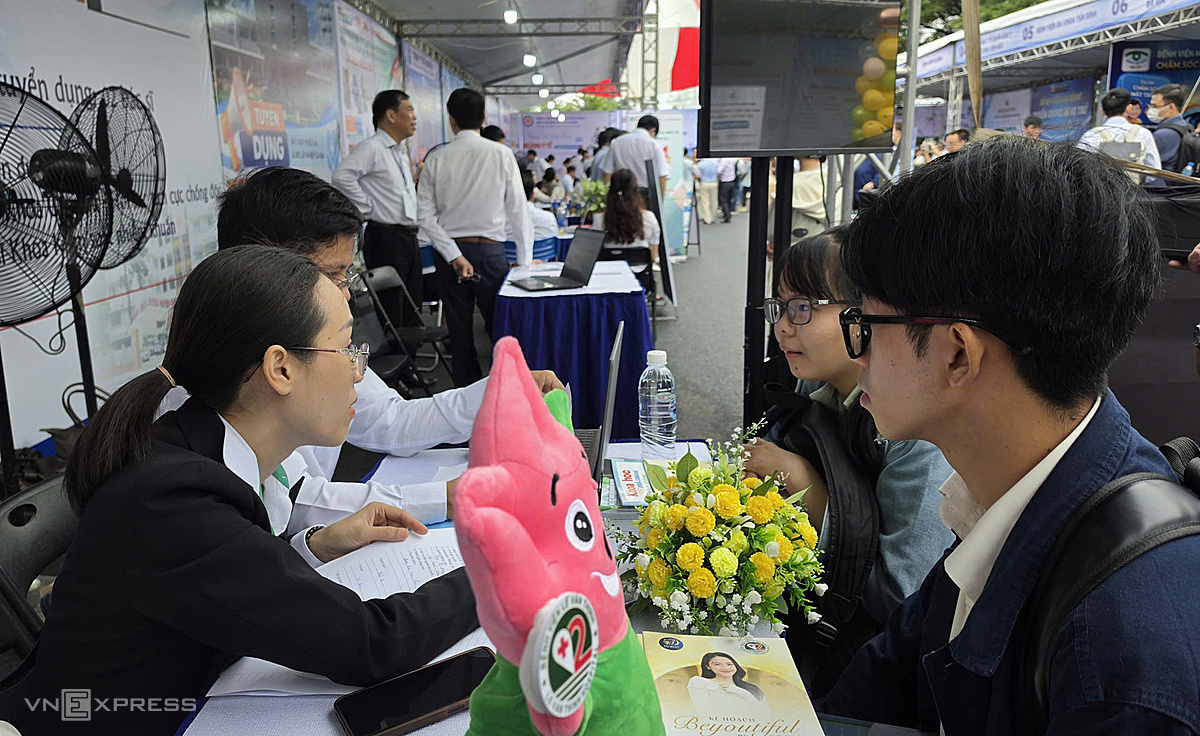 |
Le Van Thinh Hospital conducted recruitment interviews at the job fair on the morning of 10/9. Photo: Le Phuong |
The event provided an opportunity for medical units to recruit staff and helped young medical professionals define their career paths, especially as the city expands its healthcare network. Ho Chi Minh City is developing a tiered healthcare system, ranging from commune-level health stations and gateway hospitals to central specialized hospitals. This model aims to distribute healthcare services evenly across residential areas. Consequently, recruitment demand is strong at grassroots facilities, rather than solely concentrating on top-tier hospitals.
"The best place to start a career is not necessarily a large hospital or a medical facility in the city center," Thuong emphasized.
According to the city's health sector head, facilities with staff shortages offer young doctors a practical environment to handle numerous real-world cases, enhancing their skills. To alleviate concerns that working at grassroots levels might hinder career advancement, the health sector commits to ensuring top-tier specialists provide ongoing professional support, rotational training, transfer new treatment techniques, and establish clear career progression paths for medical staff at these primary facilities.
The Department of Health leadership urged recruiting units to change their talent acquisition methods. Instead of merely announcing vacancies, hospitals should outline a clear five-year plan for candidates, detailing assigned tasks, mentorship, opportunities for skill enhancement, and specific career destinations. The city's health sector considers this a fundamental solution for grassroots hospitals to retain medical professionals long-term.
Le Phuong