In 2024, a 63-year-old woman, who had no symptoms like coughing or shortness of breath, was found to have a 13x15 mm ground-glass nodule in the upper lobe of her left lung during a health check-up at the Cho Ray Vietnam Japan Health Check-up Center (HECI). The lesion initially appeared benign.
Ground-glass nodules appear as areas of increased density on lung CT scans, yet internal structures remain visible. While often benign, some can indicate pre-cancerous changes or early-stage lung cancer. The International Association for the Study of Lung Cancer (IASLC) estimates that approximately 18% of these opacities may evolve into semi-solid nodules, carrying a higher risk of becoming cancerous.
The patient underwent low-dose chest CT scans every six months for monitoring. By 2025, the nodule had grown to 15x20 mm. In 2026, it further enlarged to 20x27 mm and developed a solid component, a suspicious sign of malignancy.
Following consultations with Japanese experts and Cho Ray Hospital doctors, the patient underwent robot-assisted endoscopic lobectomy. This procedure removed the lesion while preserving most of the lung, promoting better breathing and faster recovery. Post-operative pathology confirmed the lesion was confined to the lung parenchyma, with no external invasion. One month after surgery, the patient was stable, free from fatigue or shortness of breath.
 |
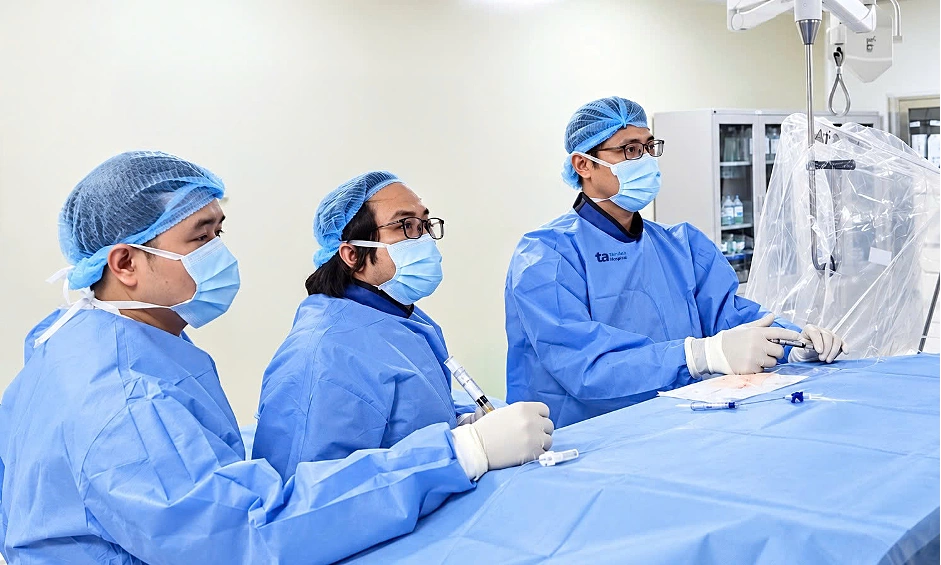
Doctor Nguyen Hoang Binh, Head of Thoracic Surgery Department (seated), performs robot-assisted surgery on a patient at Cho Ray Hospital. *Photo: Cho Ray Hospital.* |
On 15/10, Doctor Cao Thi Hong, Head of HECI Center, emphasized that this case demonstrates the importance of detecting lesions before symptoms manifest and closely monitoring their progression with sequential CT scans. Patients who delay seeking medical attention until symptoms appear risk missing the optimal window for intervention.
Doctor Nguyen Hoang Binh, Head of Thoracic Surgery Department at Cho Ray Hospital, noted that early-stage lung cancer is often curable with surgery alone, frequently eliminating the need for additional chemotherapy or radiation. Regular health screenings and comparing CT images from follow-up appointments allow doctors to pinpoint the ideal time for intervention.
Individuals with ground-glass nodules should adhere to their follow-up schedules, even if they feel healthy. Not all such nodules require immediate surgery. Doctors assess size, imaging characteristics, changes over time, and risk factors to determine whether to monitor or intervene. Nodules that grow or develop a solid component may warrant further evaluation.
HECI statistics indicate the center conducts over 2,000 health check-ups annually, identifying nearly 200 cases with potential cancer-related lesions before any clinical symptoms emerge.
GLOBOCAN data for 2026 reveals that lung cancer is the second most common new cancer diagnosis in Vietnam, after breast cancer, but it remains the leading cause of cancer deaths. Historically, lung cancer carried a grim prognosis with average survival measured in months. However, treatment advancements now allow patients to live for many years.
Early-stage lung cancer frequently presents with few clear symptoms. By the time persistent cough, chest pain, shortness of breath, or coughing up blood appear, the disease may have advanced. Risk factors include smoking, secondhand smoke exposure, air pollution, a family history of lung cancer, and extended exposure to certain toxins. Long-term smokers, particularly older individuals, require comprehensive risk assessment.
For high-risk individuals, low-dose chest CT scans can detect lesions earlier than waiting for symptoms. However, a doctor must determine the necessity and frequency of screening based on age, smoking history, health status, and professional guidelines. Conventional chest X-rays are not a substitute for low-dose CT in lung cancer screening for high-risk populations.
Le Phuong