Follow-up examination results revealed three clusters of microcalcifications in Ms. Trang’s left breast, with the largest cluster measuring approximately 64x17x14 mm. These were classified as BIRADS 4B and BIRADS 4C, raising suspicion of malignancy. Early last year, this lesion was a nodule with regular borders and clear margins, measuring approximately 3x5x6 mm, classified as BIRADS 3, with a malignancy risk of less than 2%, requiring regular follow-ups.
Doctor of Medicine II Le Nguyet Minh, Head of the High-Tech Unit for Diagnosis and Intervention of Breast Diseases, stated that microcalcifications are tiny calcium deposits in breast tissue. They are often impalpable, asymptomatic, and primarily detected through mammography. Microcalcifications can be benign or malignant. When these tiny calcium specks cluster together or form a linear pattern, the risk of malignancy increases, and patients require a biopsy to accurately determine their nature.
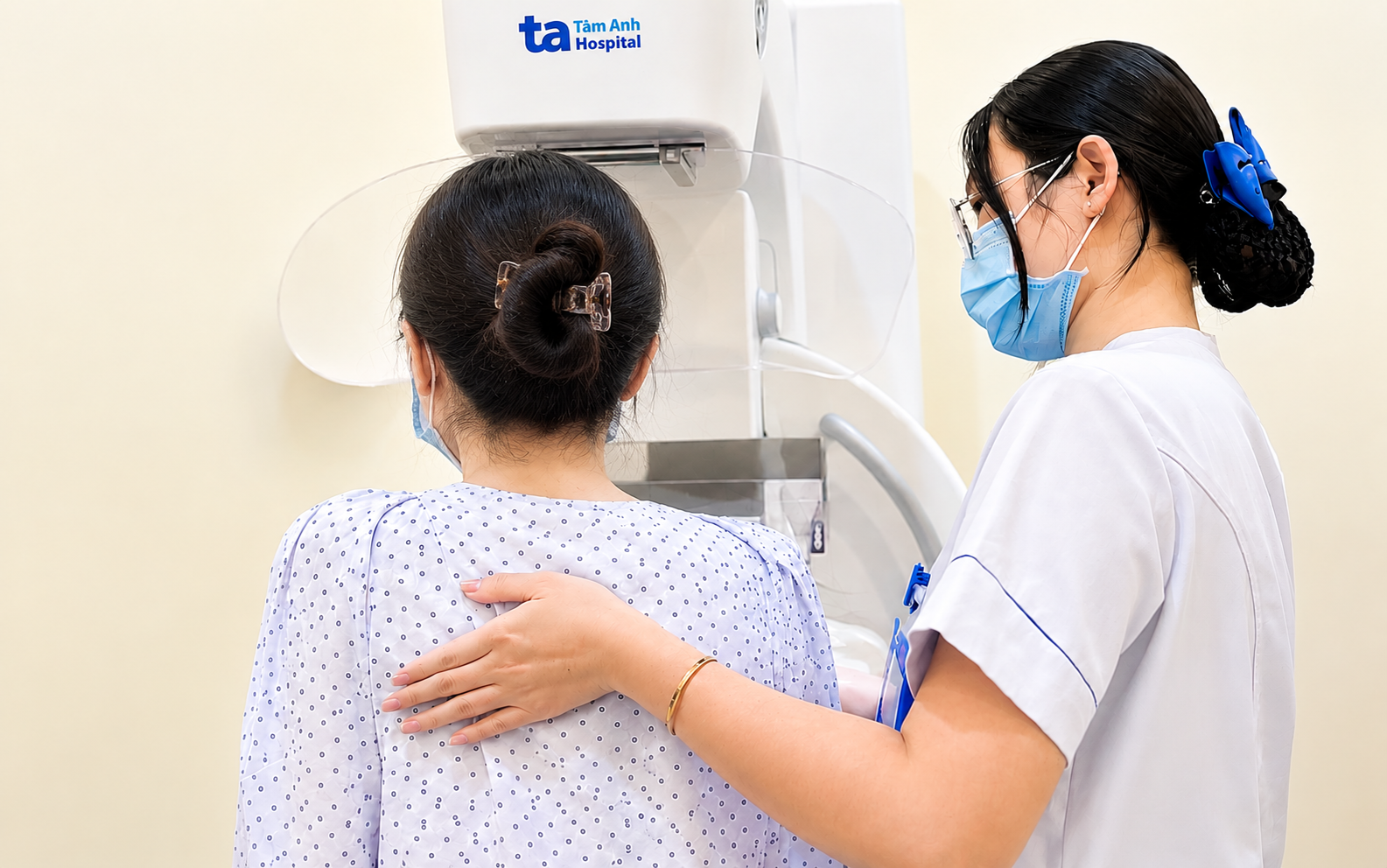 |
Ms. Trang underwent 3D mammography during her second regular follow-up. Photo: Tam Anh General Hospital
After local anesthesia, guided by the mammography system, Doctor Minh used a vacuum-assisted biopsy needle to extract 23 tissue samples from the microcalcification cluster, which were then sent for pathology. Initial biopsy results showed images of intraductal neoplasia, but this was insufficient to confirm a diagnosis. Ms. Trang underwent immunohistochemistry with 5 specialized markers. The results confirmed grade two ductal carcinoma in situ (DCIS), clear cell subtype – a rare variant of breast cancer.
According to Doctor Minh, DCIS is a very early stage of breast cancer, where cancer cells are confined within the milk ducts and have not yet invaded surrounding breast tissue. This case involves the clear cell subtype, accounting for 1-3% of all malignant breast tumors.
Following a multidisciplinary consultation, Ms. Trang was scheduled for surgery to remove the entire affected area, preserving as much healthy breast tissue as possible.
Surgery is the primary and definitive treatment for ductal carcinoma in situ (DCIS). Depending on the location, size, and extent of the lesion, doctors may recommend breast-conserving surgery or a total mastectomy. After surgery, doctors will base subsequent treatment and follow-up plans on the pathology results.
Doctor Minh advised women diagnosed with lesions to undergo regular monitoring and adhere to follow-up schedules to enable early detection of abnormalities and enhance treatment effectiveness.
Hieu Nguyen
| Readers can submit questions about cancer here for doctors to answer |