Police in Thanh Hoa province recently uncovered a syndicate producing over one million fake 'An Cung stroke prevention' pills. The main ingredients of these products included flour, chemicals, coloring agents, and other components. Packaging claimed 'imported' status, but the products were actually placed in fake boxes with counterfeit labels to mislead buyers. Each box of fake An Cung, costing approximately 105,000 VND to produce, was sold to consumers for nearly 3,000,000 VND through multiple intermediaries, a markup of almost 30 times.
Speaking to VnExpress, Doctor Doan Du Manh of the Vietnam Association of Vascular Diseases, stated that An Cung Nguu Hoang Hoan (ACNHH) is often informally promoted as a medicine capable of preventing stroke. However, "there is currently no clinical evidence to prove that its use can prevent stroke in individuals who have never had one or reduce the risk of developing the disease," he added.
According to Doctor Vu Van Dai of Military Central Hospital 108, ACNHH is a traditional Chinese medicine formula used to clear heat, detoxify, and open orifices, typically for 'heat-syndrome' conditions with symptoms like high fever and delirium. However, most current stroke cases are due to cerebral infarction (a 'cold-syndrome' condition), a vascular blockage requiring urgent medical intervention. Using An Cung in these cases is not beneficial and can worsen the situation. More dangerously, if a patient suffers from hemorrhagic stroke, the anticoagulant components in ACNHH will increase bleeding, putting the patient in a critical condition.
Doctor Dai affirmed that traditional medicine does not deny the value of ancient remedies, but their role, indications, and limitations must be correctly understood. Medicine use should be based on medical theory, evidence, and ethics, avoiding blind faith that can cause harm.
The Ministry of Health also recommends that when using ACNHH, users must understand and strictly adhere to its indications, only using it with a clear diagnosis of 'wind-heat stroke' (high fever, delirium, rapid pulse, red face). It should absolutely not be used for 'wind-cold stroke', hemorrhagic stroke, or without a confirmed diagnosis. The medicine must be prescribed by a traditional medicine specialist and not self-administered at home. Notably, pregnant women, children under 3 years old, and patients with liver or kidney failure should not use this medicine.
According to SCMP, An Cung carries a potential risk of metal poisoning if misused. Self-administering the medicine at the onset of a stroke also carries life-threatening risks.
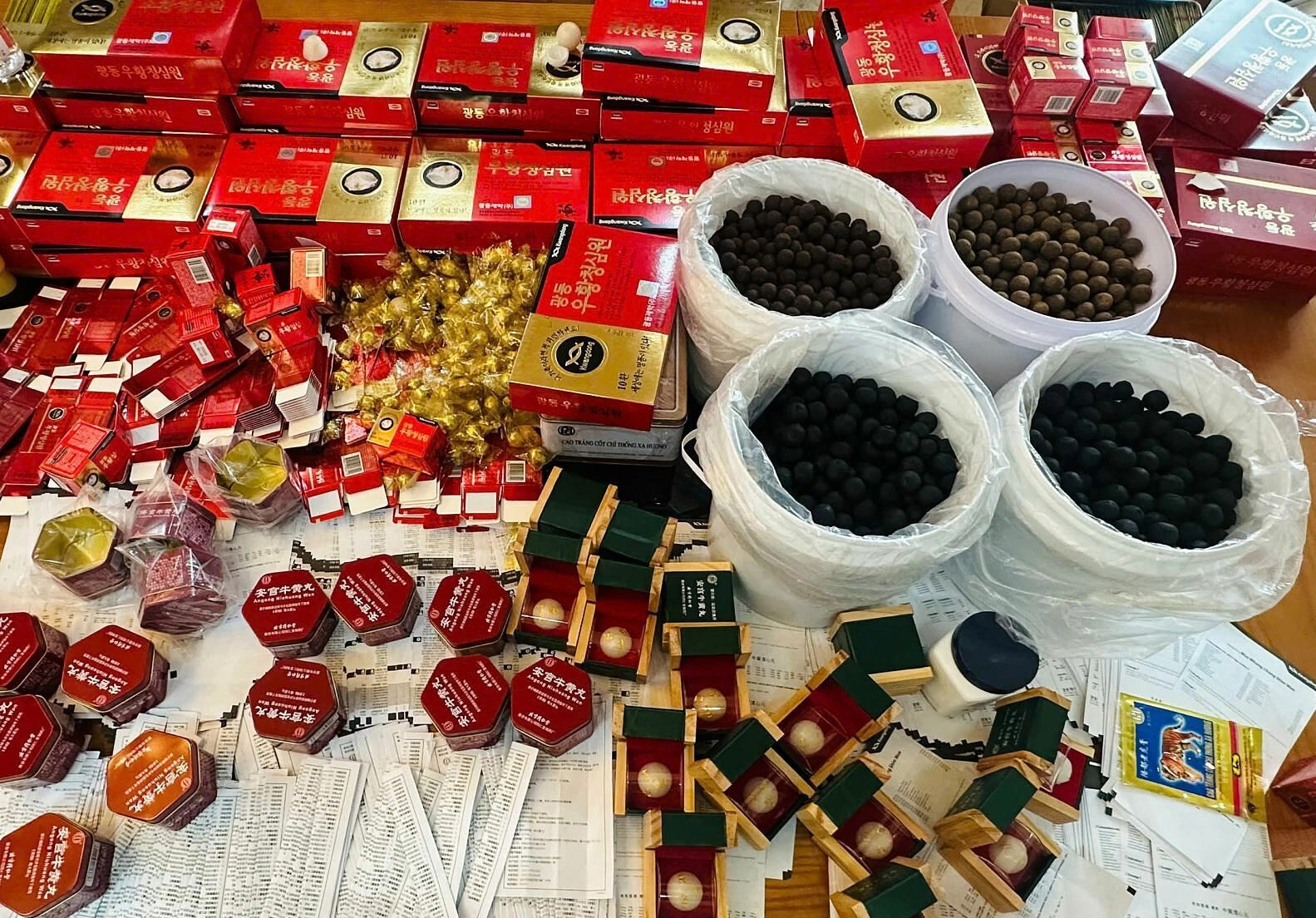 |
Fake An Cung pills advertised on social media. Photo: Lam Son |
More concerningly, the market sees the proliferation of fake, substandard, or unverified products advertised under the An Cung name. According to Doctor Manh, users spend money on these without receiving any therapeutic effects. Counterfeit products may not contain the advertised ingredients, lack guaranteed potency, or even be devoid of necessary active compounds. This is particularly dangerous because patients believe they have taken medication to prevent or manage stroke, leading them to neglect necessary medical care.
Fake or unverified products pose potential health risks. During uncontrolled production, products can be contaminated with impurities, heavy metals like sulfur, mercury, or contain undeclared ingredients. Once in the body, these substances can cause poisoning, affect multiple organs, and over time lead to complications like stroke or cancer. Therefore, it should not be assumed that any product bearing the name 'An Cung' is safe, of quality, or effective in preventing stroke.
Another danger is excessive reliance on An Cung when stroke signs appear, with the belief that simply taking it and monitoring at home, waiting for the medicine to work or symptoms to improve, is sufficient. Meanwhile, stroke is a medical emergency. If someone suddenly experiences facial drooping, limb weakness or paralysis, difficulty speaking, slurred speech, blurred vision, loss of balance, or other unusual neurological symptoms, the immediate action is to quickly go to a medical facility for diagnosis and treatment. Any delay can lead to missing the critical window for emergency care, endangering the patient's life.
Hospitals have documented numerous cases of missed treatment windows due to patients believing they had taken An Cung. A typical example is a 50-year-old man who suddenly experienced a headache, difficulty speaking, and left-sided paralysis, suspected stroke, and consequently took An Cung. After taking it, his symptoms worsened. He arrived at Military Central Hospital 108 for emergency care one hour after onset, where a brain scan revealed a hemorrhagic stroke in the right central gray matter.
Another case involved a 79-year-old woman with hypertension and diabetes for over a decade, who had suffered two previous strokes, resulting in left-sided weakness. Two months before hospital admission, she took one An Cung pill daily to prevent stroke recurrence, after which she developed unusual symptoms. Upon admission to Phu Tho Provincial General Hospital, the patient was in critical condition with respiratory failure, low blood pressure, and pale skin and mucous membranes. Doctors diagnosed severe anemia and coagulation disorders caused by An Cung misuse, with multiple cerebral infarctions in both hemispheres.
Doctors emphasize that for stroke patients, time is a decisive factor for treatment outcomes. Delaying hospital arrival, searching for medicine, or waiting for medication to take effect can cause patients to miss the opportunity for assessment and appropriate treatment within the critical timeframe. Therefore, the crucial takeaway is not to seek a drug to 'prevent' stroke at all costs, but to recognize early signs of the condition and manage it correctly. If suspicious signs appear, call emergency services and transport the patient to a medical facility as soon as possible.
Thuy Quynh