Dish sponges can become one of the most bacteria-laden tools in the kitchen, depending on usage, storage, and replacement frequency, according to The Washington Post. Studies show sponges easily retain food residue, and if left damp and warm for many hours, they form bacterial breeding grounds that spread to hands, dishes, countertops, and other surfaces.
Research by Duke University (US), published in 2022, indicated that the multi-sized porous structure within cellulose sponges creates an environment most conducive to microbial proliferation. Actual culture results demonstrated that these cavities foster both solitary species and bacterial communities, especially the intestinal bacterium E. coli.
Previously, microbiologist Markus Egert at Furtwangen University (Germany) discovered 362 species of microorganisms on used dish sponges. Bacterial density in some areas reached 54 billion individuals per cm², equivalent to the amount of bacteria in a human stool sample.
Professor Don Schaffner, head of the food science department at Rutgers University (US), warned that the habit of leaving sponges damp turns this item into a source for spreading E. coli and staphylococcus aureus to hands, dishes, and countertops. These pathogens lead to skin infections and acute food poisoning. Experimental data from 2021 showed sponges retained mot teaspoon of water after 24 hours, nurturing dangerous bacteria like cholera-causing Salmonella or Campylobacter, which causes gastroenteritis.
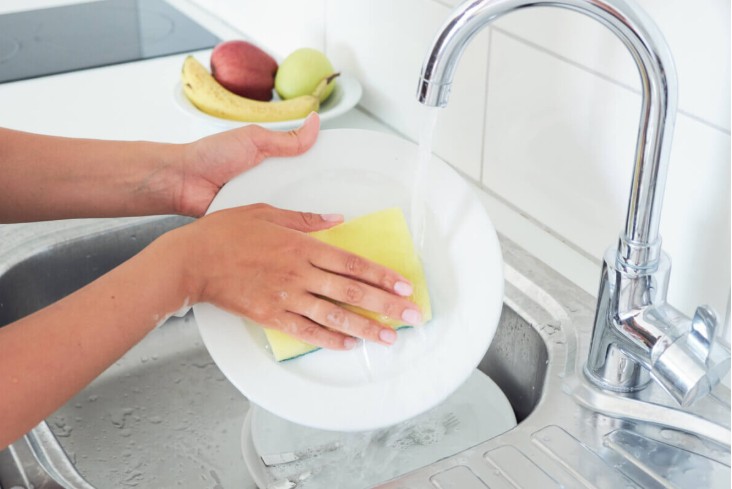 |
Illustration: Vchalup
To replace sponges, expert Jason Bolton from the University of Maine Cooperative Extension (US) suggested homemakers switch to specialized brushes, cloth towels, or silicone scrubbers. Dish brushes made from plastic or bamboo wood have sparse bristles, limiting food residue adhesion and drying completely after 4,5 hours. Users need to wash brushes hang ngay with hot soapy water, invert the bristles to drain, or clean them in a dishwasher. When brush bristles become dirty or yellowed, families should replace them immediately to eliminate pathogen habitats.
For flat surfaces or easily scratched non-stick pots and pans, families should choose cleaning cloths made of cotton, linen, or plant cellulose. Cloth towels allow for washing at high temperatures and quick drying. Homemakers need to prepare many cloths to rotate daily, and absolutely not roll up damp cloths after cleaning. Disposable paper towels also offer high disinfection effectiveness but create an environmental waste burden.
If continuing to use sponges, homemakers must sterilize them hang ngay using a dishwasher's heat dry cycle, pouring boiling water over 71°C, or thoroughly wetting and microwaving for mot minute. Nevertheless, these methods eliminate a maximum of 60% of bacteria in practice. The safest solution is still to discard sponges as soon as the material is worn out, or invest in waterproof silicone scrubbers to protect the family's health.
Binh Minh (According to Good Housekeeping, Washington Post)