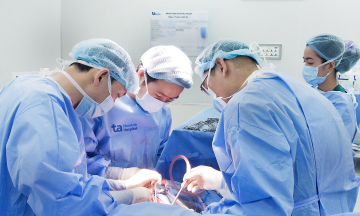
Doctors at Bach Mai Hospital's Ninh Binh facility reported on 23/7 that the patient had been discharged in stable condition, experiencing no neurological complications and recovering quickly.
The patient had previously endured persistent headaches and dizziness for years, severely impacting her daily life. When her headaches suddenly intensified, she sought examination at Bach Mai Hospital's Ninh Binh facility. Magnetic resonance imaging (MRI) and digital subtraction angiography (DSA) revealed a large aneurysm with irregular borders and complex morphology in the C5 segment of her left internal carotid artery, a major blood vessel supplying the brain.
A brain aneurysm forms when a section of a blood vessel wall weakens and bulges under the pressure of blood flow, similar to a balloon inflating. This condition often progresses silently. Should the aneurysm continue to enlarge or rupture, blood can leak into brain tissue or the space surrounding the brain (subarachnoid hemorrhage), potentially causing coma, death, or severe debilitating consequences.
Recognizing the complexity of the lesion, which precluded conventional intervention or traditional craniotomy, an interdisciplinary consultation opted for the flow diverter stent technique.
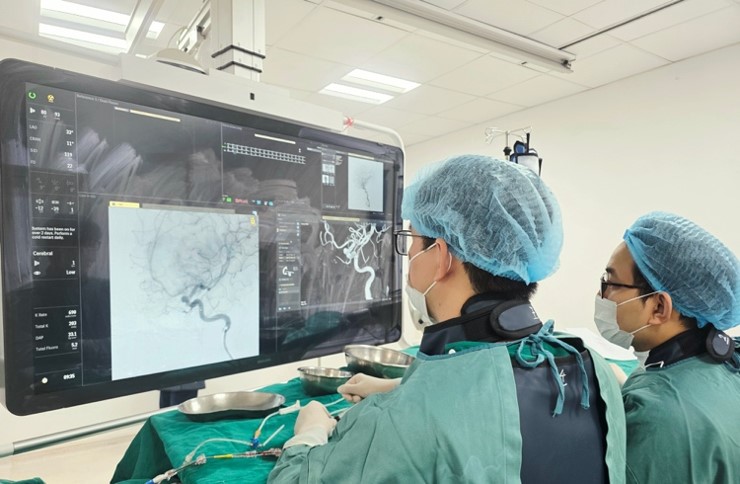 |
Doctors performing the intervention on the patient. *Photo: Nguyen Ha*
Doctor Nguyen Ngoc Trang, Deputy Director of the Institute of Diagnostic and Interventional Radiology, explained that a flow diverter stent is a micro-mesh metal tube with a unique weave. Doctors position this mesh tube to span the neck of the aneurysm. The device redirects blood flow away from the aneurysm, simultaneously creating a supportive scaffold that allows the vessel wall cells to heal naturally. Over time, the aneurysm fibroses, detaches from the circulatory system, and completely eliminates the risk of rupture.
The intervention is performed through a small incision in the groin. The medical team guides a soft catheter along the blood vessel pathway directly to the lesion in the brain, monitored by a digital angiography system. The doctor precisely deploys the stent to cover the aneurysm's neck while ensuring normal blood flow to the brain.
This technique offers minimal invasiveness, as it bypasses the need for open-skull surgery, thus preserving surrounding brain tissues. Throughout the procedure, the patient remained fully conscious and communicated normally with the doctors, allowing the team to closely monitor neurological function.
According to Doctor Nguyen Tat Thien from the Department of Radiology, the successful application of this modern technique optimizes treatment effectiveness, shortens hospital stays, and ensures maximum patient safety.
Le Nga