After returning from a flight from Australia, Ngan experienced severe ear pain and tinnitus. After one week of medication provided no relief, she sought examination at Tam Anh General Clinic District 7. Doctor Tran Xuan Nguyen, an ear, nose, and throat specialist, performed an otoscopy on Ngan, which revealed two perforations in her left eardrum and ear discharge. She was diagnosed with eardrum perforation accompanied by middle ear infection.
"Ngan's eardrum perforation resulted from ear barotrauma during the airplane's descent," Doctor Nguyen explained, adding that the middle ear is a closed cavity located behind the eardrum, connecting to the nasopharynx through the Eustachian tube. Normally, the Eustachian tube opens when swallowing, yawning, or chewing to equalize pressure between the middle ear and the external environment.
As an airplane descends, pressure gradually increases. To equalize pressure within the ear, air travels from the nasopharynx through the Eustachian tube into the middle ear. However, if the Eustachian tube does not open quickly enough, the external pressure becomes higher than the pressure in the middle ear, pulling the eardrum forcefully inward. An excessive and prolonged pressure difference can cause the eardrum to tear or perforate. At this point, the natural protective barrier between the middle ear and the external environment is compromised. The perforation creates an entry point for bacteria from the outer ear canal and nasopharynx to invade the tympanic cavity, leading to ear discharge and middle ear infection.
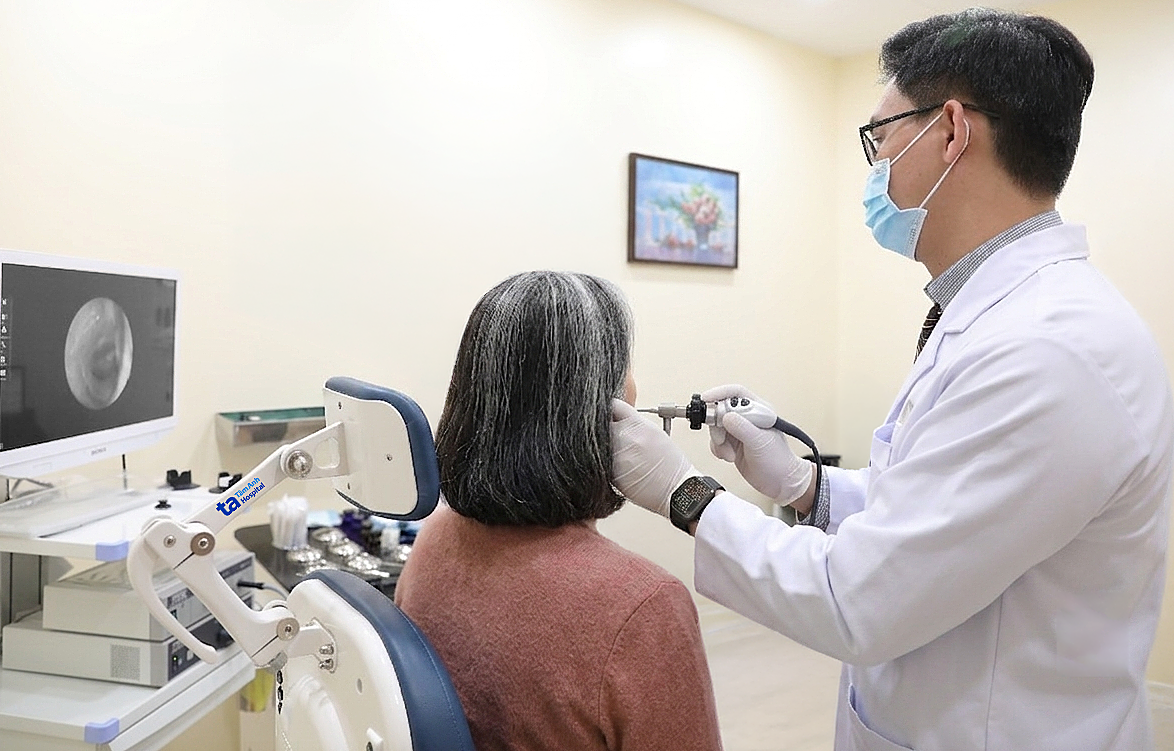 |
Doctor Xuan Nguyen performs an otoscopy on Ngan. *Photo: Tam Anh General Clinic District 7*
Ngan's ear was cleaned, and she was prescribed medication with a follow-up appointment scheduled for one week later. She was advised to keep water out of her ear, avoid swimming, and refrain from picking her ear. Following treatment, Ngan's ear discharge ceased, the inflammation stabilized, and her eardrum healed well, eliminating the need for eardrum repair surgery.
When flying back to Australia, she was advised to use specialized earplugs to reduce pressure on her eardrums and to swallow saliva or chew gum during takeoff and landing.
According to Doctor Nguyen, individuals with a perforated eardrum undergoing treatment must have their inflammation and healing status evaluated before flying. If the injury is not stable, or if there is persistent ear discharge or an active infection, they may be advised to postpone their flight until the condition is controlled.
Eardrum perforation caused by barotrauma commonly occurs with sudden pressure changes, such as during scuba diving or airplane travel. Symptoms include sudden ear pain, ear discharge, tinnitus, hearing loss, and dizziness.
After an injury, a small eardrum perforation can heal naturally if it is not infected and the patient adheres to treatment. If the perforation is large and cannot heal on its own, doctors may recommend eardrum repair surgery to prevent complications such as chronic otitis media with perforation, hearing loss, and mastoiditis.
Doctor Xuan Nguyen advises that individuals experiencing sudden ear pain, tinnitus, hearing loss, or ear discharge after flying, scuba diving, or exposure to loud noise should seek an early consultation with an ear, nose, and throat specialist for timely diagnosis, treatment, and prevention of complications.
Uyen Trinh
*Patient's name has been changed
| Readers can submit questions about ear, nose, and throat conditions here for doctors to answer. |