Doctor Duong Pham Van Thanh, from the Emergency Department at Tam Anh General Hospital, Ho Chi Minh City, reported that Ms. Thuan was admitted approximately two hours after symptoms began. Her NIHSS score was 21, indicating a severe stroke.
The patient had a history of atrial fibrillation, hypertension, and complete arrhythmia. Atrial fibrillation increases the risk of blood clot formation in the heart. These clots can travel to the brain, blocking arteries and causing ischemic stroke.
Doctors ordered a brain CT scan to rule out cerebral hemorrhage, followed by a contrast-enhanced cerebral CT angiography to pinpoint the blockage. Typically, patients arriving within the "golden hour" might receive thrombolytic medication to dissolve the clot. However, Ms. Thuan was on anticoagulants for atrial fibrillation, but the specific type and last dose time were unknown. Therefore, the medical team did not administer thrombolytic medication due to the risk of hemorrhage.
According to Doctor Nguyen Trung Duc, from the Diagnostic Imaging and Interventional Radiology Center, patients who cannot receive thrombolytic medication may still have a chance to restore blood flow through mechanical thrombectomy if viable brain tissue remains and meets intervention criteria. After identifying the blockage, the team transferred the patient to the digital subtraction angiography (DSA) suite for the procedure.
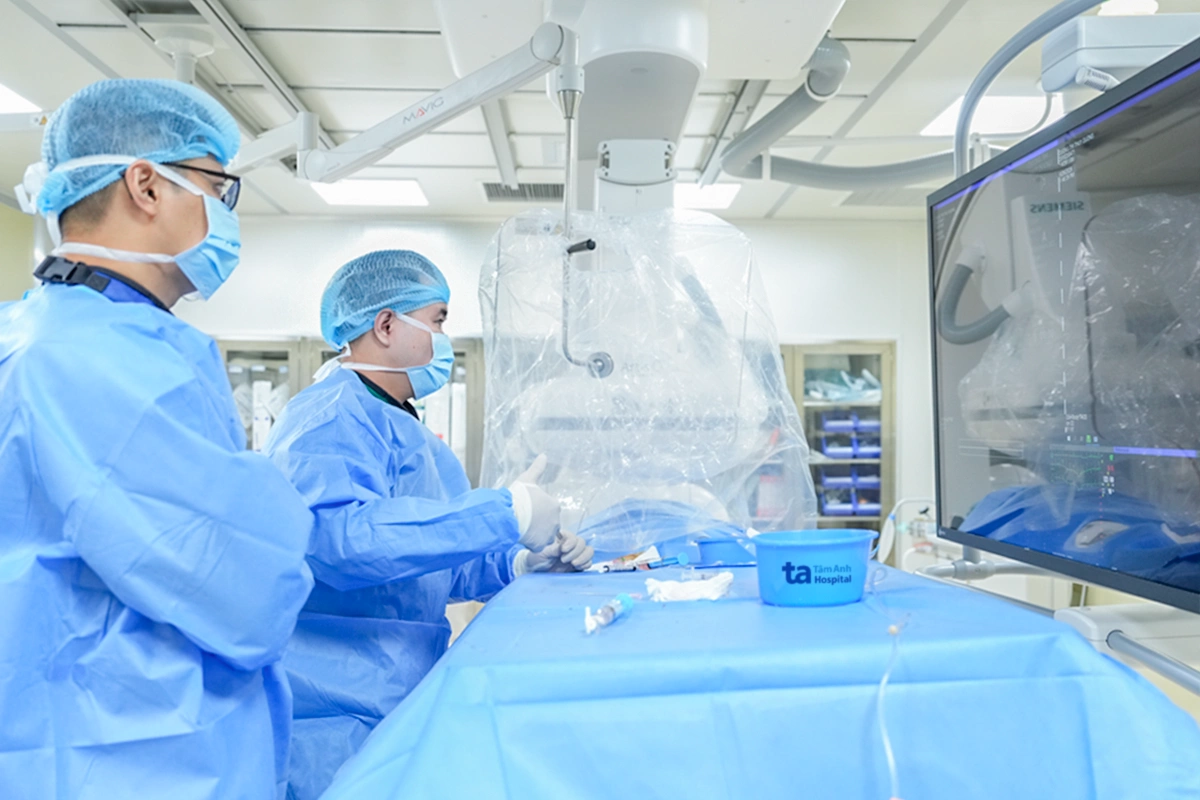 |
The medical team performs mechanical thrombectomy on the patient. Photo: Tam Anh General Hospital |
Doctor Duc explained that unlike thrombolytic medication, which dissolves blood clots with drugs, mechanical thrombectomy uses specialized tools guided through the blood vessels directly to the blockage to remove the clot. After about 15 minutes of intervention, the team removed a blood clot approximately one centimeter long, restoring blood flow to the brain.
One day later, Ms. Thuan was able to sit up, talk, move her limbs, and practice walking with the assistance of medical staff. She was discharged after one week of treatment combined with rehabilitation.
Doctor Thanh noted that many families believe elderly stroke patients have little chance of recovery, especially if thrombolytic medication cannot be used. However, for strokes caused by large arterial blockages, mechanical thrombectomy can still re-establish blood flow and save viable brain regions if the patient arrives at the hospital promptly. The decision to intervene must be individualized based on the patient's pre-stroke condition, the extent of damage, the location of the blocked vessel, treatment time, and procedural risks.
Strokes due to large vessel occlusion account for 20-30% of ischemic stroke cases but result in high rates of mortality and disability. If blood flow is restored within the "golden hour," patients have a significant chance of recovery, even at an advanced age.
Doctors advise individuals with atrial fibrillation, hypertension, diabetes, dyslipidemia, or those taking anticoagulants to undergo regular check-ups and adhere to treatment to reduce the risk of blood clot formation. If symptoms such as facial droop, limb weakness or paralysis, difficulty speaking, or altered consciousness appear, patients should be immediately taken to a facility capable of stroke intervention.
Nhu Ngoc
*Patient's name has been changed
| Readers can submit questions about neurological conditions here for doctors to answer |