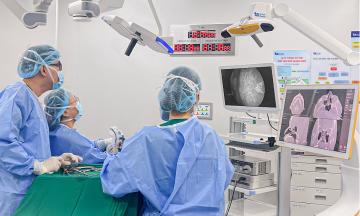
Ionizing radiation therapy, particularly in the pelvic region, can significantly harm women's reproductive organs, potentially leading to premature ovarian failure. This was highlighted by Doctor Nguyen Thi Yen Thu of the Obstetrics and Gynecology Center at Tam Anh General Hospital, Ho Chi Minh City, during the hospital system's annual scientific conference on 18/9. Oocytes are highly sensitive to radiation, with an estimated 2-4 Gy sufficient to destroy 50% of primordial follicles. Losing ovarian function early after radiation therapy increases the risk of early menopause, cardiovascular disease, and osteoporosis.
 |
Dr. Yen Thu presents on the laparoscopic ovarian transposition technique at the scientific conference held on 16-20/9. Photo: Tam Anh General Hospital |
Dr. Yen Thu presents on the laparoscopic ovarian transposition technique at the scientific conference held on 16-20/9. Photo: Tam Anh General Hospital
To mitigate these risks, the technique of surgically moving ovaries out of the radiation field helps preserve both endocrine and exocrine functions. This procedure is typically recommended for patients under 40 years old with a low risk of ovarian metastasis.
Pelvic radiation therapy is a treatment for various cancers, including Hodgkin's lymphoma, cervical cancer, vaginal cancer, pelvic sarcoma, and rectal cancer. However, not all patients are suitable candidates for ovarian transposition. Doctors must carefully assess several factors: the patient's age, ovarian reserve, cancer type and stage, the risk of cancer cells spreading to the ovaries, the scope of radiation therapy, and any combined treatment methods.
The procedure involves laparoscopic ovarian suspension surgery performed before radiation therapy. Surgeons dissect and reposition both ovaries, suspending them high on the right and left abdominal walls. The optimal position for preserving ovarian function is at least 1.5 cm above the iliac crest, effectively distancing them from the targeted pelvic radiation area. Following surgery, the ovaries' new location is marked on radiation planning images. This allows radiation oncologists to precisely adjust the radiation field and apply appropriate shielding, minimizing radiation exposure to the ovaries.
Ovarian suspension surgery can be performed either concurrently with primary cancer treatment or as a separate procedure prior to radiation. Doctor Yen Thu cited studies demonstrating promising results: ovarian function was preserved in 61% to 93% of cervical cancer patients and 68% of colorectal cancer patients. Successful pregnancy rates ranged from 14% to 60% among patients who underwent the procedure.
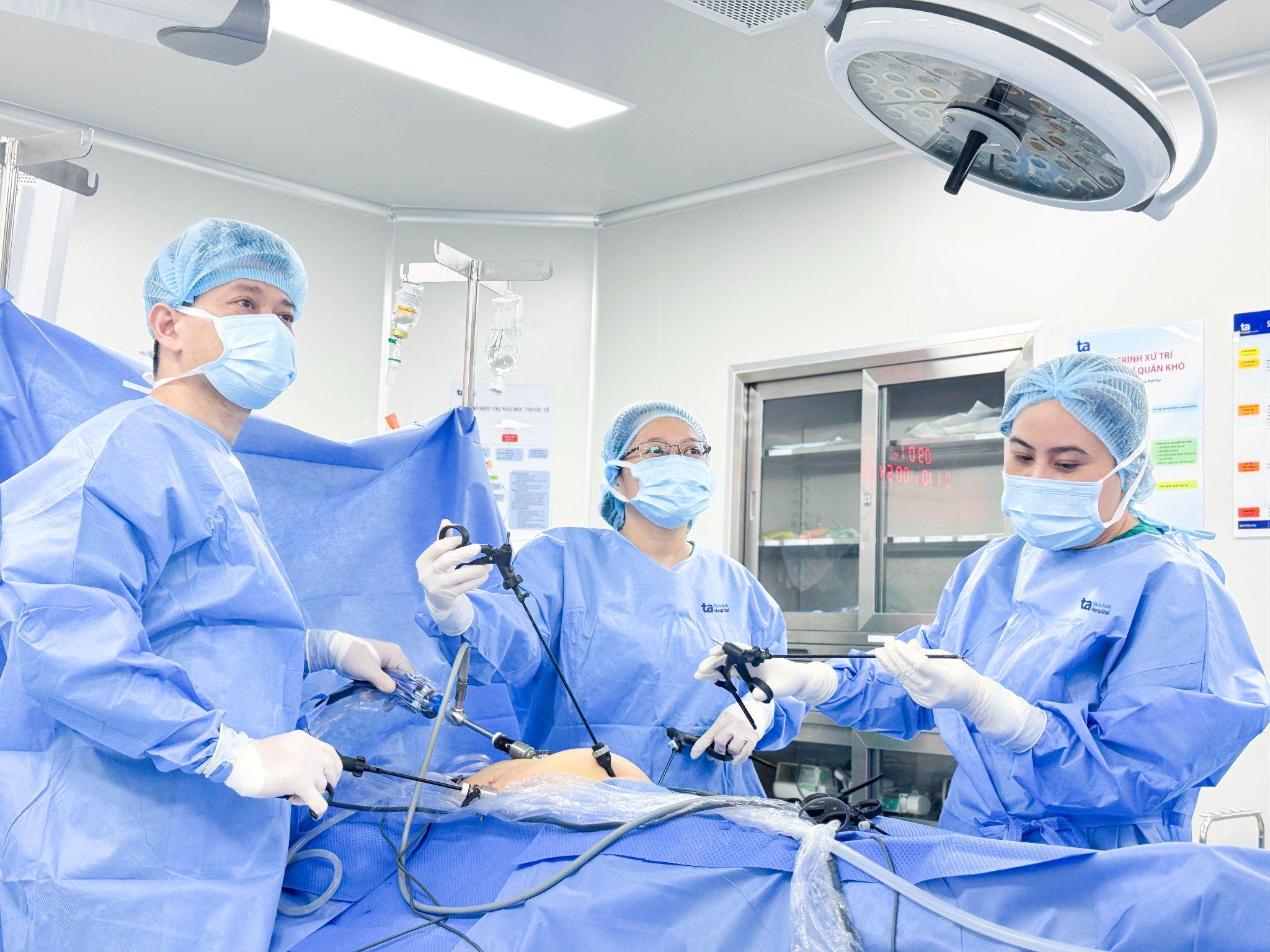 |
Dr. Yen Thu (center) performs laparoscopic ovarian transposition surgery. Photo: Tam Anh General Hospital |
Dr. Yen Thu (center) performs laparoscopic ovarian transposition surgery. Photo: Tam Anh General Hospital
Despite its potential, ovarian suspension is not yet widely adopted. According to Doctor Yen Thu, a key challenge is the need for early identification of fertility risks and timely counseling for patients. Effective coordination among oncologists, radiation therapists, obstetrician-gynecologists, and reproductive specialists is crucial. However, many existing counseling and referral systems for fertility preservation are not yet optimized.
At the Tam Anh General Hospital system, patients benefit from multidisciplinary evaluation and consultation within the same institution. This involves close collaboration among specialists in oncology, radiation therapy, obstetrics and gynecology, and reproductive support.
By Tue Diem
| Readers can submit questions about obstetrics and gynecology here for doctors to answer. |