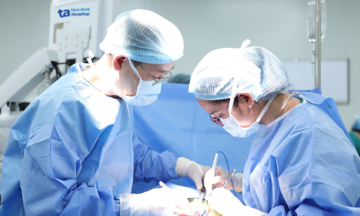
In the days leading up to the Lunar New Year, the Plastic Surgery Department at Hoai Nhai General Hospital has been consistently admitting emergency cases stemming from cosmetic complications. Most patients arrive with severe swelling, intense pain, and even skin necrosis, all resulting from beauty treatments received at private spas and aesthetic clinics.
One case involved a 32-year-old woman who faced the risk of nasal necrosis just two days after receiving filler injections. The dermal filler compressed her blood vessels, causing her nose to become swollen, purple, and painful. Another patient, 26 years old, lost money and suffered harm when a botched V-line chin filler procedure resulted in the substance migrating to her neck, creating a "double chin" and severely distorting her facial balance.
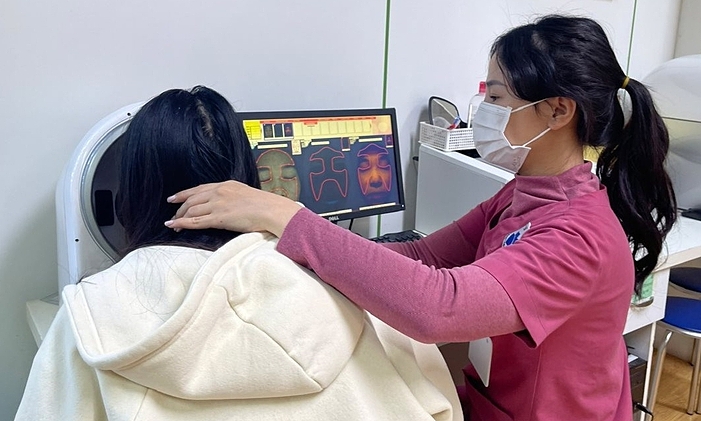 |
A patient undergoes a skin examination at the National Hospital of Dermatology and Venereology. Photo: Le Nga |
A patient undergoes a skin examination at the National Hospital of Dermatology and Venereology. Photo: Le Nga
Master of Science, Doctor Nguyen Minh Nghia, who is in charge of the Plastic Surgery Department, stated that correcting these "disasters" is significantly more challenging than performing the initial cosmetic procedure. When low-quality filler has integrated, fibrosed, or formed hard masses within the tissue, doctors must not only address the damage but also reconstruct facial contours without impacting healthy structures. The prolonged recovery process inflicts not only physical pain but also severe psychological distress and a lasting loss of self-confidence on patients.
According to Doctor Nghia, the primary cause stems from many women's desire to "be beautiful immediately" for year-end photos and parties. Capitalizing on this demand, numerous unlicensed establishments launch advertisements for "super-fast", non-surgical beauty treatments to attract clients. However, the individuals performing these procedures often lack anatomical knowledge, use unregulated fillers, inject into incorrect tissue layers, or administer excessive dosages.
More dangerously, a common mistake involves injecting new filler over old, undissolved layers, which significantly increases the risk of vascular occlusion, edema, and allergic reactions. Complications frequently occur in areas with complex vascular systems such as the nose, lips, and chin. In the worst-case scenario, if the dermal filler enters blood vessels around the eyes, it can cause blindness, or lead to necrosis, leaving irreversible permanent fibrous scars.
Beyond invasive procedures, the trend of at-home skin peeling or self-injecting rejuvenating substances also carries significant risks. The National Hospital of Dermatology and Venereology has recently recorded numerous cases of hyperpigmentation, granulomas, skin atrophy, and pitted scars resulting from these methods. Doctor Vu Thai Ha, Head of the Department of Research and Application of Stem Cell Technology, emphasized that not all skin types can tolerate strong exfoliating chemicals. Bypassing a specialized medical examination places individuals seeking beauty treatments at high risk.
Medical experts advise the public to be wary of social media promises like "beautiful in 15 minutes" or "instant whitening". There is no aesthetic method that is simultaneously cheap, fast, and absolutely safe. To avoid celebrating the New Year in a hospital, clients must thoroughly research, insist on choosing licensed medical facilities and certified doctors, and demand clear consultation regarding all risks before undergoing any procedure.
Le Nga