Mrs. Tuyen was diagnosed with moderate aortic valve stenosis four years ago, taking medication and attending regular check-ups. Late last year, her condition worsened, causing weakness, shortness of breath, and difficulty breathing even with minimal exertion.
Professor Doctor Vo Thanh Nhan, Director of the Interventional Cardiology Center at Tam Anh General Hospital, TP HCM, stated that the pressure gradient (the pressure difference between the left ventricle and the aorta) was above 40 mmHg, eight times higher than normal. This indicated a severely narrowed aortic valve opening, forcing the left ventricle to contract forcefully to pump blood through the constricted passage. Without treatment, patients risk heart failure, arrhythmias, stroke, and even death.
According to Professor Nhan, previously, the only treatment for aortic valve stenosis was open-chest surgery, which involved sawing the sternum and using a heart-lung machine for three to four hours. After valve replacement, patients typically needed one to two months for recovery and had to take anticoagulants lifelong, adhering to strict dietary and lifestyle restrictions. Currently, transcatheter aortic valve implantation (TAVI) is the primary treatment method due to its minimally invasive nature and lack of surgical scars. Patients receive local anesthesia, remain conscious during the procedure, experience fewer complications, and have a shortened recovery period of two to four days.
 |
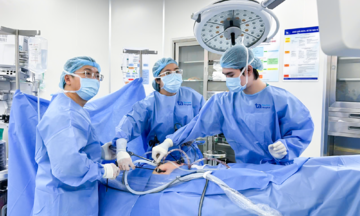
Professor Nhan (right) and his team perform a heart valve replacement. *Photo: Tam Anh General Hospital* |
In Mrs. Tuyen's case, Professor Nhan selected the SAPIEN 3 valve – an advanced, high-precision balloon-expandable valve. This improved biological valve aims to reduce paravalvular leakage complications, minimize the risk of vascular damage, and optimize hemodynamics for cases with small valve annuli. The valve has a lifespan of over 10 years and is designed to allow doctors to implant a new valve inside the old one via catheter if a second replacement is needed, eliminating the need for sternotomy.
The intervention lasted about 45 minutes. The artificial valve was accurately positioned at the damaged valve annulus under the guidance of a digital angiography system. One day after the procedure, Mrs. Tuyen experienced no pain, engaged in light activity, ate normally, and was discharged three days later.
 |
Professor Nhan examines Mrs. Tuyen before her discharge. *Photo: Thai Minh* |
Aortic valve stenosis tends to increase with age. Causes include calcified heart valves in older adults, congenital defects (bicuspid aortic valve), and rheumatic heart disease (a complication of strep throat that damages heart valves). Other risk factors may include smoking, high blood pressure, dyslipidemia, and obesity.
Doctor Nguyen Van Duong, from the Interventional Cardiology Center at Tam Anh General Hospital, TP HCM, noted that aortic valve stenosis often presents no clear symptoms in its early stages, progressing silently for 10 to 20 years. By the time chest pain, shortness of breath, fatigue, fainting, or near-fainting episodes occur, the disease has become severe. Patients experiencing these symptoms should seek specialized cardiac examination for timely treatment to limit complications. Currently, transcatheter aortic valve implantation has been approved by health insurance, offering patients access to this modern treatment at a reasonable cost.
Ngoc Chau
| Readers can submit their cardiology questions here for doctors to answer. |