After approximately two weeks of applying the medication, Mr. Toan's hemorrhoids detached, but he experienced burning pain in his buttocks and difficulty with bowel movements. When the pain became severe, he sought medical attention at Tam Anh General Hospital, Ho Chi Minh City. A rectal endoscopy revealed a 5 mm polyp 10 cm from the anal verge, along with several hyperplastic polyps. The anal sphincter was abnormally closed, accompanied by fibrotic scars from old anal fissures.
Master of Science, Doctor Nguyen Van Hau, from the Center for Endoscopy and Gastrointestinal Endoscopic Surgery, stated that Mr. Toan had hypertonia of the anal sphincter. Previous fissures had formed hardened, inelastic scar tissue, preventing the anus from dilating normally during defecation.
Doctor Hau cautioned that unverified topical hemorrhoid medications, often advertised as "traditional herbal medicine" or "family remedies" that cause hemorrhoids to fall off, typically operate by causing tissue necrosis. This is achieved through strong corrosive agents like alkali or acid. These products damage both the hemorrhoids and surrounding healthy tissue, leading to deep chemical burns. Over time, the injuries heal, forming hardened, contracted scar tissue, resulting in anal canal stricture, as seen in Mr. Toan's case.
 |
Doctor Hau consults with Mr. Toan. Photo: Tam Anh General Hospital |
Mr. Toan was scheduled for surgery to excise the fibrous ring, reconstruct the anus, and partially cut the internal sphincter. This procedure aimed to relieve the stricture and restore the anus's elasticity. After surgery, he needed wound care and anal hygiene according to instructions to prevent infection, and was discharged after two days.
Doctor Hau advised people with hemorrhoids to seek treatment at reputable medical facilities with proctology specialists. He strongly cautioned against self-medicating with unverified traditional methods or drugs of unknown origin.
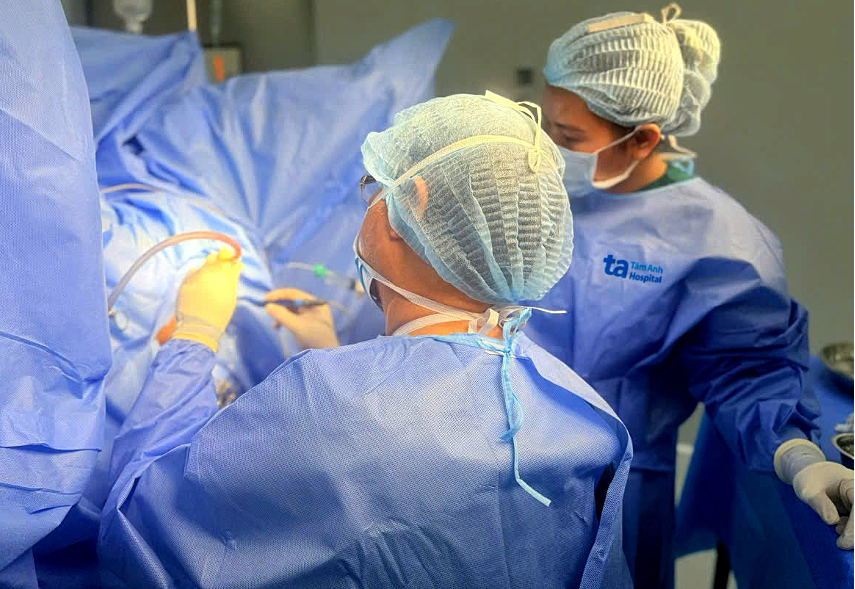 |
Doctor Hau performs surgery to excise the fibrous ring and reconstruct the anus for Mr. Toan. Photo: Tam Anh General Hospital |
Anal stricture is a condition where the anal canal loses its normal ability to expand to pass stool. Typical signs include difficult bowel movements, excessive straining, small or flattened stools, severe burning pain during defecation, and possibly fresh bleeding due to mucosal tears. When these symptoms appear, patients should seek early examination for diagnosis and timely intervention.
Quyen Phan
*Patient's name has been changed
| Readers can ask questions about digestive diseases here for doctors to answer |