For couples living abroad, such as yourself, the decision to use fresh or frozen sperm for IVF treatment primarily depends on reproductive health, timing, and the infertility treatment protocol.
If your husband can travel to Vietnam precisely when your egg retrieval is scheduled, and he has good health and sperm quality, using fresh sperm is entirely appropriate. However, travel schedules can introduce risks such as flight delays, plan changes, or psychological stress, which might complicate sperm collection. Therefore, doctors recommend cryopreserving (freezing) sperm as a backup. This stored sample can be used immediately if needed, helping to avoid the risk of canceling an IVF cycle if fresh sperm cannot be obtained at the right time.
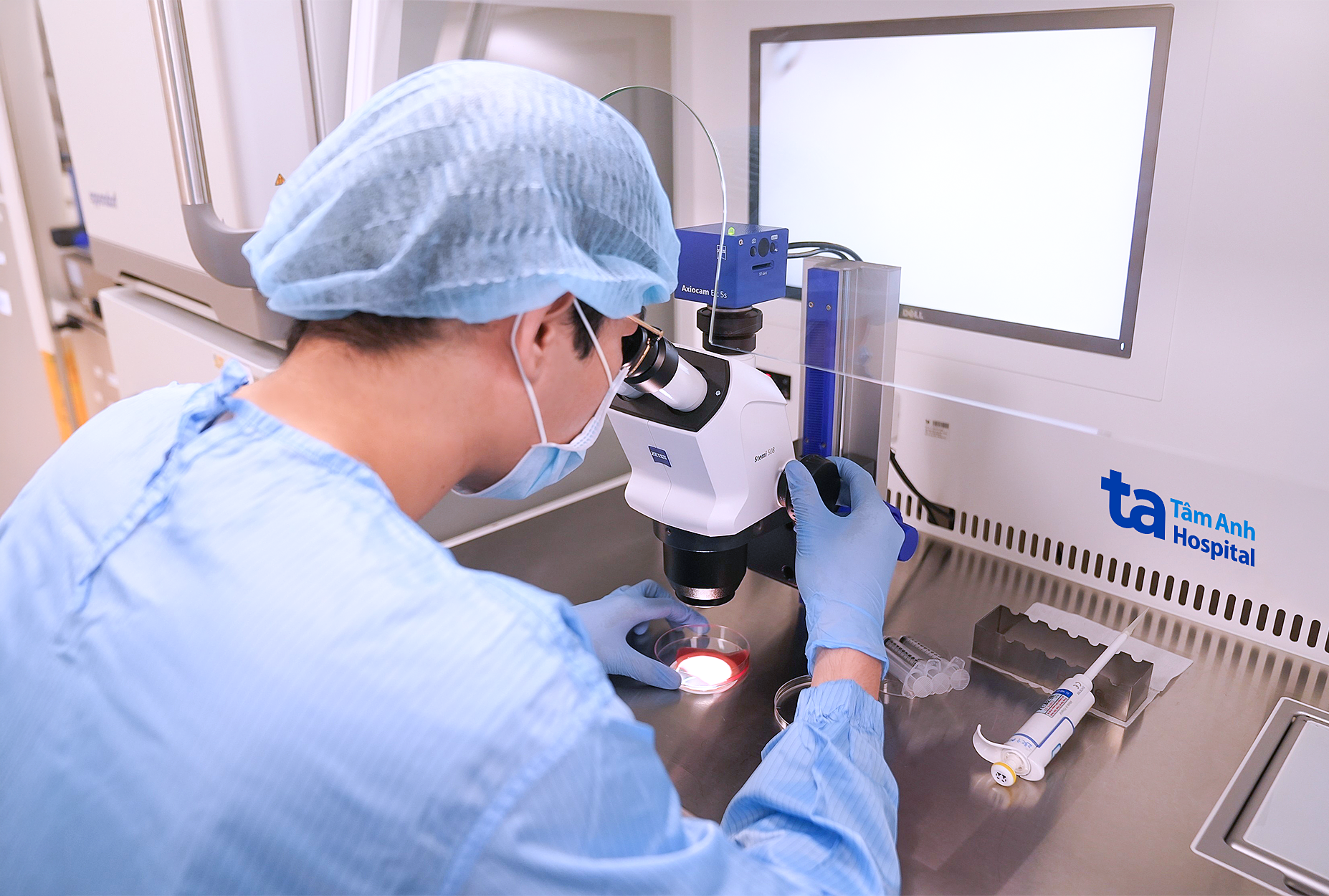 |
Lab technician observing under a microscope, checking a sperm sample before cryopreservation. Photo: IVF Tam Anh
Frozen sperm is also used in various other situations, such as for men who have difficulty ejaculating, require surgical sperm retrieval from the testicles, or need to freeze sperm before cancer treatment.
Many people worry that freezing sperm for infertility treatment might reduce its quality or lower pregnancy rates. However, numerous studies indicate that there is no significant difference in fertilization rates, embryo formation, and pregnancy rates between fresh and frozen sperm in IVF/ICSI procedures. In some cases, such as sperm retrieved from the testicles, frozen sperm can even yield more consistent results due to thorough preparation and selection.
At the Center for Reproductive Assistance, Tam Anh General Hospital, using vitrification cryopreservation and washing to eliminate DNA-fragmented sperm, fertilization, embryo formation, and pregnancy rates from frozen samples are comparable to fresh samples, especially when performed using intracytoplasmic sperm injection (ICSI) technique.
Dr. Le Dang Khoa
Center for Reproductive Assistance
Tam Anh General Hospital, Ho Chi Minh City
| Readers can submit questions about infertility here for doctors to answer. |