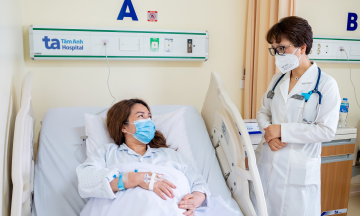
For the past year, Ms. Thao's menstrual cycle typically lasted about 5-7 days, which she attributed to perimenopausal hormonal imbalance. Recently, she experienced two weeks of prolonged heavy bleeding accompanied by abdominal pain, prompting her to visit Tam Anh Hanoi General Hospital. Blood test results showed her hemoglobin (HGB) level was 4,4 g/dL, roughly one-third of the normal range (11,7-14,4 g/dL), indicating severe anemia.
"In over 40 years of practice, this is the first time I have encountered such a severe case of anemia," stated Associate Professor Doctor Nguyen Duc Hinh, Director of the Obstetrics and Gynecology Center.
Ms. Thao had multiple uterine fibroids, with the largest measuring 11 cm, causing her uterus to enlarge to the size of a 5-month pregnancy. The patient also suffered from endometrial adenomyosis and numerous polyps within the uterine cavity. According to Associate Professor Hinh, when these conditions coexist, abnormal uterine bleeding can persist over many cycles. Additionally, Ms. Thao had hypertension and mild heart failure.
Doctors recommended a hysterectomy to definitively address the gynecological conditions while preserving both ovaries to maintain hormonal function.
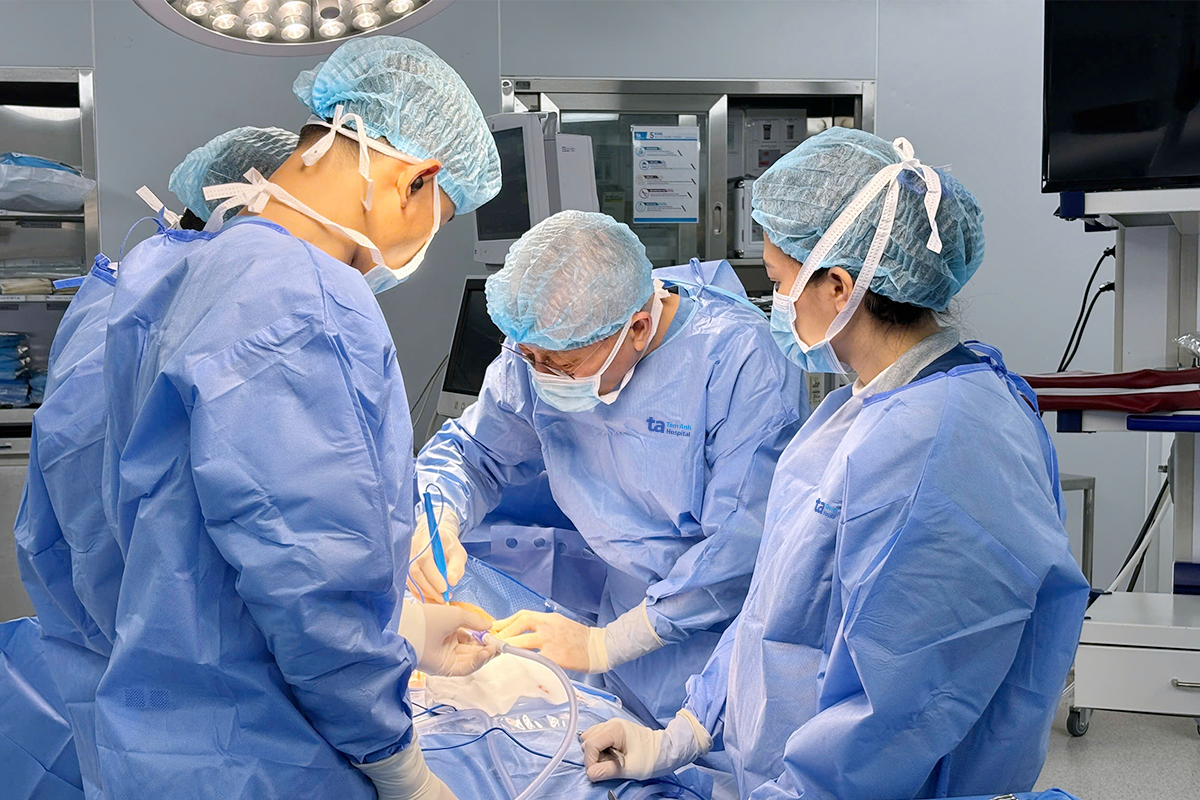 |
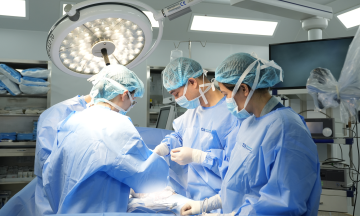
Associate Professor Hinh (second from right) and his team perform surgery on the patient. Photo: Tam Anh General Hospital |
The patient received three units of 350 ml blood transfusions before surgery. The team performed a laparoscopic hysterectomy using a high-frequency electrosurgical unit, removing a specimen weighing 750 g.
Post-surgery, Ms. Thao was alert and recovered well, discharged after 6 days. Two weeks later, during a follow-up examination, her anemia had significantly improved, with her HGB level increasing to 10,2 g/dL.
Uterine fibroids are benign tumors originating from the uterine muscle, which can enlarge the uterus, causing prolonged heavy bleeding and pelvic pain. Endometrial adenomyosis causes painful menstruation, prolonged periods, and heavy bleeding. Uterine polyps present with symptoms of abnormal bleeding and prolonged spotting. Some women experience heavy periods, fatigue, and dizziness, often mistaking these for normal disorders, only to discover severe anemia after a blood test.
Associate Professor Hinh stated that treating uterine conditions requires an individualized approach based on age, symptoms, degree of anemia, uterine size, and desire for childbearing. Depending on the case, patients may undergo observation, medication, polyp removal, fibroid removal, or a hysterectomy if the condition is severe, causes significant anemia, the uterus is enlarged, or there is no longer a desire to have children.
Women should undergo regular gynecological examinations every 6-12 months, especially if their menstrual period lasts longer than 7 days, if they experience abnormal heavy bleeding, or if they bleed after intercourse.
Van Anh
*The patient's name has been changed.
| Readers can submit questions about pregnancy and childbirth here for doctors to answer. |