Additionally, the total expenditure by medical tourists and their companions, encompassing accommodation, travel, dining, shopping, leisure, and related services, is targeted to reach 2,5 billion USD by 2030. These ambitious goals are outlined in the draft Medical Tourism Development Project for the 2026-2030 period, currently under review by the Ministry of Health.
The project seeks to establish Vietnam as a competitive medical tourism destination in Southeast Asia, gradually approaching the leading group in Asia. The envisioned service chain includes modern medicine, traditional medicine, rehabilitation, comprehensive healthcare, and elderly care.
While health-combined tourism activities have a long history in Vietnam, modern medical tourism has only developed significantly over the last decade, according to the Ministry of Health. Vietnam currently possesses substantial medical capacity. By 2025, the country will have 2,107 hospitals with over 339,000 hospital beds and more than 105,000 doctors. The specialized system comprises 103 hospitals, including 13 high-tech specialized hospitals concentrated in Hanoi, Hue, and Ho Chi Minh City. Some facilities have mastered complex techniques such as robotic surgery, organ transplantation, cardiovascular interventions, cancer treatment, reproductive assistance, and various specialized techniques in ophthalmology, otolaryngology, and maxillofacial surgery.
International visitors utilizing medical services in Vietnam are estimated at about 300,000 visits annually. Their total expenditure, including medical costs and associated accommodation, travel, and dining, is approximately 1-2 billion USD; the medical portion has not been separately identified. This activity primarily occurs in Ho Chi Minh City and Hanoi. Ho Chi Minh City accounts for about 40% of international visitors, while Da Nang, Hue, and Khanh Hoa are developing products combining medical services, resorts, and healthcare.
The most popular services among international visitors include dental care, aesthetics, reproductive assistance, general health check-ups, and certain high-tech specialties. Key source markets are overseas Vietnamese, as well as visitors from Cambodia, Laos, Korea, Japan, Australia, and some European countries.
Despite its "significant potential," Vietnam's medical tourism market faces many challenges, according to the Ministry of Health. A major bottleneck is the absence of a dedicated, synchronized legal framework for the entire medical tourism chain. Current regulations are scattered across laws concerning medical examination and treatment, tourism, pricing, immigration, insurance, and personal data protection. Vietnam also lacks unified criteria for recognizing facilities qualified to provide medical tourism services. Regulations for resolving cross-border medical disputes and for protecting and exchanging cross-border medical data also require further development.
Regionally, Vietnam competes with well-established medical tourism destinations such as Thailand, Singapore, Malaysia, Korea, and Japan. The number of facilities with Joint Commission International (JCI) certification – awarded by the US-based international hospital accreditation organization – is considerably lower than in Thailand and Malaysia. Vietnam currently has 13 JCI-certified hospitals and three hospitals certified by the Australian Council on Healthcare Standards International (ACHS International). Furthermore, the quality of service infrastructure and the ability to offer all-inclusive medical-accommodation-tourism-resort packages remain limited.
Specialized foreign language proficiency, intercultural communication skills, and the capacity to serve international clients among some medical staff, nurses, and support personnel do not fully meet requirements. Positions such as medical tourism coordinators, medical interpreters, international insurance coordinators, and international client consultants also lack specialized training systems and personnel.
The insurance mechanism presents another challenge. Direct payments between Vietnamese medical facilities and international insurance companies are currently implemented only in some private hospitals, not in public ones. This reality limits the ability to attract patients with international health insurance.
Conversely, Vietnamese citizens spend approximately 2-3 billion USD annually on medical examinations and treatment abroad, exceeding the estimated total expenditure of international medical tourists in Vietnam. Therefore, developing medical tourism aims not only to attract foreign visitors but also to improve domestic service quality and reduce the outflow of people seeking treatment abroad, according to the draft project.
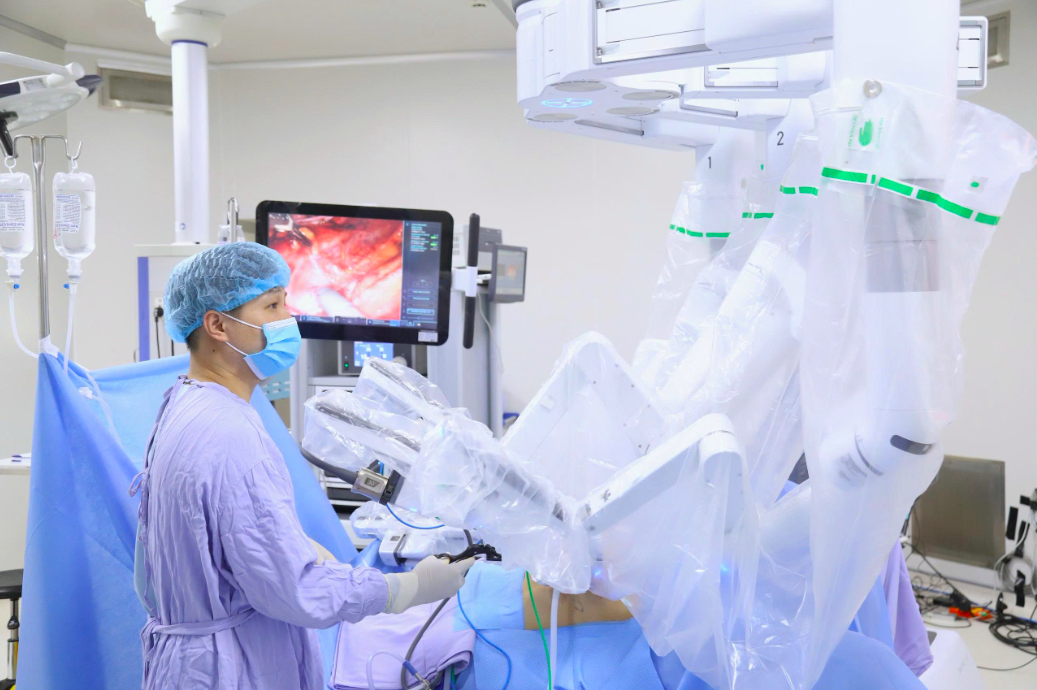 |
A doctor uses a robot to perform cervical cancer surgery on a patient. Photo: Manh Tran |
In this context, the Ministry of Health is developing a project with various solutions aimed at retaining domestic patients and attracting foreign medical tourists to Vietnam. By 2030, Vietnam strives to have a minimum of 20 hospitals achieve international quality standards like JCI, ACHS, or equivalent, with at least five being public hospitals. At least 30 standardized medical tourism product packages will be developed, covering the entire process before, during, and after service utilization. These products will focus on screening, dental care, traditional medicine, and some high-tech specialized services. The satisfaction level of international medical tourists and patients at facilities within the medical tourism network is targeted to reach at least 90%.
The National Multilingual Medical Tourism Information Portal and the National Medical Tourism Database are expected to be operational by 2028. A national brand identity for "Vietnam Medical Tourism" will also be developed and implemented uniformly.
The project will focus on refining six groups of mechanisms: facilitating service access and administrative procedures; finance and service pricing; quality management; cooperation and investment; data governance; and rights protection and dispute resolution. This includes researching appropriate visa, entry, and stay mechanisms for patients and their companions.
The project will also finalize pricing mechanisms at public medical facilities; promote direct payment with international insurance; and establish a set of standards for evaluating and recognizing medical tourism service providers. It encourages increasing public-private partnerships, stimulating investment, and developing suitable insurance products. A system ensuring cross-border medical data sharing in accordance with legal regulations and a mechanism for handling disputes involving foreign elements will also be established.
Regarding the market, Vietnam will focus on developing specialties with competitive advantages, while combining the strengths of modern medicine, traditional medicine, rehabilitation, and resort systems in various localities.
Experts estimate that with proper investment, the medical tourism market could generate 4 billion USD in revenue by 2033.
Le Nga