Knee osteoarthritis is a condition characterized by damage to articular cartilage and subchondral bone, accompanied by inflammation and reduced synovial fluid quality, leading to pain, swelling, and difficulty in movement. According to the World Health Organization (WHO), about 365 million people globally suffer from osteoarthritis, with knee joints being the most frequently affected.
Doctor Hoang Quyet Tien, from the Medical Information Center at Tam Anh General Hospital Ho Chi Minh City, highlights the reasons leading to knee osteoarthritis.
Firstly, the knee joint bears the most significant load and acts as a "pillar" supporting nearly the entire body. Every step taken, whether walking, running, jumping, climbing stairs, or carrying heavy objects, creates direct pressure on the cartilage and subchondral bone.
Doctor Tien cites research showing that the knee joint bears 80% of body weight when standing still, and this can increase to 150% when moving. When this pressure is repeatedly applied over many years, articular cartilage gradually wears down, synovial fluid decreases, and the joint begins to suffer from osteoarthritis. The risk of knee osteoarthritis is often elevated in overweight or obese individuals due to the prolonged load on their joints.
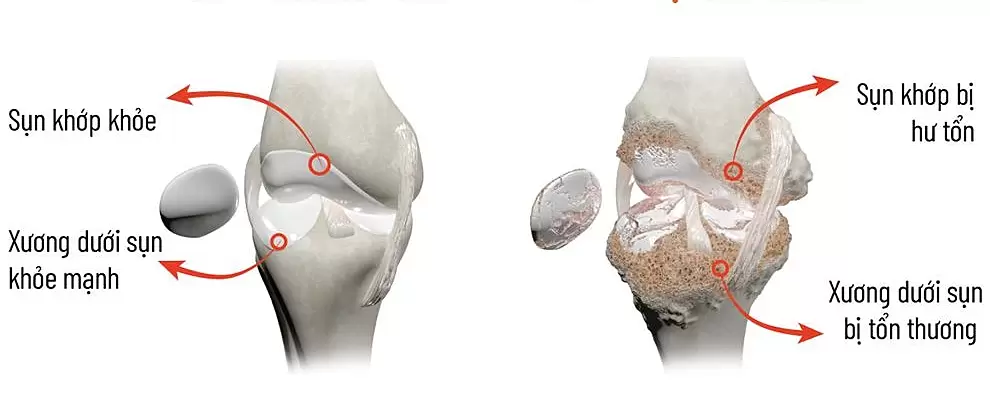 |
An image depicting a normal joint (left) and a damaged joint (right). Photo: Eco Pharmaceutical Joint Stock Company |
The knee joint has a complex structure, formed by the femur, tibia, fibula, and patella. These structures work with ligaments, menisci, and synovial fluid to maintain stability and enable flexible movement. However, due to bearing significant loads and being involved in most physical activities, the knee joint is also susceptible to injury from falls, sports, incorrect posture during exercise, prolonged squatting, or heavy labor.
Doctor Tien states that knee injuries sometimes do not cause immediate severe pain but can silently leave damage to the cartilage or the muscle-tendon structures surrounding the knee joint. Over time, accumulated damage increases friction between bone ends, causing cartilage to wear down faster and accelerating early osteoarthritis.
Age is also a significant factor that accelerates knee osteoarthritis, causing articular cartilage to gradually lose its elasticity and load-bearing capacity. Unlike other tissues, articular cartilage has almost no direct blood supply, so its ability to self-repair after injury is quite low, thereby silently weakening the joint structure.
Osteoarthritis often progresses silently over many years. Many individuals only discover the condition after experiencing prolonged joint pain or when the joint has already become deformed. Early signs might simply be a dull ache during extensive activity or a creaking, cracking sound from the joint when climbing stairs.
To prevent the risk of knee osteoarthritis, Doctor Tien advises individuals to maintain a healthy weight, choose exercises suitable for their physical condition, and avoid activities that aggravate symptoms, such as climbing stairs, squatting, or carrying heavy loads. Supplementing with nutrients like undenatured collagen type II, hydrolyzed collagen peptide, eggshell membrane, chondroitin sulfate, and turmeric root extract can support cartilage protection, increase flexibility, and help slow down the process of osteoarthritis.
Dinh Dieu