Despite having good embryos, four embryo transfers have not resulted in pregnancy. What are the reasons, and how should we proceed with treatment? (Thanh Huong, TP HCM)
The success rate of in vitro fertilization (IVF) depends on a complex interplay of factors beyond just embryo quality. These include the quality of the uterine lining, the interaction between the embryo and the lining, the woman's age, and her overall physical and mental health. Understanding these elements is key to addressing persistent IVF failures.
Embryo quality is a primary factor. Good quality embryos exhibit correct developmental speed during culture, with evenly divided and uniformly sized cells, minimal or no cytoplasmic fragments, and tightly linked trophoblast cells (which form the placenta) and inner cell mass (which forms the fetus). Such embryos are typically graded one to two, indicating a much higher potential for pregnancy compared to lower quality grade three to four embryos.
However, even with good quality day-5 embryos, an suboptimal uterine lining can cause embryo transfer to fail. The uterine lining is a thin layer of cells inside the uterus. Both excessively thick or thin linings can impede implantation. A thickness of 8-14 mm is generally considered ideal for embryo implantation. If the uterine lining is less than 7 mm thick at the time of transfer, the failure rate increases significantly. Furthermore, uterine abnormalities such as polyps or chronic inflammation also raise the risk of failed embryo transfer.
Even when embryo quality, uterine lining quality, and uterine structure are all optimal, non-pregnancy can still occur due to an abnormal interaction between the embryo and the uterine lining. Embryo transfer should ideally take place when the uterine lining is most receptive to the embryo, a period known as the implantation window. This window is unique to each woman. If the implantation window is not accurately identified, transferring embryos either before or after this specific time can reduce the pregnancy rate.
Other patient-specific factors also play a role. If a woman is older, has underlying medical conditions, or experiences poor physical and mental health, these circumstances can further increase the risk of failed embryo transfer.
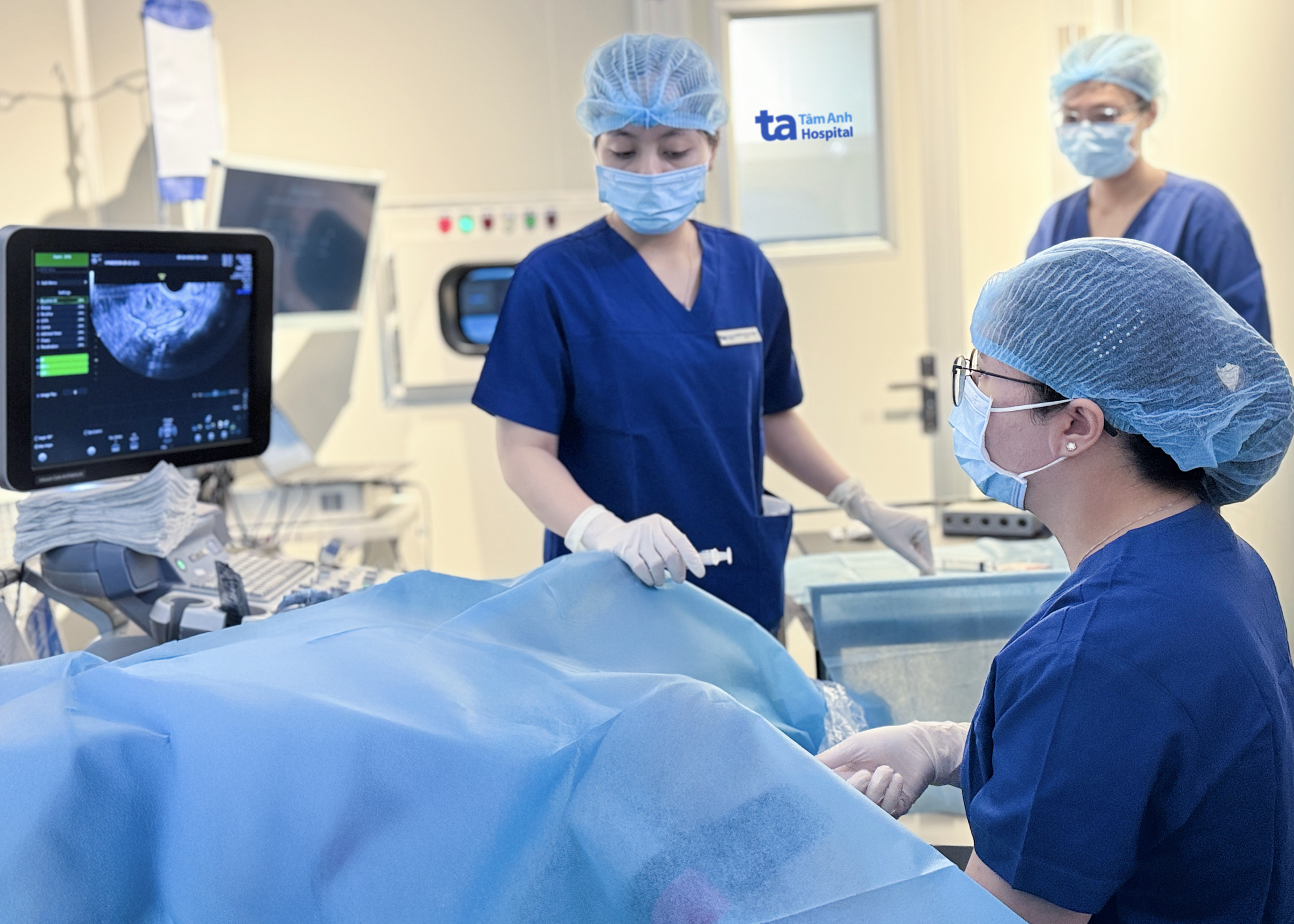 |
Master, Doctor Tran Ngoc Ha Giang performs oocyte retrieval for in vitro fertilization treatment for a patient. Illustration: Dinh Lam
To address these complexities, the Center for Reproductive Assistance at Tam Anh General Hospital (IVF Tam Anh) in TP HCM employs advanced technologies. Their ISO5 "lab-in-lab" system and time-lapse embryo culture technology improve the rate of culturing embryos to day five. Embryologists thoroughly observe and assess embryo development, while artificial intelligence (AI) software scores embryo quality, helping select embryos with the highest predicted pregnancy potential for transfer.
Prior to embryo transfer, doctors at Tam Anh conduct detailed examinations. If necessary, hysteroscopy is performed to precisely diagnose any abnormalities, leading to a definitive treatment plan. They also collaborate with various specialties to comprehensively manage any underlying medical conditions. Doctors develop a protocol to prepare the uterine lining, prescribing autologous platelet-rich plasma therapy for thin uterine lining when required. Patients receive comprehensive guidance on nutrition and adequate rest before, during, and after embryo transfer, all designed to enhance pregnancy rates.
Master, Doctor Tran Ngoc Ha Giang
Department of Reproductive Assistance,
Tam Anh General Hospital - District 8
| Readers can submit questions about infertility here for doctors to answer. |