According to a report by the Population Department released on Vietnam Population Day, 26/12, the national average birth rate in 2025 reached 1,93 children per woman. This marks a slight increase from the historical low of 1,91 the previous year, but it remains below the replacement level. A significant disparity exists, with 19 provinces and cities recording birth rates above 2,2 children, while 11 other localities fell below 2,0. Regional differences continue to widen, as Ho Chi Minh City is among the lowest nationwide with 1,51 children per woman, while Dien Bien leads with 2,91 children. Northern mountainous provinces like Lai Chau, Son La, Lao Cai, and Gia Lai have consistently been in the high birth rate group for many years.
Doctor Mai Xuan Phuong, former Deputy Director of the Communication and Education Department, General Department of Population (now the Population Department, Ministry of Health), explains this trend as a consequence of disparities in economic development and access to social services. In agricultural and forestry-based economic regions such as the Northwest and Central Highlands, people view children as an important labor resource.
"Having 3-4 children provides families with more hands for farming and serves as a social safety net when parents age. Unlike the high cost of living in urban areas, raising children in highland regions does not create an immediate economic burden," Phuong observed.
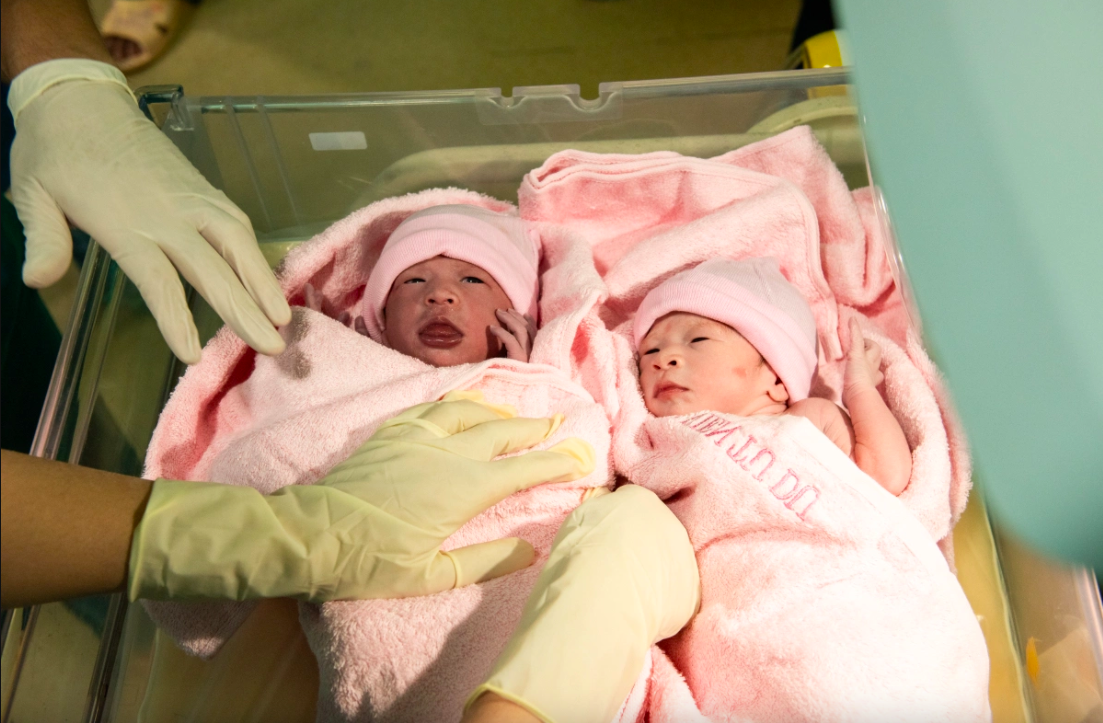 |
Two babies born on New Year's Eve 2025. Photo: Ngoc Ngan
Furthermore, women's educational attainment directly impacts fertility decisions. In areas with high birth rates, the proportion of women who complete high school is low, and child marriage still exists, which prolongs their reproductive period. Conversely, women in developed urban areas like Ho Chi Minh City and Dong Nai often marry later, prioritizing careers and quality of life, thus opting for fewer children or delaying childbirth.
Beyond economic factors, cultural barriers and inadequate healthcare infrastructure also contribute to high birth rates. Beliefs such as "many children bring many blessings," "the desire for both sons and daughters," or the psychological tendency to have more children as a buffer against risks of illness or early death, remain deeply rooted in ethnic minority communities. The system of family planning services and modern contraception has not yet widely reached remote villages, leading many women to have more children due to a lack of knowledge and tools for active control.
Experts warn that if high birth rates in disadvantaged areas are not addressed promptly, they will create a cycle of poverty and exacerbate social inequality. Large families mean that educational investment resources are fragmented, leading to low future labor quality, while basic healthcare and education systems face overload pressure.
Addressing this situation, Deputy Minister of Health Do Xuan Tuyen has urged the population sector to adopt flexible regional approaches. For high birth rate areas, the core solution is not imposed administrative measures or empty slogans, but rather linking population policies with poverty reduction, improving public education, and enhancing women's status. Tuyen emphasized the need to promote pre-marital counseling, eliminate child marriage and consanguineous marriage to improve population quality from the outset, rather than merely pursuing quantity.
Le Nga