The incident prompted doctors to issue a strict warning about the risks associated with such eating habits, according to Chinese media. Wang was diagnosed with an esophageal ulcer after consuming hot food too quickly. She recounted that one cool day in March, she was having hotpot with friends. Being hungry and engrossed in conversation, she immediately swallowed food taken directly from the pot without blowing on it to cool it down. At the time, she only felt a slight tightness in her chest, which subsided after drinking a mouthful of iced water, so she didn't pay much attention. However, the next day, she experienced severe pain every time she swallowed, even when drinking plain water.
Tests at Changsha No. 8 Hospital revealed that Wang had an 8 cm esophageal ulcer, nearly one-third the length of an adult esophagus (which ranges from 25 to 30 cm). Doctor Wu Xiaoqing stated that people often mistakenly believe the esophagus can withstand high temperatures, but this organ can only tolerate food at temperatures around 50 to 60 degrees Celsius. In contrast, food just removed from a hotpot can reach 80 or 90 degrees Celsius. In Wang's case, her sensitive oral mucosa caused her to swallow the hot food faster, leading to a burn on the equally sensitive esophageal lining.
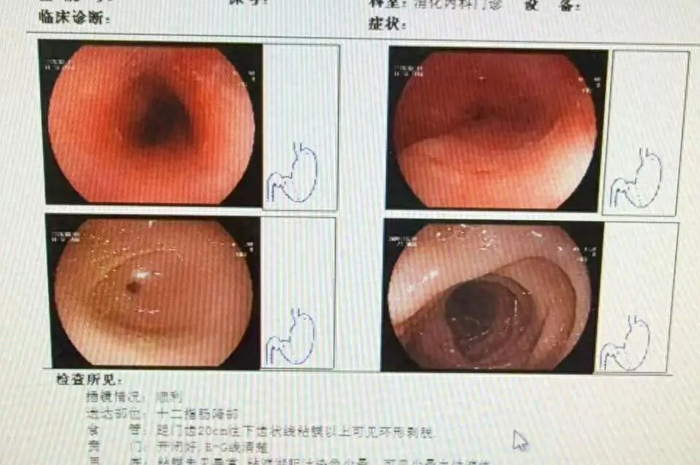 |
Endoscopic images show the severe extent of Ms. Wang's injury. Photo: Sina |
Additionally, Chinese people often have a habit of drinking cold water while eating hotpot, believing it helps neutralize the temperature. Doctor Wu warned that such eating habits further irritate the esophagus and cause more severe damage to the lining. If an esophageal ulcer injury is treated promptly, patients usually recover completely and it does not progress to cancer. Conversely, in cases where ulcers recur frequently, there is a risk of developing cancer.
To prevent these risks, doctors advise people to let food cool for about one to two minutes after removing it from the pot before eating. The safest way to eat is when the food is warm and no longer burns the mouth. People need to abandon the habit of "blowing and eating" and instead eat when the food has cooled down. If discomfort symptoms appear after a meal, such as pain behind the breastbone, a burning sensation, or a feeling of obstruction in the throat, patients should immediately seek medical attention. They should not be complacent and delay treatment.
Wang's case, reported by the media in recent days, has sparked a lively discussion on social media about Chinese eating habits. In China, people often believe that eating piping hot food and drinking warm water is beneficial for health. Hotpot is also one of the most popular dishes in China in any region. Spicy hotpot, originating from Sichuan and Chongqing, is particularly loved for its characteristic combination of hot, numbing, and stimulating sensations.
China currently accounts for 40% of esophageal cancer cases worldwide, and the preference for hot food among its population is considered one of the main causes. Only in recent years have people begun to realize that food is not "the hotter, the better." The International Agency for Research on Cancer (IARC) under the World Health Organization (WHO) has classified beverages above 65 degrees Celsius as "probably carcinogenic to humans."
Binh Minh (According to SCMP, Sohu, Sina)