Tran Dang Phuoc Cuong, 33, active in the aesthetics and fashion business under the stage name Bach Nguyen, cannot recall if happiness or emotion was his first reaction upon seeing his new face after a nose augmentation. He only remembers smiling.
"That was the first time I felt closer to the image I had always wanted," Nguyen recounted. "Finally, I had enough confidence to love myself."
 |
Nguyen after undergoing 20 cosmetic surgeries. Photo: Courtesy of subject |
The surgery took place when he was 19. He spent all his accumulated earnings from part-time jobs, about 5 million VND, to find a doctor in Da Nang. The cost was quoted at 7 million VND, but instead of leaving, he explained his situation and asked for assistance. The doctor agreed.
More than two hours later, Nguyen left the operating room with his nose bandaged, breathing with difficulty. In the next few weeks, for the first time, he felt motivated to change.
Before this, his face made him withdrawn. During his time studying abroad, friends easily found customer-facing jobs thanks to their neat appearance, while he was mostly hired for serving and carrying tasks. His high school photos were often mocked. For a period, he dared not take pictures, avoided social interaction, and shied away from crowds for fear of judgment.
Standing before the mirror, a question repeatedly crossed his mind: "If I had a better appearance, would I dare to live differently?"
The initial nose augmentation did not result in the balanced face he had imagined. This marked the beginning of a prolonged journey of revisions. Over 15 years, Nguyen underwent more than 20 procedures: cheekbone reduction, jawline contouring, chin augmentation, genioplasty, jaw surgery for prognathism, lip correction, nose augmentation, philtrum adjustment, prominent ear correction, and scar treatment. Some procedures lasted over one hour, while others extended for many consecutive hours.
Each time he went under the knife, according to the young man, was not a spontaneous decision. "It was a long journey with many considerations." Each procedure was accompanied by a difficult recovery process. Sometimes his face was temporarily disfigured, taking many months to stabilize. Prolonged pain, a strict diet, and the waiting period made him want to stop multiple times. Looking in the mirror, he questioned if he was making a mistake.
The jaw correction surgery left the biggest trauma. The surgeon operated on his entire cheekbones, jaw angle, chin, and nose. When the anesthesia wore off, pain spread throughout his body, his face swelled many times its normal size, and both cheeks were so bruised that he dared not look in the mirror. On the first day, he could barely open his mouth. Meals consisted only of blended porridge or milk administered through a tube, and each swallow caused a sharp pain in the incision site.
Orthognathic surgery, or jawbone correction surgery, is classified in medical literature as a major surgery of the head and face region, an area with many large blood vessels and sensory nerves. A study tracking 3,236 patients, published in a maxillofacial surgery journal, noted that sensory nerve damage, presenting as numbness in the lips and chin, was the most common complication, affecting about 19% of cases. Among these, about 2% of patients experienced permanent, irreversible loss of sensation. Another study on 485 cases showed a general complication rate of 19.2%, and this number increased with the number of bone segments intervened in a single surgery, consistent with the multi-region intervention Nguyen experienced.
 |
Bach Nguyen after revisions. Photo: Courtesy of subject |
But the most uncomfortable aspect, for him, was not the pain, but the waiting. Each morning, Nguyen held a mirror to see if the swelling on his face had subsided. On the first day he saw his swollen face, he almost did not recognize himself. It took one week for the swelling to begin to decrease, and many more months for his features to gradually take shape. Throughout this period, all meetings with friends were declined, and outings were minimized.
The nose revision using rib cartilage left a similar impression. The nose area almost lost sensation, while the site where the cartilage was taken from his rib hurt for many consecutive days. There were sleepless nights. The doctor explained that this was a possible reaction during the recovery process, which somewhat reassured the young man.
Not everyone supported him. A few close friends encouraged him to pursue what made him more confident, but others believed he was "addicted" to surgery, even mocking him for trying to become someone else. Each time he posted post-surgery photos, comments below included: "Is this worth it?", "Natural beauty is still better," and "You'll regret it." Nguyen chose to remain silent.
"No one but myself understands the feeling of living many years in self-doubt, or the harm of becoming other people's laughing stock," he said. He has never regretted it; that is what Nguyen affirms. Each time he overcame a surgery and saw a change, his motivation rekindled. The hardest part, for him, was not the physical aspect, because "pain will eventually end," but the mental pressure of waiting for results, the anxiety each time he entered the operating room, and the negative comments he had to bear when he had not yet seen the desired outcome.
"More than 20 surgeries represent many years of studying and working, accumulating resources and making efforts," Nguyen said. "Every change has its price, not just money but also time, health, and even opportunities that had to be put aside for recovery."
That price, physically, increased with each subsequent surgery. Literature on revision cosmetic surgery indicates that fibrous scar tissue accumulated after each intervention blurs natural anatomical boundaries and disrupts the local vascular system. According to these documents, from the third surgery onwards, the risk of infection, tissue contraction, and skin necrosis is many times higher than for the first time. In other words, the more revisions, the more difficult and risky each subsequent surgery becomes.
His new face made the young man more outgoing, daring to stand before crowds, and gaining more career opportunities. However, surgery, he believes, only accounts for one-half of the change. The other half comes from exercising, taking care of his health, training his mindset, and learning to love himself. He wants to tell others that beauty enhancement is a personal right, but one should only choose it after understanding what they want, having sufficient knowledge, and seeking out a reputable doctor.
"Do not undergo surgery just because of a criticism, or change just to please others," Nguyen said. "Ultimately, what makes me happiest is not compliments, but being able to look in the mirror each morning and smile. No longer feeling self-conscious, no longer avoiding cameras, no longer worrying about others' judgment. For me, that is the greatest gift."
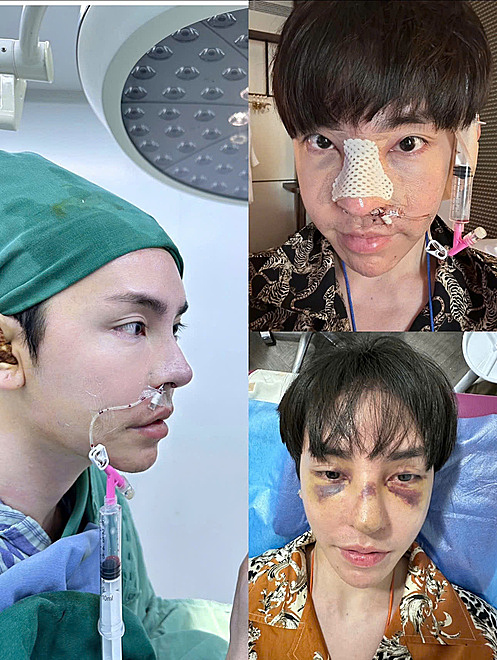 |
The young man underwent many different surgeries. Photo: Courtesy of subject |
Thuy Quynh