Hoang visited Tam Anh General Hospital Hanoi after experiencing increased pain radiating from his back to his buttocks and thighs, accompanied by numbness in his right leg. A magnetic resonance imaging (MRI) scan of his lumbar spine revealed a L5/S1 herniated disc, which was compressing a nerve root. He was treated with radiofrequency ablation combined with anti-inflammatory medication.
Doctor Le Van Khanh, a second-degree specialist and Head of the Department of Interventional Radiology, explained that radiofrequency ablation (RFA) is a minimally invasive percutaneous technique. It uses high-frequency alternating current to generate heat in the targeted tissue. This method reduces the risk of complications, particularly compared to open surgery, and offers cosmetic benefits in treatment.
Radiofrequency ablation targets the damaged disc, reducing its volume and the pressure within it. This, in turn, lessens irritation and compression on the nerve root, thereby alleviating the patient's pain.
After administering local anesthesia, Doctor Khanh used a digital subtraction angiography (DSA) system to precisely locate the L5/S1 disc and determine the access path. A small guide needle was inserted through the skin to the damaged disc area, followed by the radiofrequency ablation needle, which was advanced through the guide needle into the center of the disc.
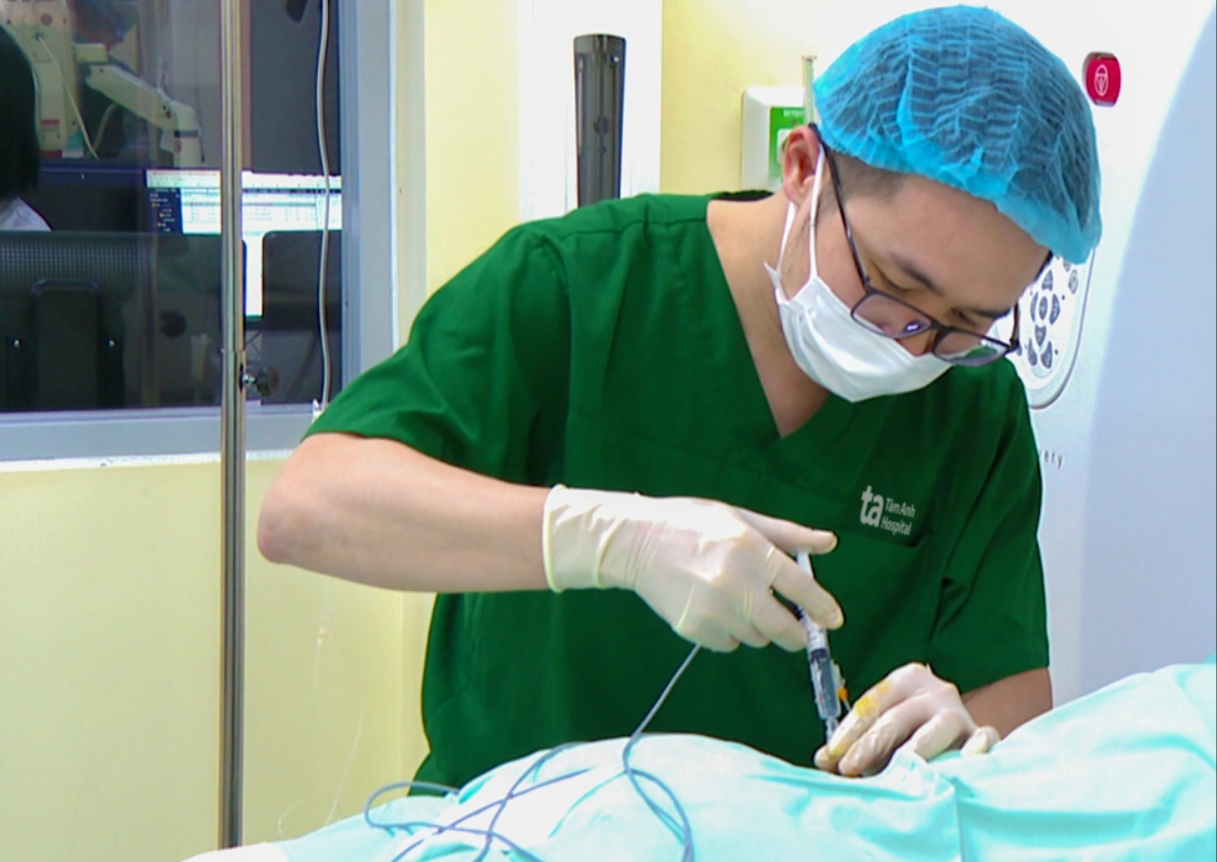 |
Doctor Khanh performs radiofrequency ablation to treat Hoang's herniated disc. *Photo: Tam Anh General Hospital*
Doctor Khanh adjusted the needle's position sequentially, applying energy from the high-frequency waves to various parts of the affected disc. Finally, local anesthetic and anti-inflammatory medication were administered around the corresponding nerve root to reduce pain and inflammatory reactions.
Following the intervention, Hoang experienced pain reduction, and his herniated disc condition improved significantly after about two months. A follow-up scan one year post-treatment showed stable L5/S1 disc damage, with the remaining herniated portion having shrunk to a mild level. The patient's back pain and leg numbness decreased, enhancing his quality of life.
According to Doctor Khanh, radiofrequency ablation is typically indicated for patients with mild to moderate herniated discs who have not achieved adequate symptom control with medication, physical therapy, and rehabilitation. This includes cases where the herniated disc is still contained within the annulus fibrosus, has not ruptured or migrated, and patients experience back pain or radiating leg pain due to nerve root irritation but without weakness or paralysis.
Hieu Nguyen
*The patient's name has been changed.
| Readers can submit questions about neurological conditions here for doctors to answer. |