A cycle of "ask-and-give" within the Food Safety Department of the Ministry of Health has led to 34 officials being recommended for prosecution on charges of receiving bribes, totaling over VND 107 billion. Among those implicated are two former department directors, Nguyen Thanh Phong and Tran Viet Nga, along with two former deputy directors and numerous department heads, deputy heads, and specialists.
According to the investigation conclusion issued by the Investigation Police Agency Office of the Ministry of Public Security (C01), 21 individuals from businesses and service providers are accused of giving bribes.
Decree 15/2018, which details certain articles of the Law on Food Safety, mandates that individuals producing and trading health protection foods must register product declarations. Additionally, health protection foods, medical nutrition products, and those for special diets must register for content confirmation certificates before advertising.
Registration dossiers for product declarations include the declaration itself, a certificate of free sale (for imported products), food safety test results, and a good manufacturing practice certificate. Notably, "scientific evidence" is required to prove the product's claimed uses or the efficacy of its ingredients.
If scientific evidence for ingredient efficacy is used, the product's daily dosage must be at least 15% of the amount of that ingredient cited in the documentation.
Applications for advertising content confirmation certificates require a registration form, product declaration, label samples, and proposed advertising content. These regulations represent new requirements compared to the previous Decree 38/2012.
 |
Cuu cuc truong Nguyen Thanh Phong va Tran Viet Nga. Anh: Bo Cong an/Y te
Since Decree 15 took effect, few dossiers met the requirements, resulting in a significantly lower number of accepted applications than before. Businesses also struggled to supplement information and documents, primarily related to scientific evidence and daily dosages, as requested by the Food Safety Department.
To address these difficulties, Mr. Phong chaired a meeting of the Food Safety Department's Party Committee. The director assigned the Food Safety Application and Training Center and the Standards and Food Testing Management Department to review product declaration registration dossiers.
Meanwhile, businesses sought their own solutions to avoid prolonged product declaration processes that would prevent them from manufacturing and bringing products to market. Consequently, many individuals and businesses "proactively offered" payments ranging from VND 5 to 10 million, averaging VND 7 million, per dossier to receive "guidance for compliance." This also expedited the appraisal process, leading to quicker issuance of product declaration acceptance certificates.
These "subtle suggestions" were reported by specialists to their department and center leaders, who then informed the directorate. Mr. Phong approved the policy allowing specialists to accept money to assist applicants. This came with a clear profit-sharing mechanism: the director received VND 2,5 to 3 million per dossier, with the remainder distributed among various levels, from department leaders to the handling specialists.
For advertising content confirmation certificates, Tran Viet Nga (deputy director from 2018-2024, director from 2024 until her arrest) was in charge. Ms. Nga required at least VND 2 million for the department leadership per dossier. She instructed specialists to be "subtle and discreet." After receiving the money, specialists shared VND 2 to 3,5 million per dossier with Ms. Nga.
Abusing power to create a "ask-and-give" mechanism
C01 determined that this chain of illegal acts stemmed from lax management by officials and leaders of the Food Safety Department. This directly led to the public production and trade of counterfeit food products on a large scale.
The consequences were significant, undermining the effectiveness of state management in food safety and functional food products. Moreover, it created an unfair competitive environment among businesses. Those who complied with the law suffered various disadvantages, including time, costs, and rights.
According to C01, the mechanisms, policies, and professional procedures also revealed many loopholes. Appraisal and dossier processing procedures were complex, lengthy, and involved many intermediaries. Some evaluation criteria were subjective, allowing officials to abuse their authority to interfere, create difficulties, or prolong processing times for personal gain.
Decision-making authority for many specialized matters was concentrated in a few individuals or departments. The rotation of positions for dossier appraisal officials was not carried out regularly for a long time, leading to "close benefit relationships between officials and businesses." This resulted in "abuse of power" and the formation of an "ask-and-give" mechanism in administrative procedures.
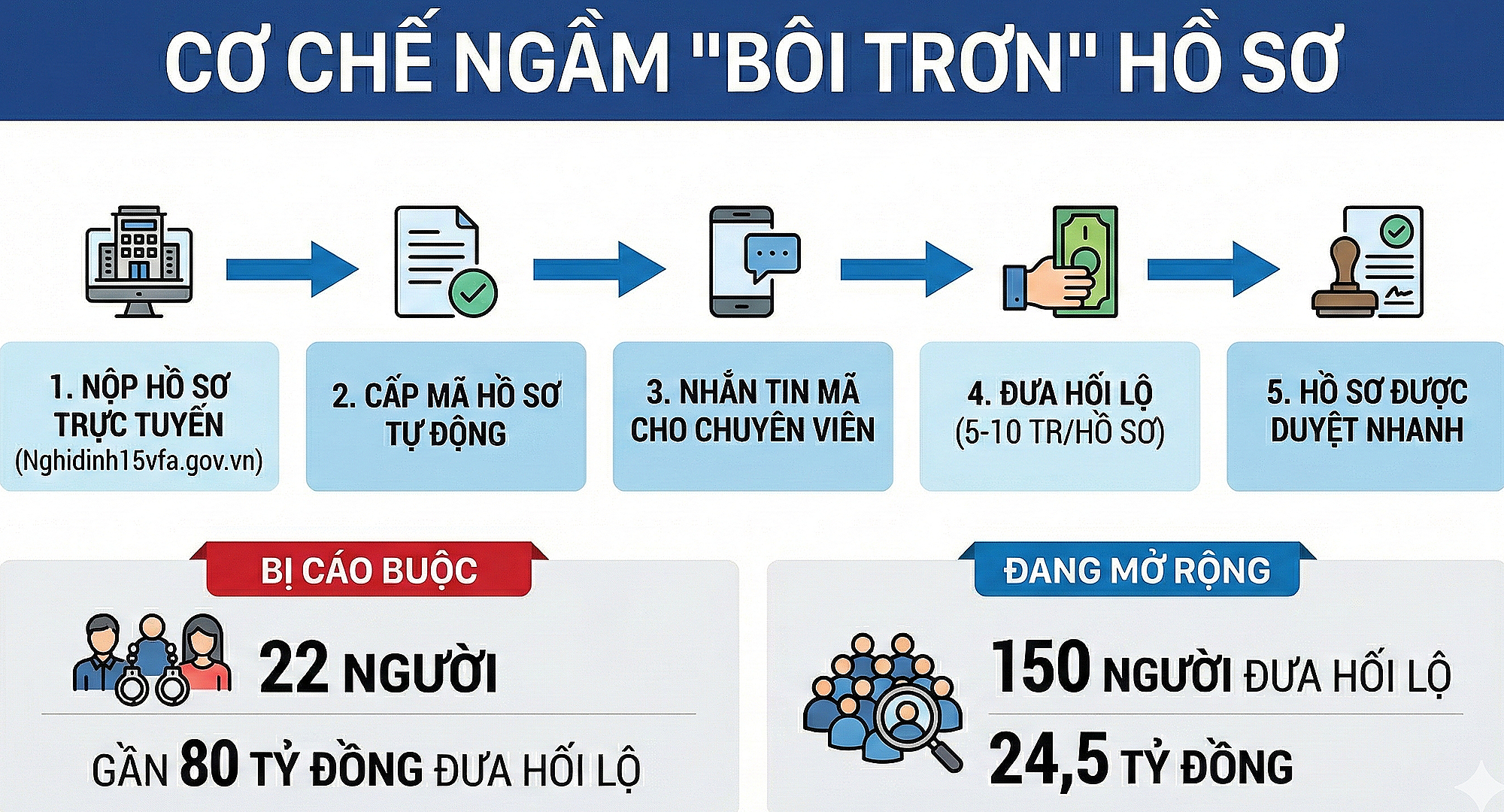 |
Quy trinh boi tron ho so tai Cuc An toan thuc pham.
The investigation identified that businesses in the food sector faced pressure to bring products to market quickly. Therefore, many organizations and individuals, "prioritizing profit," proactively offered bribes to shorten appraisal times and legalize non-compliant dossiers.
Intermediaries also exploited the lack of transparency in dossier processing to approach businesses and connect with officials to facilitate bribery.
Recommendations to close subjective legal loopholes
Police also pointed out many subjective reasons. Numerous acts of giving and receiving bribes occurred over a long period without detection, leading many to become complacent and disregard the law. Some specialists even openly accepted bribes while performing their duties.
Certain provisions of Decree 15 were inadequate, allowing officials to exploit them, while individuals and businesses "gained momentum" to act unlawfully. To remedy this situation, C01 recommended reviewing and amending the clauses in articles 5, 6, and 7 of Decree 15. The amendments should aim for specific, quantifiable appraisal criteria, minimizing subjective elements prone to abuse. It is necessary to clearly define mandatory grounds for rejecting dossiers, avoiding repeated, unfounded requests for additional information.
The Ministry of Public Security suggested mandating the application of electronic dossier management systems that record all processing actions, times for requesting supplements, and reasons for proposals to control individual accountability. If officials arbitrarily create difficulties or prolong processing times without legal basis, specific penalties should be stipulated in the decree. Officials handling dossiers in sensitive areas must be rotated periodically to prevent the emergence of interest groups.
Competent authorities need to add consistent guidelines on mandatory testing parameters for products requiring declaration registration. This will help prevent officials from arbitrarily requesting unnecessary additional parameters.
=> Details of the list of 55 defendants
Pham Du