


Between 2021 and 2024, over 11,500 minors were abused in criminal cases, an estimated average of over 2,500 individuals each year, according to statistics from the Supreme People's Procuracy.
Trials involving minor victims reveal that many cases lack compensation or payment. This often occurs because defendants are unable to pay, belong to impoverished or near-poor households, are elderly, or have absconded, resulting in significant disadvantages for the victims.
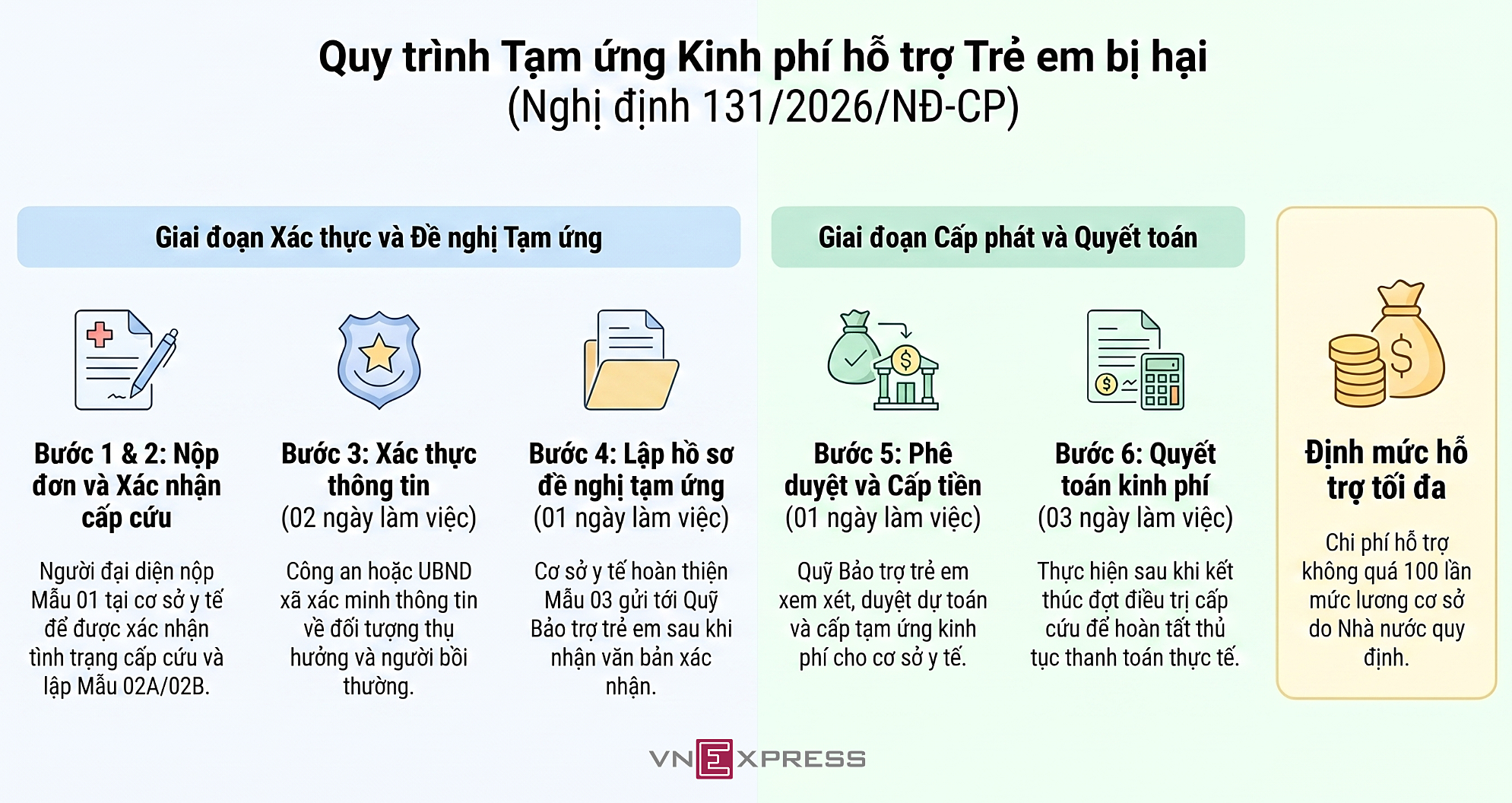
To address this issue, the government issued Decree 131/2026, which details the use of funds from the Child Protection Fund to cover emergency medical examination and treatment costs for children.
Maximum medical support up to 100 times the basic salary
Specifically, the Child Protection Fund will cover costs when two conditions are met: The child is in an emergency, requiring immediate treatment at a medical facility to prevent serious consequences; and the party obligated to compensate cannot provide immediate compensation.
Reasons for the inability to compensate immediately are accepted in one of the following cases: impoverished households; near-poor households; deceased; absconded; or the perpetrator of the crime has not been identified.
The amount provided by the Child Protection Fund will be based on the actual medical examination and treatment costs for the minor victim. However, this fund does not cover on-demand medical services or costs already covered by health insurance (if applicable).
The maximum amount the Fund will pay for one case is no more than 100 times the basic salary, equivalent to 234 million VND.
 |
Children coloring during class at Huoi Da preschool, Nam Ke commune, Dien Bien province. *Photo: Ngoc Thanh* |
Hospitals must provide immediate treatment even if the Fund has not yet paid
A key principle outlined in Decree 131 is that medical facilities must provide emergency treatment to patients immediately, even without an advance payment from the Child Protection Fund.
Although the Fund has made payments, the party obligated to compensate (perpetrator, perpetrator's family, etc.) must reimburse the Fund as soon as they are able.
If the Fund has already settled with the state budget, the party obligated to compensate must reimburse the state budget. Reimbursement can occur during the initiation of criminal proceedings, investigation, prosecution, trial, or from the effective date of the court's judgment.
If this person remains unable to reimburse, or absconds for over 24 months, the state budget will cover this payment.
 |
According to the Law on Juvenile Justice, a minor victim is a person under 18 years old who has directly suffered physical, mental, or property damage caused or threatened by a crime.
Hai Thu


