In villages across central and western Hubei province, the number of single men like Li is growing. When asked about the biggest barrier to marriage, they all share the same answer: money.
In 2014, sociologists estimated China had about 20 million single rural men. A decade later, this number is believed to have increased to 30 million. This group of men, already the most vulnerable in the marriage market, faces unprecedented competition.
The primary challenge for these men is economic pressure, particularly the high cost of a bride price. Liao, 40, lost his first love in the 2000s because he could not meet the bride price requested by the woman's family. The woman agreed to marry, but her family demanded a bride price of about 21,000 USD. At the time, Liao worked as a chef, earning only tens of USD per month, making it impossible for him to comply, which led to the relationship's end.
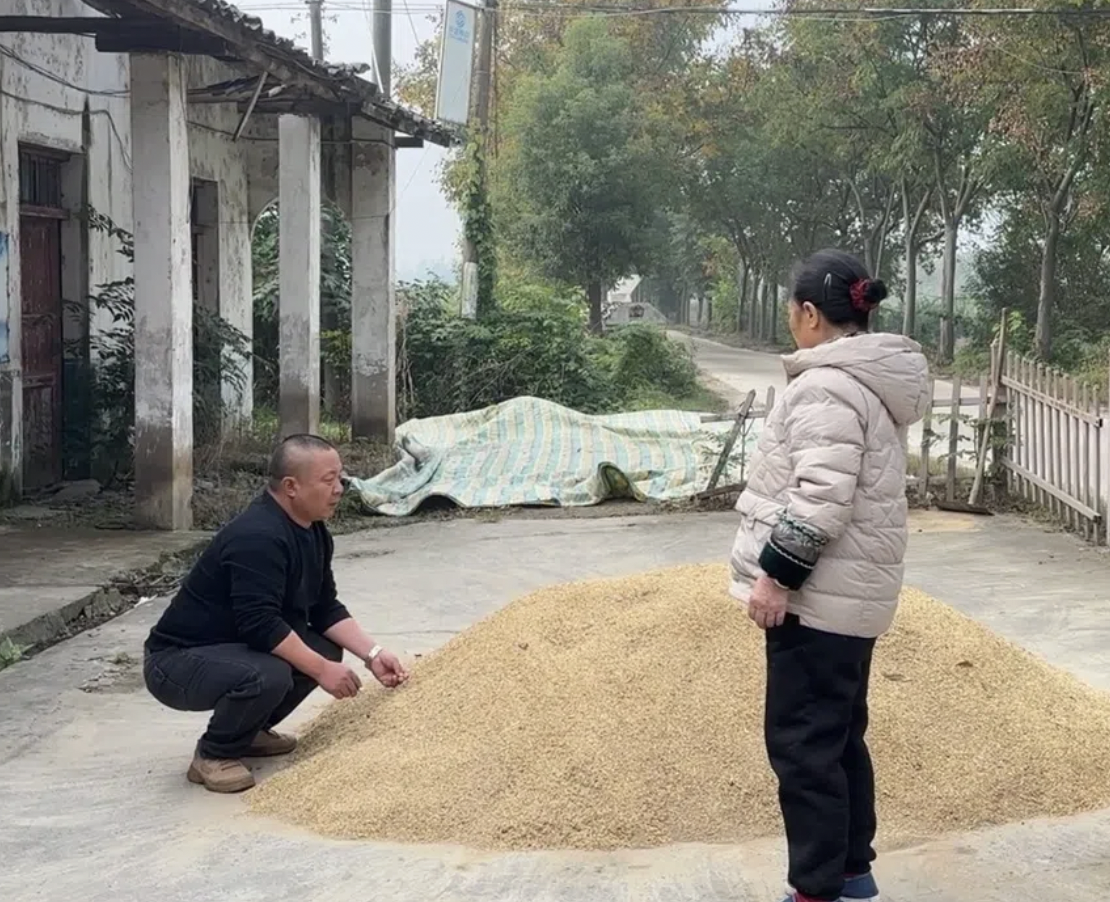 |
Xiong Xiaohong and his mother are drying rice in front of their home in Hubei province, China. Photo: Think China |
Beyond economic pressure, low education and unstable jobs effectively end marriage prospects for rural Chinese men. Xiong Xiaohong, 42, also faces a similar situation, living in the home his parents left him in his hometown. He once earned 3,000 USD per month from business but lost everything due to gambling and imprisonment. Now, working as a construction worker with a worn appearance, he bitterly admits, "Our generation still valued love, but now everything is about money." Yi Chunlei is a prime example of unstable employment. Starting work at 16, Yi has held various jobs, from welder to internet cafe employee to real estate agent, but none lasted long. Zhuang, 35, recently left the city to return to his hometown, working as a maintenance technician with an income of less than 560 USD. Tall and good-looking, he was once set up with a woman with a leg disability. "I had already lowered my standards, but even she paid no attention to me," Zhuang recounted.
 |
Yi Chunlei in Hubei province, China. Photo: Think China |
According to demographer Yi Fuxian, from the University of Wisconsin-Madison, US, gender imbalance is the root cause. After 2000, China's sex ratio at birth increased to 120 boys for every 100 girls. In provinces like Jiangxi, Anhui, and Fujian, the ratio of boys to girls once reached an alarming 160/100, creating "pockets" of bachelorhood crises.
Associate Professor of Sociology Zhan Shaohua, from Nanyang University of Technology, Singapore, notes that women today tend to seek partners with higher status to improve their lives (hypergamy), pushing rural men to the bottom of the marriage market. "Many elderly people in rural areas must continue to work hard just to save money to help their sons get married," he said.
Li Hongxing exemplifies these desperate efforts. Graduating in 1993, he and his family spent 30 years transforming their mud house into a solid concrete home. After paying off the housing loan in 2021, he borrowed another 8,000 USD to buy a car – minimum requirements for matchmaking. By August 2025, Li will have paid off his car loan. With a home and a car, he attempted to get to know two women over 40 in the area. However, in less than a month, both requested that he buy them gold. Unable to afford it, Li decided to stop.
According to Zhan, the shortage of wives in rural areas cannot be quickly resolved. Immediate feasible solutions include reducing urban living and education costs so that workers can stabilize their lives instead of constantly relocating. A legal, transparent, and reasonably priced matchmaking system could also offer more options for those facing difficulties in marriage.
"If you don't have money, it's best not to get involved in romantic relationships," the man in his 40s concluded.
Ngoc Ngan (According to Think China)