On the afternoon of 15/5, at a cafe approximately 30 m2 in size in Mapo district, western Seoul, six female employees wearing revealing outfits continuously invited and served drinks to customers.
"I like wearing unique clothes, so I find this job interesting", said an employee who is also a first-year university student. She stated that most customers are young men, ranging from high school students to those in their 20s.
The "maid cafe" model, where female staff dress as maids and address customers as "masters", was questioned in the South Korean National Assembly last year. Despite criticism, this model has evolved into many new variations.
In Gwanak, Seodaemun, and Mapo districts, many cafes operate with themes such as "animal maids", "gamers", or "sexy cat cafes". Images of employees wearing scanty clothing are constantly posted on social media.
Some establishments adopt a semi-interactive business model. At a cafe in Mapo district, customers who purchase premium alcohol packages receive personalized interaction services with a designated employee. The most expensive alcohol costs 700,000 won (approximately 510 USD).
This cafe sells private service sessions based on spending. A 169,000 won (approximately 123 USD) package offers 30 minutes of scripted conversation, with the employee consistently praising the customer's stories. A 300,000 won (approximately 218 USD) package lasts one hour.
Besides drinks, instant photo services generate significant revenue. For 10,000-20,000 won (7-14 USD), customers can take Polaroid photos with female employees wearing suggestive outfits. Themed photo sets of employees are also sold online.
In South Korea, teenagers are permitted to access these services.
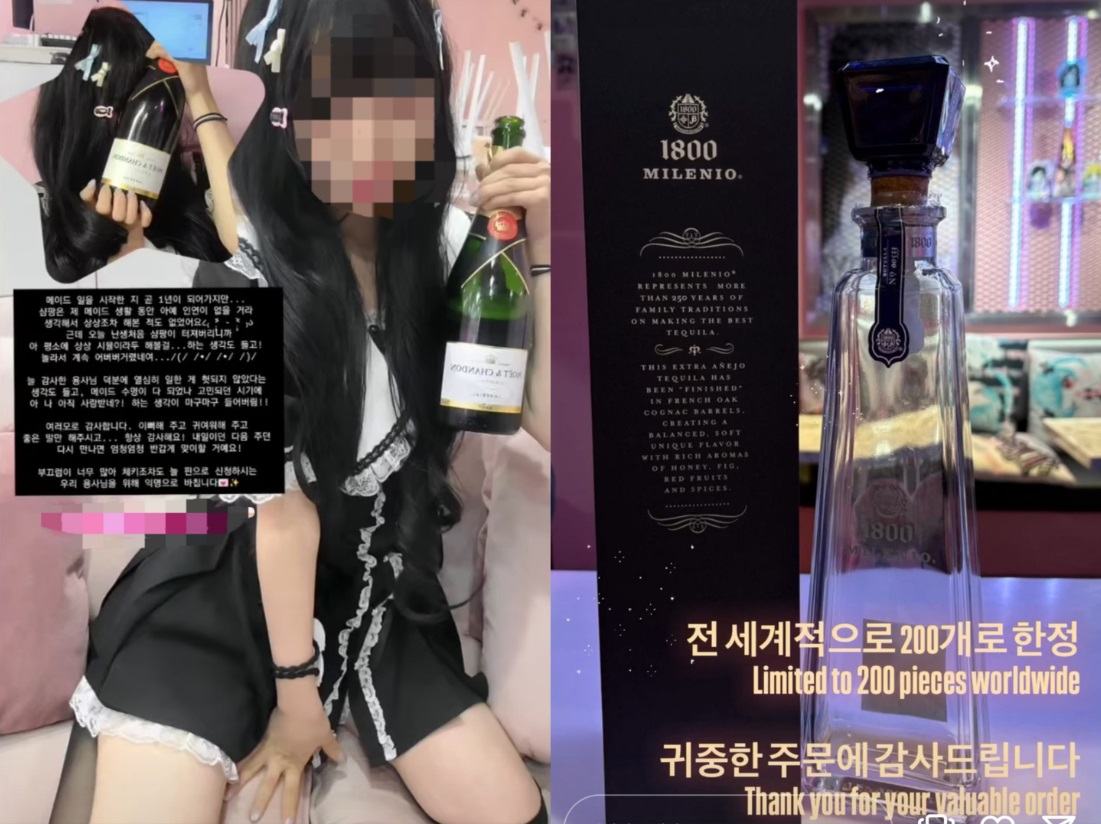 |
A post uploaded to a cafe's social media account congratulates a customer who purchased an expensive champagne package. *Photo: Korea Joongang Daily* |
"I found out about the cafe through social media and tried it with friends. Now I often go alone", said Kim, a high school student present at the cafe in Mapo district. "After finding my favorite employee, I return frequently because talking to her is very enjoyable".
Many customers take photos of employees and post them on social media with comments about their appearance and bodies. Some private groups have been created to share experiences at these themed cafes.
Lawyer Noh Yoon-ho of Attorney in April Law Firm, stated that the problem stems from the mindset that spending money equates to the right to "consume the appearance and emotions" of others. "When people are treated as tools, the risk of sexual offenses increases", he said.
However, local authorities face difficulties in management due to a lack of legal grounds. Most cafes register their businesses under the "general restaurant" category according to the Food Safety and Sanitation Act. Authorities cannot prohibit teenagers from entering or working there. Currently, there are no specific legal criteria to determine the level of suggestiveness of attire in restaurants.
A local government representative stated that in the past, authorities could penalize "enclosed room cafes" for using illegal partitions. However, current themed cafes have an open structure similar to regular cafes.
"We can only intervene if we can prove there is prostitution or the provision of adult entertainment services. The legal boundaries for identifying these acts are currently very strict, making enforcement almost impossible", the representative said.
Heo Min-sook, a researcher at the National Assembly Research Service of South Korea, suggested that the Ministry of Gender Equality and Family promptly amend the business categories that prohibit the employment of underage workers.
"Strong measures need to be applied to activities targeting children, even if the establishment is registered as a general restaurant", he stated.
Nhat Minh (According to Korea Joongang Daily)