Early-life nutrition forms the foundation for a child's long-term development. A child's nutritional needs change with age, physical condition, and developmental stage. This makes selecting nutritional products a decision many parents carefully consider. Beyond ingredients or brand, many families now focus on these key factors:
Suitability for the child's needs
A child's nutritional needs are not static; they evolve through each developmental stage. During the first months, nutrition supports growth, brain development, immunity, and digestion. As children begin weaning, their bodies adapt to new food groups. Later, increased activity, exploration, and learning change their requirements for energy, protein, vitamins, and minerals.
Thus, a suitable nutritional product goes beyond brand or ingredient count; it ensures the nutrients meet the child's specific needs at their current developmental stage.
 |
A child's nutritional needs change with each developmental stage. Photo: Nestle Vietnam |
Backed by research
Beyond suitability, a formula's scientific foundation is crucial. Parents should understand the underlying mechanisms, target needs, and supporting research, rather than focusing solely on ingredient lists.
A deeper understanding of children's nutritional needs is reshaping the infant nutrition industry. Instead of focusing on single nutrients, research now delves into digestive mechanisms, gut microbiota, and the immune system.
Decades of breast milk research have also advanced infant nutrition science. Understanding breast milk's composition and biological functions helps scientists grasp how nutrients collaborate to support early-life growth, digestion, immunity, and development.
Human Milk Oligosaccharides (HMOs), bioactive components in breast milk, and the role of probiotics in gut microbiota are key research areas. Studies increasingly clarify the link between gut microbiota, digestive function, and a child's immunity. This provides nutritional companies a basis for developing formulas better suited to early-life biological needs.
Nestle's Sinergity formula exemplifies this, combining six HMO types with two probiotic strains: B.Infantis and B.Lactis. B.Infantis effectively uses certain HMOs as a growth substrate. Nestle states this combination supports gut microbiota and immune function indicators, demonstrating how scientific discoveries translate into specific nutritional solutions for children.
To drive innovation in infant nutrition, major corporations have invested in research and development for decades. Nestle's LIFE (Longitudinal Infant Growth and Development and Early-Life Feeding) project is a prominent example. It aims to understand breast milk composition through scientific research and collaborates with universities, research institutes, and hospitals globally.
According to Marc Alder, Head of Nutrition and Infant Category at Nestle, understanding breast milk's composition and biological functions is a core research direction. This helps the company expand its knowledge of children's nutritional needs at each stage.
 |
Nestle's Research and Development Center in Konolfingen, Switzerland. Photo: Nestle |
Rigorous quality control processes
Beyond suitability and advancements in nutrition science, quality control processes are crucial for parents selecting infant nutritional products. Safety must be guaranteed at every stage of production.
Experts state product quality requires control from formula research, raw material selection, and production to the final product. This approach ensures batch consistency and safety before products reach consumers.
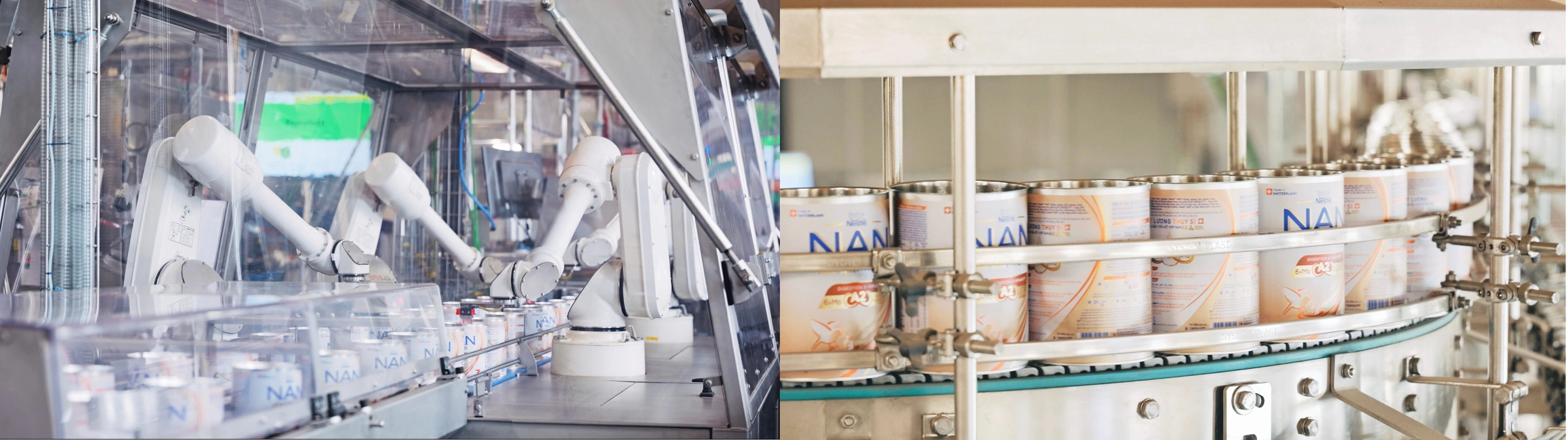 |
A closed production system with quality monitored at every stage. Photo: Nestle Vietnam |
Nestle exemplifies a multi-layered control system. Olivier Robin, Quality Director at Nestle Research and Development Center, states each product batch undergoes over 1,200 quality inspection criteria before shipment. This process integrates a multi-tier control system and production line surveillance to meet technical standards.
Considering these factors, the criteria for choosing children's nutritional products are becoming more comprehensive. Beyond ingredients and brand, parents increasingly prioritize suitability for their child's needs, scientific evidence, and rigorous quality control. This helps Vietnamese parents feel secure when selecting nutritional solutions for their children.
Van Ha