Every afternoon, Ha Minh Tuan in Long Ho, Vinh Long, opens his phone and taps a few times to activate the automated irrigation and fertilization system for his nearly 2-hectare durian orchard. Water and nutrients are distributed to each tree root via the system, completely replacing manual watering, which required more labor and was difficult to control. Over the past two years, this investment has helped him significantly reduce labor costs and improve fruit quality.
Previously, Tuan worked as a teacher in TP HCM. After some time, his family decided to move to Vinh Long and purchased additional land to develop a high-tech agricultural model. Their goal was to increase income and produce clean, safe products for consumers.
In addition to his savings, Tuan borrowed capital from Agribank to purchase equipment, install the automated irrigation system, improve the orchard, and dig fish ponds, gradually establishing an integrated agricultural production model. He also applies off-season flowering techniques for durian, while intercropping rambutan and Podocarpus macrophyllus to optimize land use. According to Tuan, this approach ensures uniform plant growth, reduces material waste, and enhances fruit quality, allowing products to sell at better prices compared to the main season.
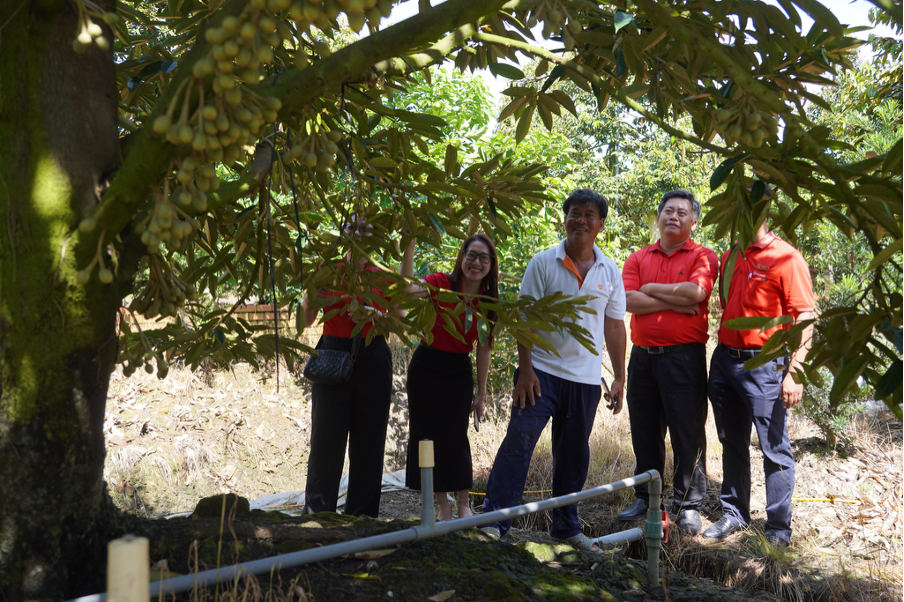 |
Tuan's automated irrigation system delivers water to each plant. Photo: Agribank |
Not far away, in Duc Hoa, Long An, Le Van De's garden stands out with its lush green rows of lettuce grown in modern greenhouses. Instead of working in muddy fields, the vegetables are cultivated hydroponically, without soil contact.
De previously worked as a technical worker in Japan, where the advanced agricultural practices inspired him to return home and start a recirculating hydroponic vegetable farming model. In this system, water pumped to nourish the plants is recovered, its nutrient concentration is measured, and then it is reused. Crucially, sensor systems monitor pH, temperature, and water environment, ensuring uniform vegetable growth and minimizing pests without harmful pesticides, thereby reducing environmental emissions.
"I have a technical background, so I believe in numbers and machinery. Everything must be measurable and calculable to easily control risks. I believe that if done properly, Vietnamese agricultural products can compete internationally," De shared. Currently, with five greenhouses, his farm harvests 50-70 kg of vegetables daily, meeting VietGAP standards and aiming for GlobalGAP.
However, De noted that the biggest barrier to high-tech agriculture is the initial investment cost. To invest in the greenhouse system, nutrient equipment, and automated pumps, he spent approximately 600 million VND, partly financed by a loan from Agribank. He believes that quick and stable access to capital is essential for farmers to confidently invest in technology.
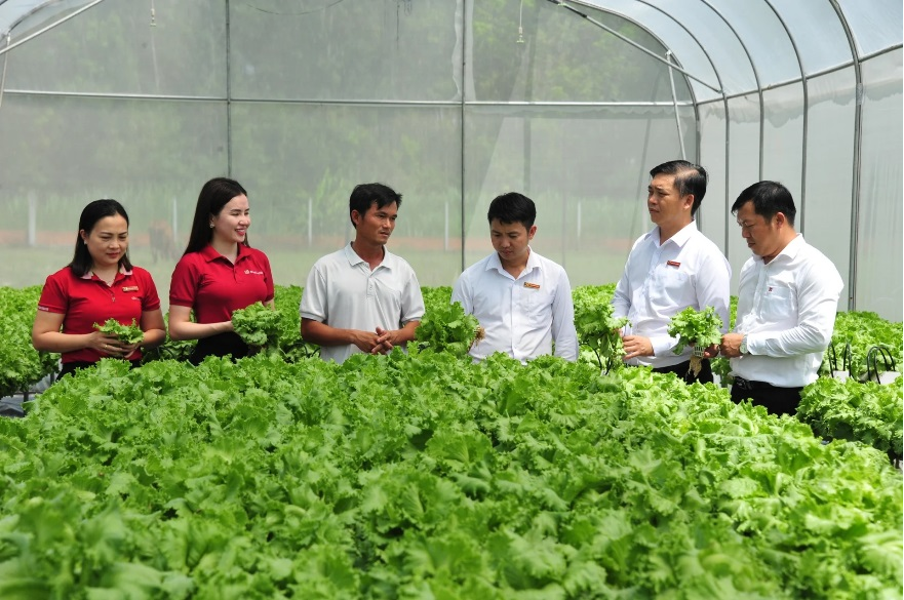 |
Agribank officers visit Le Van De's hydroponic vegetable farming model. Photo: Agribank |
On a larger scale, the wave of high-tech agriculture is transforming the Mekong Delta's rice bowl. In Can Tho, Tien Thuan Cooperative, led by Director Nguyen Cao Khai, is proactively participating in the "Sustainable Development of 1 Million Hectares of High-Quality, Low-Emission Rice" project.
Across the 132-hectare field, modern mechanized machines handle everything from sowing to harvesting, replacing manual labor. Cluster sowing technology combined with fertilizer burial helps reduce rice seed usage by two-thirds. Fertilizer loss due to evaporation or runoff is prevented, and the amount of pesticides used is significantly decreased.
"This model offers multiple benefits. Input costs are reduced, rice yields increase, and most importantly, it completely changes environmentally harmful farming practices," Khai stated enthusiastically.
Khai explained that to transition to this new farming method, more than 10 cooperative members borrowed over 6 billion VND from Agribank at below-market interest rates. This enabled them to invest confidently and fully mechanize their production process.
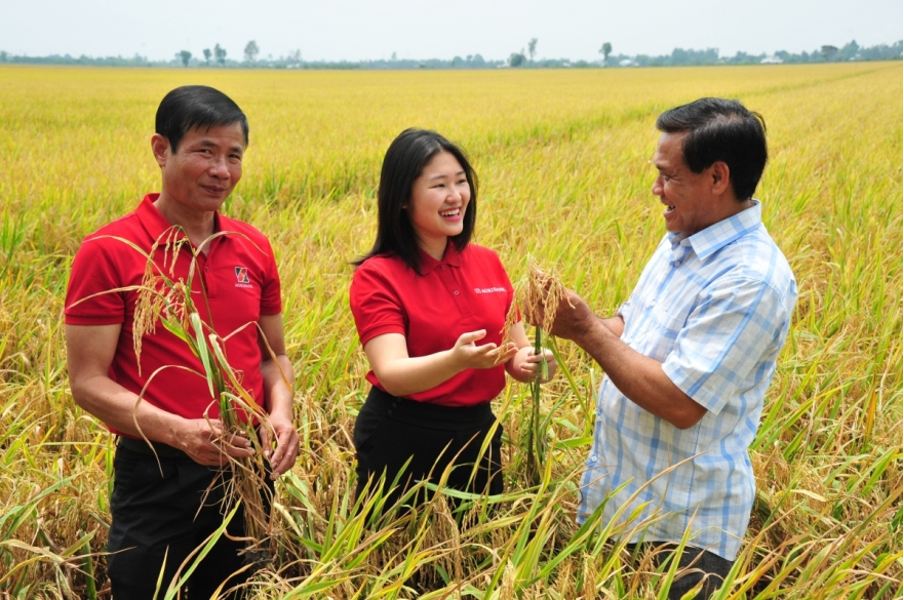 |
Nguyen Cao Khai shows Agribank officers around Tien Thuan Cooperative's rice field. Photo: Agribank |
The stories of De, Tuan, and Tien Thuan Cooperative represent a glimpse into the broader high-tech agricultural landscape Agribank is fostering. Recognizing clean agriculture as an essential trend for food security and enhancing the standing of Vietnamese agricultural products, Agribank has dedicated significant resources to this sector for many years.
According to an Agribank representative, the bank consistently allocates more than 65% of its total credit outstanding to "Tam nong" (agriculture, farmers, and rural areas). Notably, since 2016, the bank has implemented a preferential credit program worth 50 trillion VND to support clean agriculture, extending it to businesses, cooperatives, and farm owners, with interest rates reduced by 0.5% to 1.5% per year compared to standard rates.
To date, Agribank's lending turnover for high-tech agriculture has exceeded 25 trillion VND, accounting for 50% of the total investment capital in this sector, with outstanding loans reaching over 2 trillion VND. Improvements in the bank's appraisal and disbursement processes are likened to "clearing the flow," enabling bold agricultural ideas to germinate and flourish.
In the context of deep international integration, the combination of technology and financial leverage has empowered farmers to transform, take control of their processes, enhance the value of agricultural products, and move towards sustainable development.
Minh Ngoc