Vietnamese music was completely unfamiliar to Darren Stoker, 37, from England, just two months ago. Now, his phone's playlist is filled with remixes like "Canh hoa heo tan" and "Mua dong khong lanh". Darren is drawn to the interesting contrast: vibrant, catchy melodies with deeply narrative lyrics.
"My social media is full of international tourists dancing to these songs in Vietnam. That made me want to 'catch the trend' immediately," he said.
Darren Stoker, 37, living in Preston, England (first video) and some foreigners catching the trend of singing and dancing to Vietnamese music. *Video: TikTok/@amelieanddaddy*
Darren noted that in the West, dance music and love songs often have distinct boundaries. Modern Vietnamese music, however, transforms profound sadness into energetic dance. To better understand his favorite songs, the 37-year-old began self-studying Vietnamese and plans to visit Ha Noi and TP HCM later this year.
Not just Darren, TK Ndlovu, 33, from South Africa, also found a connection. A former choir member, Ndlovu spent nearly one month learning Vietnamese pronunciation and singing to perform songs like "Vung la me bay" and "Thiep hong sai ten". She doesn't lip-sync but covers them herself, set to Rumba or Bolero rhythms, which share similarities with traditional African music.
"I had to look up the meaning of every word to fully express the emotions," Ndlovu said. Her video singing Vietnamese music with poignant expressions garnered over 10 million views on TikTok.
Darren and Ndlovu are two of hundreds of thousands of international accounts swept up in the "Vietnamese music remix" wave. On digital platforms, old ballads and bolero songs, when given vibrant remixed or sped-up treatments, have attracted billions of views. For example, snippets from "Canh hoa heo tan" or "Dung hoi em on khong" remixes have tens of millions of uses as background music on TikTok and Douyin, far surpassing the original versions' reach.
Vietnamese music is trending globally. In 2025 alone, over 20 Vietnamese remix songs achieved millions of daily interactions from international users.
TK Ndlovu, 33, from South Africa, sings Vietnamese love songs. *Video: Tiktok/@tkndlovu.sings*
Explaining this appeal, The Phuong VBK, Director of VBK Music production company, stated that ballad music is a popular staple in Vietnam. In the era of social media, which favors quick connections, a short music segment combined with an easy-to-remember dance has helped melancholic love songs from previous decades revive and become global hits. This trend offers an opportunity for traditional music to reach a young international audience.
Nguyen Tien Dat, Vice Chairman of the Ha Noi Tourism Association, believes social media is becoming an effective "tourism ambassador". Tourism's recent success owes a significant contribution to songs with viral dances on TikTok and authentic review videos of culture, landscapes, and cuisine. "When a Vietnamese melody captivates listeners, it creates an invisible impulse, making international visitors want to come and experience firsthand the land that produced those energetic sounds," Dat said.
According to him, the combination of music with tourist check-in photos at famous landmarks like Ha Noi Old Quarter or Hoi An has created a ripple effect. These "addictive" melodies have paved the way, bringing the image of a modern, youthful, and culturally rich Vietnam closer to friends worldwide.
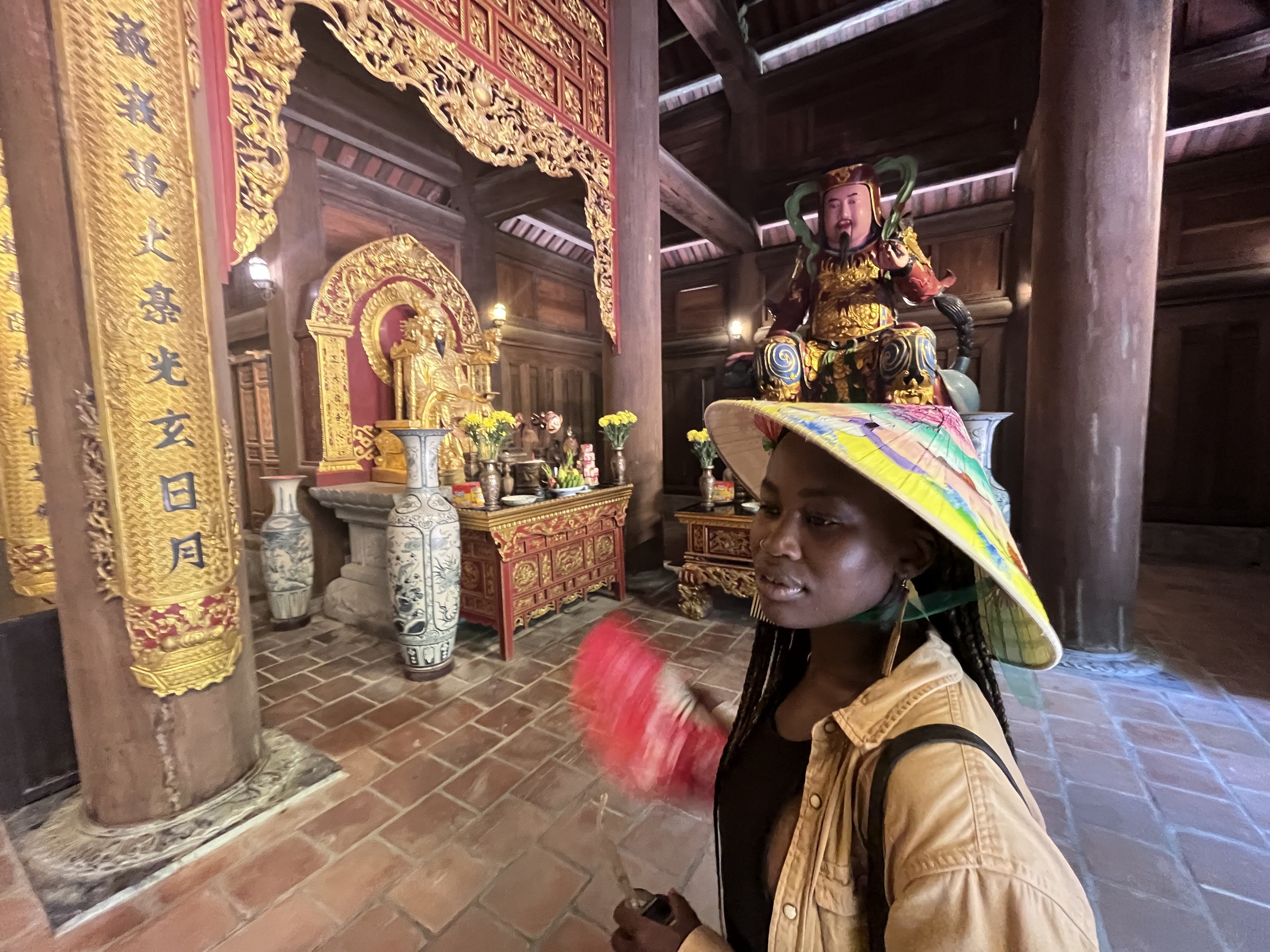 |
TK Ndlovu (33, from South Africa) visits one temple in TP HCM, 2026. *Photo: Provided by subject*
From the perspective of Kyo York, an American singer with 15 years of experience with Vietnamese music, this appeal stems from the blend of new and old. He noted that many Vietnamese songs possess a characteristic melancholic quality, which, when refreshed, creates an alluring charm: just novel enough to spark foreign curiosity, and profound enough to keep them engaged.
"The initial curiosity comes from the vibrant rhythms, but what truly keeps international listeners engaged is the soul behind the lyrics. I am very happy to see young foreigners willing to learn Vietnamese to sing Vietnamese music. That is the first step towards cultural empathy," Kyo York said.
Kyo York sings "Nho mua thu Ha Noi".
Nga Thanh