After years as a civil servant, Wangmo, 35, decided to settle in Canberra, Australia. "I had everything I needed in Bhutan, but I still left because I felt increasingly stagnant and wasted," Wangmo said. She cited a hierarchical work environment, few opportunities for advancement, and reliance on personal connections as reasons for her resignation.
Bhutan is often known as "the world's happiest country" because it uses the Gross National Happiness (GNH) index as a measure of development, rather than solely Gross Domestic Product (GDP). This concept, initiated in the 1970s, assesses quality of life based on nine criteria: living standards, health, education, environment, community, time use, psychological well-being, governance, and culture.
Despite this, a 2022 GNH survey revealed that only 48% of Bhutanese aged 15 and above were categorized as "happy." The remaining 52% of the population fell into the "unhappy" group due to a lack of basic conditions. The 2019 World Happiness Report also ranked Bhutan 95th out of 156 countries for this index.
Bhutan is facing a significant brain drain. Many young graduates and professionals are leaving the country not due to unemployment, but because they have lost faith in domestic development prospects. A World Bank report indicates that approximately 53% of highly skilled Bhutanese and university-educated civil servants tend to emigrate, compared to a 7% rate for general laborers. Currently, over 65,000 Bhutanese live abroad, which is equivalent to 9% of the population.
Data from the Royal Civil Service Commission of Bhutan shows that from 2023 to 2025, approximately 1,500 civil servants resigned. The largest group of resignations was among those aged 27-35, primarily in information technology, nursing, and engineering. Nearly 10% of staff resigned in their first year, and 32% left early in their careers.
Australia stands out as the primary destination. In the first six months of the financial year 2025-2026, Australia granted visas to over 5,900 Bhutanese. Many Bhutanese international students are transitioning to vocational trades such as carpentry, tiling, and welding to enhance their job prospects and ease settlement.
Latso, a Bhutanese woman with family living in Australia, stated that she renounced her Bhutanese citizenship early last year to become an Australian citizen, as Bhutan does not permit dual citizenship.
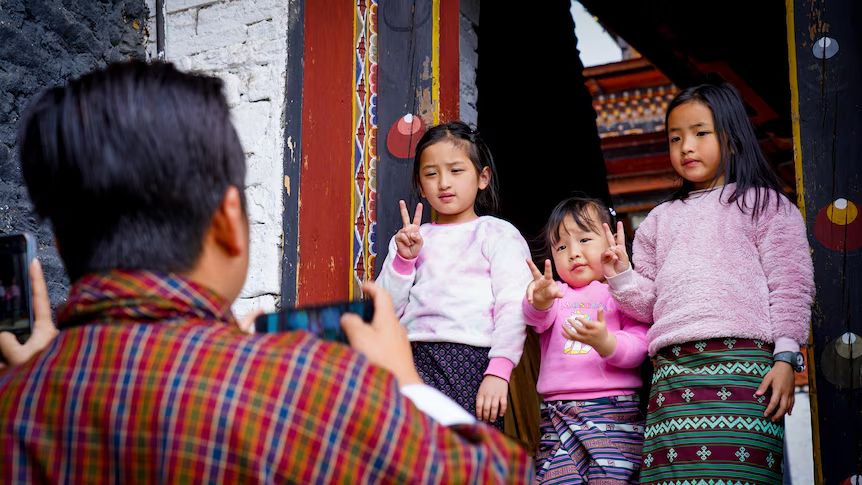 |
A Bhutanese family poses in front of their home, 2025. Photo: ABC News |
The domestic situation is increasingly challenging for young people. Low wages, combined with pressure from housing and living costs, make it difficult for them to save or build a stable life. Many reside with their parents until age 30 because they lack the financial means to live independently. This migration wave to Australia also makes it hard for private businesses in Bhutan to recruit and retain staff. Many low-wage positions struggle to maintain long-term employees due to stagnant incomes over several years.
Since 2023, Bhutan has implemented programs to encourage citizens to return, but their effectiveness remains limited. By 5/2025, only 170 people had returned. The program recorded 570 registrations in the financial year 2024-2025 and an additional 53 registrations in the financial year 2025-2026.
Thinley Wangchuk, currently living in Australia, noted that many hesitate to return due to limited job opportunities and inadequate salaries.
While causing a labor shortage, the migration wave brings substantial foreign exchange. In 2025, remittances sent to Bhutan reached USD 342,9 million, more than double the USD 164,4 million recorded in 2024. Of this, remittances from Australia accounted for the majority, at USD 253,3 million.
Ngoc Ngan (According to ABC News, Kuensel)