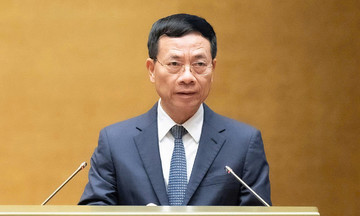
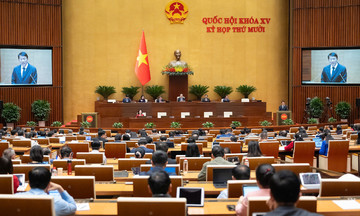
On the morning of 25/11, Minister of Education and Training Nguyen Kim Son, authorized by the Prime Minister, presented to the National Assembly the investment policy for the National Target Program for modernizing and improving education and training quality for the 2026-2035 period. This initiative institutionalizes major Party policies, especially Resolution 71 of 2025, which calls for a new national target program for education to establish a long-term foundation for high-quality human resource development.
According to Minister Nguyen Kim Son, education has achieved significant results recently but lacks the breakthroughs needed to meet the country's rapid, sustainable development requirements. Educational infrastructure remains uneven across regions; preschools lack teachers and sturdy classrooms. Teaching equipment and subject-specific classrooms in general education meet only about one-half of the demand. Universities and vocational education institutions also face shortages in infrastructure, laboratories, and research centers, which are essential for training personnel in strategic fields such as semiconductors, artificial intelligence, high-speed rail, and nuclear power.
The government proposes implementing the program over 10 years with total resources estimated at approximately 580,133 billion VND. This includes over 349,000 billion VND from the central budget, more than 115,000 billion VND from local budgets, over 89,000 billion VND in counterpart funds from universities and vocational training institutions, and the remainder from other legal capital mobilization. For the 2026-2030 phase, at least 174,673 billion VND will be allocated, with approximately 405,460 billion VND designated for the 2031-2035 phase.
The program comprises 5 component projects: ensuring infrastructure for preschool and general education; modernizing vocational education, establishing 6 national and 12 regional high-skill training centers; strengthening technical infrastructure for key universities; developing teachers, management staff, and learners in the context of digital transformation; and inspecting, monitoring, and evaluating program implementation. The government considers these crucial components for building foundational capacity and improving educational quality across all three levels.
 |
Minister of Education and Training Nguyen Kim Son presents to the National Assembly the investment policy for the National Target Program for modernizing and improving education and training quality for the 2026-2035 period. Photo: Hoang Phong |
By 2030, the program aims to standardize the preschool and general education systems, ensuring 100% of classrooms are robust. It also seeks to complete a network of boarding schools and public housing in disadvantaged areas. At least 30% of general education schools should have sufficient STEM/STEAM teaching equipment for English-medium instruction. Vocational education strives to establish 18 high-quality schools. Higher education targets at least 8 institutions ranking among Asia's top 200 universities, with at least one university entering the world's top 100 in specific fields.
Additionally, the program aims for 95% of teachers and 70% of students to receive digital competency training. At least 30% of educational institutions will effectively apply digital technology and artificial intelligence in management, teaching, and innovation. English will gradually become a second language, with 30% of general education schools having teachers proficient enough to teach science subjects in English, and 100% of key pedagogical universities capable of training these teachers.
By 2035, all preschool and general education institutions must meet infrastructure standards and possess sufficient equipment to implement English as a second language instruction. The vocational education network aims for 60 high-quality colleges to reach ASEAN-4 standards and 6 institutions to achieve G20 group levels. All planned public universities will meet infrastructure standards and establish innovation centers at key institutions.
The Cultural and Social Committee endorsed the program's necessity but advised the government to review it to avoid overlaps with other national target programs. They also requested clarification on the basis for determining the counterpart funding ratios from local authorities and universities, as the proposed amounts are currently high.
The committee further urged the government to thoroughly assess the feasibility of the goal to make English a second language, considering existing disparities in teacher resources, equipment, and infrastructure across regions. Additionally, the drafting committee should include specific targets for the number of individuals sent for overseas training using state funds. They also recommended reviewing regulations related to adjusting unspent capital across years to ensure compliance with the Law on State Budget, while simultaneously improving institutional frameworks and incorporating the content into the annual law-making program.
The National Assembly will discuss this content in groups on the morning of 25/11, followed by a plenary discussion on 2/12, and a vote for approval on 11/12.
Son Ha