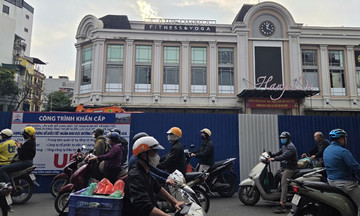
At 7 am, the air quality monitoring system of the Department of Environment (Ministry of Agriculture and Environment) showed four monitoring stations at a very poor level. The most severe pollution was on Hung Vuong street, Phan Dinh Phung ward, Thai Nguyen province, with an air quality index (AQI) of 275, equivalent to a very poor level. Earlier, at 3 am, the pollution index at this station reached 365 – a hazardous level.
Thai Nguyen also recorded a high pollution index of 223 in Quan Trieu ward.
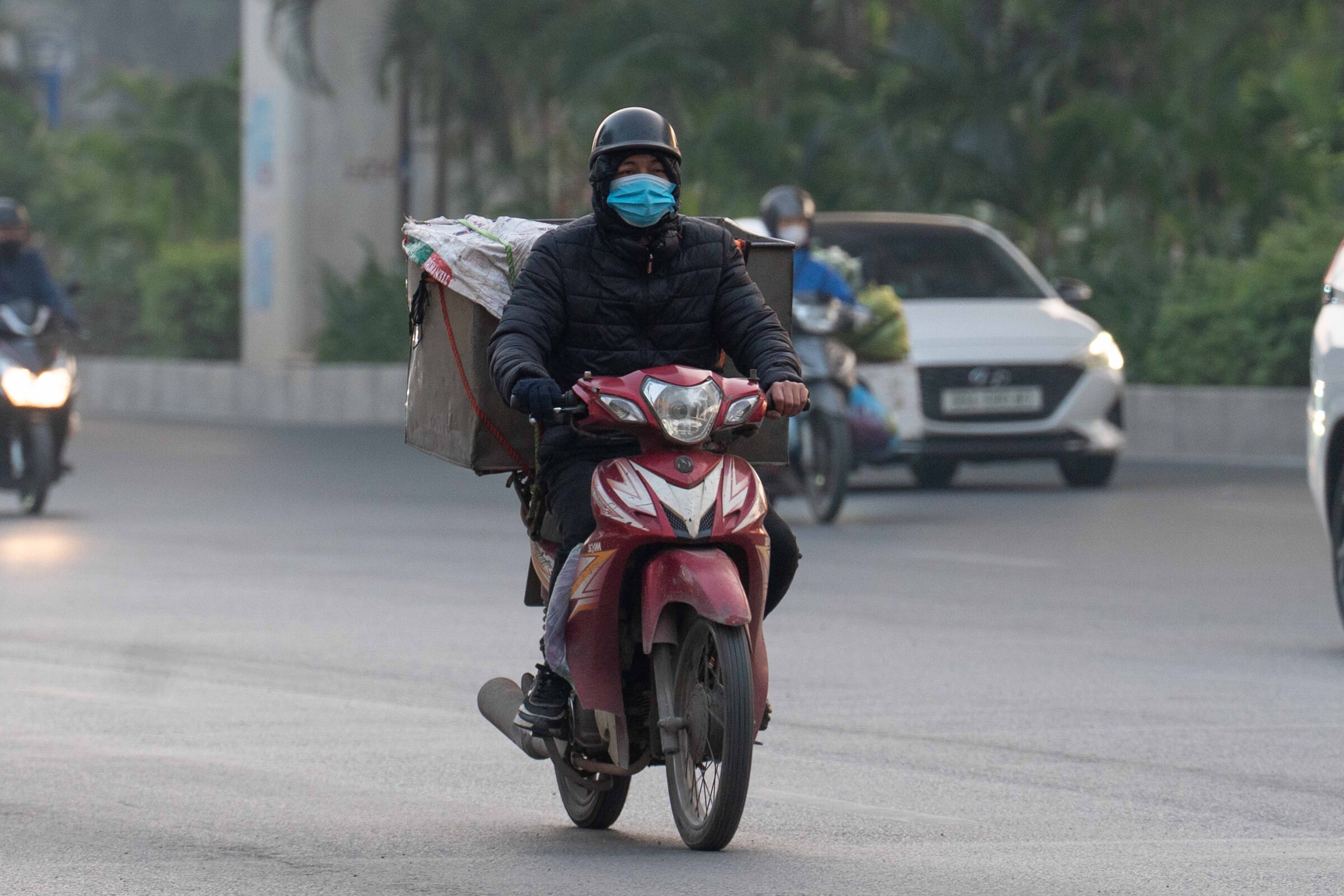 |
Air pollution on 29/11/2025 on Nguyen Trai street, Thanh Xuan ward. *Photo: Hoang Giang* |
Air pollution was also recorded at Nam Cao park (formerly Phu Ly), Ninh Binh province, with an AQI of 224. On Nguyen Van Linh street, Hung Yen province, the AQI was 223.
In Hanoi, on the morning of Tet day, traffic on the roads was sparse, but all three monitoring stations reported poor air quality. The station at the gate of Hanoi University of Science and Technology, Giai Phong street, showed an AQI of 197; Nguyen Van Cu station 171; and Nhan Chinh park station, Khuat Duy Tien street, 168.
Data from the IQAir system indicated that on the morning of 17/2, Hanoi ranked 4th globally for air pollution with an index of 179. Delhi, India, topped the list with an AQI of 260, followed by Lahore, Pakistan, at 223, and Kolkata, India, at 208. Within Hanoi, the Tay Ho station recorded an AQI of 223.
The air quality index (AQI) indicates pollution levels and their impact on human health; a higher index signifies a greater risk. According to authorities, current air pollution is primarily caused by PM2.5 fine dust.
The Department of Environment forecasts that air quality will improve to a moderate level from noon today as cold air moves into the Northern region.
Gia Chinh