General Director Duong Quang Minh announced at a press conference on the afternoon of 1/12 that the opening ceremony on the evening of 26/12 will be the main highlight of the week-long program. The stage, built entirely on water, will be the largest ever in the western region. There, 350 actors will reenact the history of land reclamation and the riverine culture of residents in Can Tho and the Mekong Delta.
During the opening night, organizers will present a pyrotechnic display and nine rounds of fireworks along a 2 km stretch of the river, from Can Tho bridge to Ninh Kieu wharf. Additionally, 1,000 drones will perform two times for 15 minutes, forming cultural symbols and folk songs of the western region.
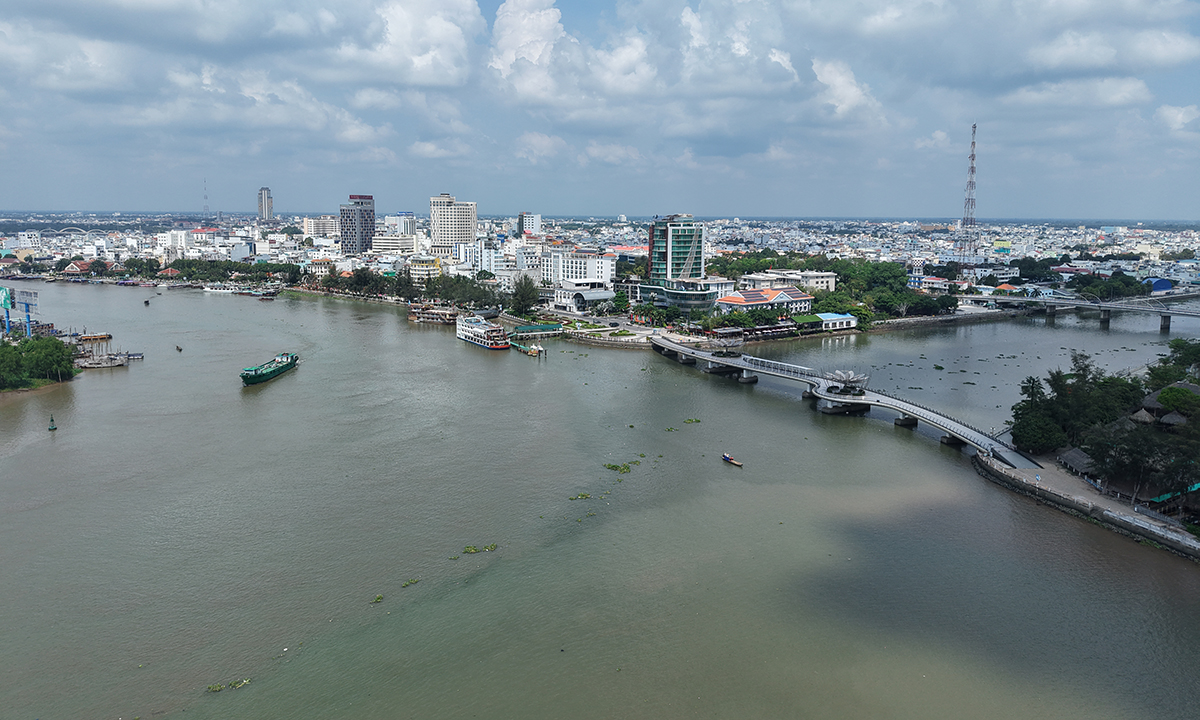 |
The Can Tho River at Ninh Kieu wharf was chosen as the main stage for the festival. *An Binh* |
Six barges, tugboats, and approximately 100 smaller boats will participate in the festival. The largest barge, measuring 20 m wide, 85 m long, and with a 3,600-ton capacity, will serve as the main stage, while another barge will be used for backstage operations. The boats will parade, reenacting the atmosphere of famous floating markets such as Cai Rang, Nga Bay, and Nga Nam.
Throughout the festival, Ninh Kieu wharf, Hau River park, and surrounding areas will host numerous activities: nightly art performances, a photo exhibition titled "Life on the River - Western Region Past and Present", sailing races, SUP races, a culinary and specialty product zone, and local tourism promotion.
Nguyen Thi Ngoc Diep, Vice Chairman of Can Tho City People's Committee, stated that the festival aims to promote the city's image as a "Mekong river tourism center". It seeks to attract domestic and international visitors, boost local services, cuisine, and accommodation, and establish the event as a large-scale annual activity.
After merging with Hau Giang and Soc Trang, Can Tho now spans 6,360 square kilometers with a population of approximately 4,2 million people. Over the past ten months, the city welcomed nearly 10 million visitors, generating tourism revenue of nearly 8,700 billion VND, representing increases of nearly 26% and 25% respectively compared to the same period last year.
An Binh