The bridge construction over the Truong Giang river, part of the Da Nang City Integrated Adaptive Development Project, involves an investment exceeding 2.720 billion VND. Funded by Official Development Assistance (ODA), which accounts for 67.53% of the total, and reciprocal budget, the project is slated for completion by 2031. This initiative spans across the communes and wards of Duy Nghia, Thang An, Thang Truong, Ban Thach, Quang Phu, Tam Xuan, Tam Anh, and Tam Hai.
The comprehensive plan outlines the construction of six new bridges and the reconstruction of one rural bridge. The new bridges include: Binh Duong bridge (0.92 km long), Hung My bridge (2.6 km long), Binh Nam bridge (2.24 km long), Tinh Thuy bridge (1.7 km long), Tam Thanh bridge (1.70 km long), and Tam Tien bridge (0.85 km long). Additionally, the Tam Tien rural bridge, measuring 0.28 km, will be rebuilt. Each bridge will feature a width of 30 m and a height of 6 m.
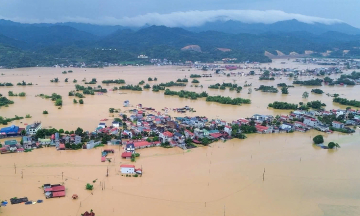
Beyond the bridge infrastructure, the project also encompasses significant waterway and flood control initiatives. It involves dredging 60 km of the Truong Giang inland waterway, from Cua Dai to Cua Lo, to enable navigation for vessels with a capacity of 100 tons, coupled with riverbank erosion protection. Additionally, a flood drainage complex will be built to mitigate inundation. This complex comprises the A3 canal, stretching 2.38 km with a 50 m wide bottom, connecting Song Dam lake to the Truong Giang river, alongside a system of regulating sluices and boat locks.
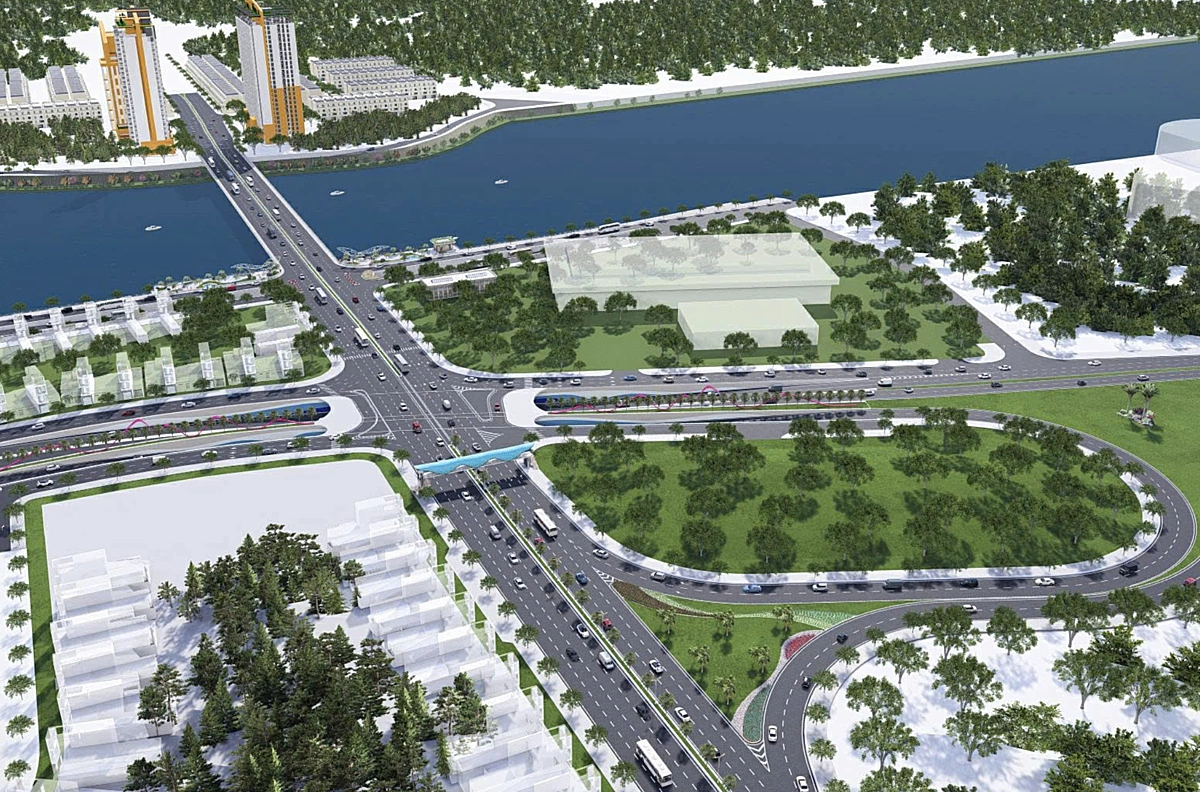 |
Perspective of the Hoa Xuan bridge area interchange. |
Concurrently, Da Nang launched the Le Thanh Nghi - Cach Mang Thang Tam - Thang Long Interchange Cluster Project, targeting critical traffic improvements. This project will utilize the existing Hoa Xuan bridge while adding a new link bridge downstream. Costing over 1.570 billion VND, the 730-day construction aims to resolve traffic bottlenecks in the city's southern central area.
During the groundbreaking ceremony, Nguyen Manh Hung, Chairman of Da Nang City People's Committee, highlighted the dual projects' strategic importance. He stated that these infrastructure developments fulfill three core requirements: connectivity to expand development space, adaptability to ensure sustainable development, and safety to protect the lives of residents.
Chairman Hung issued a clear directive to all participating entities regarding project execution. He urged them to strictly oversee progress and quality, while ensuring labor safety and environmental hygiene. "Once started, it must be implemented immediately; once committed, it must be fulfilled; once fulfilled, there must be concrete products and efficiency," Mr. Hung emphasized.