On the morning of 1/10, General Secretary and President To Lam worked with the Central Policy and Strategy Committee on leveraging the power of academies and research institutes in strategic advisory, emphasizing flexible methods for mobilizing talent.
The General Secretary and President observed that the nation possesses substantial research potential, yet it lacks a unified structure to harness this strength. The two academies, institutes under ministries and sectors, universities, businesses, and both domestic and international experts each have distinct strengths. The Central Policy and Strategy Committee must connect these resources with the Central Committee's advisory requirements.
It is crucial to correctly identify problems, mobilize the right individuals early, and integrate research findings into policy decisions at the opportune moment. The objective is to establish a sufficiently robust research, forecasting, and strategic advisory capacity for the Central Committee.
He stated that agencies could utilize interdisciplinary research groups, rapid response teams, part-time experts, temporary secondments, and facilitate personnel exchange between advisory bodies and research institutions. Specific assignments should connect overseas Vietnamese experts and international specialists. Young scientists also need bold assignments, empowerment, and initial support. Expanding cooperation must align with the requirement to protect data, secrets, and national interests.
The Central Policy and Strategy Committee is responsible for identifying issues, setting research requirements, integrating arguments, and developing advisory options. The two academies serve as scientific knowledge pillars, tasked with in-depth research, providing data, forecasts, critiques, and proactively warning of new issues, rather than waiting for specific requests.
Specifically, the Vietnam Academy of Science and Technology should leverage its strengths in natural sciences and technology, while the Vietnam Academy of Social Sciences should utilize its expertise in institutions, development models, culture, and human factors. Major challenges should involve both academies from the outset.
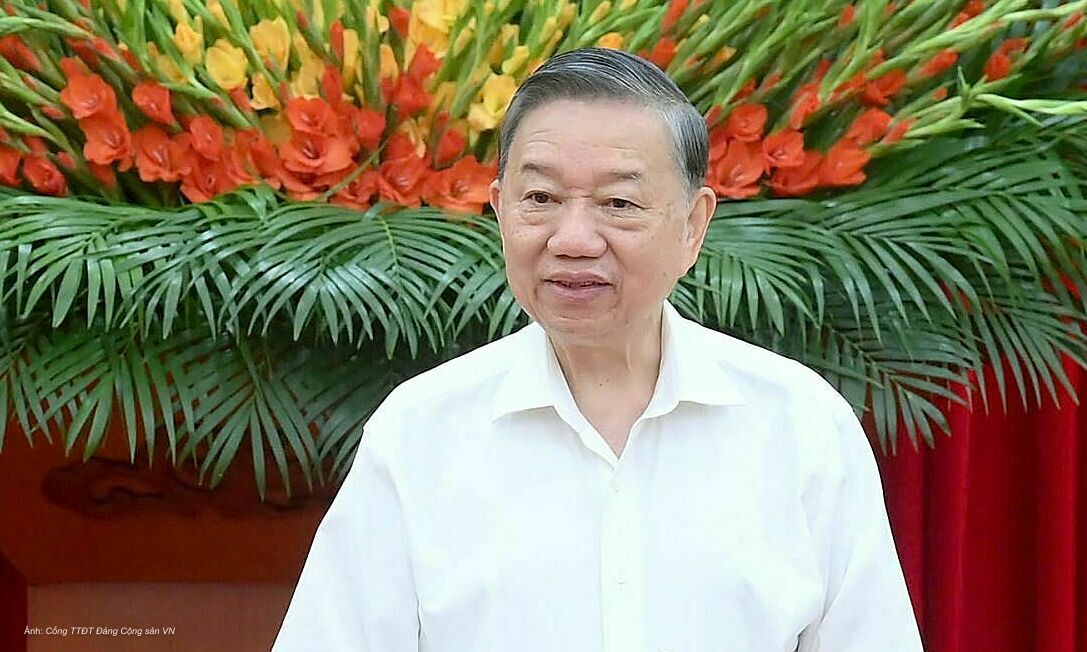 |
General Secretary and President To Lam speaking on the morning of 1/10. *Photo: Portal of the Communist Party of Vietnam* |
Party and State leaders requested that forces be organized according to each strategic issue, recognizing that a major national problem cannot be compartmentalized by institutional or scientific discipline boundaries. Depending on the task, strong teams from the two academies, institutes under ministries and sectors, universities, businesses, and leading experts need to be assembled, with clear designation of the lead, coordination responsibilities, and expected deliverables.
Research assignments require clarity and respect for scientific independence. The Central Committee and the Central Policy and Strategy Committee define the questions to be answered, deadlines, and product requirements, but do not predetermine conclusions.
For major projects, scientists need to participate from the proposal development stage. Issues with multiple perspectives can be assigned to parallel research groups, with independent reviews organized and all differing opinions fully documented. Scientists should have access to necessary information, while also ensuring confidentiality, scientific integrity, and taking responsibility for their recommendations.
The General Secretary and President also called for developing both long-term research capabilities and rapid response capacity. Agencies must study trends over the next 10-20 years, while also being able to mobilize experts promptly when new developments emerge.
The General Secretary and President also mandated a change in how research effectiveness is evaluated. The volume of reports or number of projects is not a complete measure of advisory quality. More importantly, research should help in early problem detection, understanding root causes, selecting policies, and resolving practical difficulties.
According to him, contributions to policy decisions must serve as the primary metric. Each research product should clearly outline the issues requiring decisions, available options, benefits, costs, risks, implementation conditions, and any remaining uncertainties.
The Central Policy and Strategy Committee must provide feedback on the extent to which research results are utilized and monitor their practical value after policies are issued. The contributions of scientists need to be recognized in funding allocation, evaluations, appointments, and awards for personnel.
"Ultimately, each task must answer: what practical problem it solves, what it contributes to understanding, and what value it brings to the nation," the General Secretary and President demanded.
Vu Tuan