The Hai Phong City People's Committee has asked the Ministry of Construction, the Vietnam Road Administration, and the Vietnam Infrastructure Development and Financial Investment Corporation (VIDIFI) to study methods for encouraging trailers and semi-trailers to use the Hanoi - Hai Phong expressway.
Hai Phong City Police also sent a document to the Vietnam Road Administration and VIDIFI, proposing solutions to improve the operational efficiency of the Hanoi - Hai Phong expressway for heavy trucks and container vehicles.
One identified reason is the high toll cost for heavy trucks and container vehicles on the expressway. Therefore, Hai Phong City Police suggested exploring a reduction in tolls for vehicle class 4 (trucks from 10 to under 18 tons, 20-foot container trucks) and vehicle class 5 (trucks 18 tons and above, 40-foot container trucks) using the Hanoi - Hai Phong expressway.
Currently, the full-route toll for the Hanoi - Hai Phong expressway ranges from 221,000 to 870,000 dong, depending on the vehicle group. Specifically, vehicle class 4 pays 675,000 dong per trip, and vehicle class 5 pays 870,000 dong per trip.
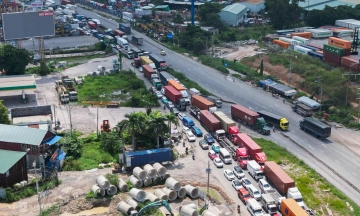
According to Hai Phong City Police, the area at the end of National Route 5 and the Hanoi - Hai Phong expressway hosts numerous large seaports and dozens of inland waterways ports. Thousands of container trucks enter and exit daily to facilitate import and export activities. However, most vehicles opt for National Route 5 instead of the Hanoi - Hai Phong expressway, despite the expressway interchanges to the ports being considered quite convenient.
The Hai Phong City People's Committee stated that cargo transportation activities through the city's seaport system are currently concentrated on three routes: National Route 5, the National Route 10 - Nguyen Truong To - Bui Vien axis, and the Hanoi - Hai Phong expressway.
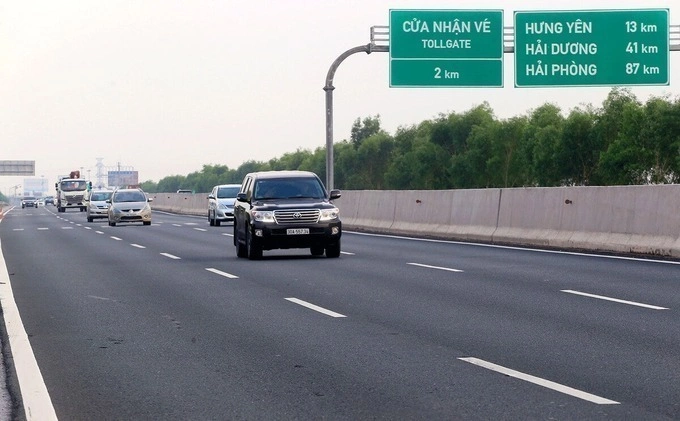 |
Hanoi - Hai Phong expressway. *Photo: Phuong Son*
On the National Route 10 - Nguyen Truong To - Bui Vien axis, the city is simultaneously implementing 4 transport infrastructure projects. Vehicle traffic on this axis is currently very high, averaging about 15,110 automobiles per day, including approximately 5,000 trailers and semi-trailers.
Heavy traffic frequently causes congestion on this route, posing potential traffic safety risks and impacting construction organization and the completion progress of ongoing transport projects.
National Route 5 also faces significant vehicle pressure. This route currently handles approximately 35,180 automobiles daily, including as many as 14,493 trailers and semi-trailers. The actual traffic volume has exceeded its design capacity, leading to frequent congestion in certain areas.
Meanwhile, data from the final toll station of the Hanoi - Hai Phong expressway during the first 6 months of 2026 shows that trailers and semi-trailers accounted for only about 6% of the total automobiles in circulation.
The Hanoi - Hai Phong expressway, approximately 105,5 km long, was developed under a build-operate-transfer (BOT) model, with VIDIFI as the investor. The entire route became operational in late 2015, featuring 6 lanes, two emergency stopping lanes, and a maximum design speed of 120 km/h.
This is a vital transport axis connecting Hanoi with Hai Phong and the northern region's seaport system, also sharing traffic volume with National Route 5.
However, the number of heavy trucks, tractor-trailers, and container vehicles using this route remains low compared to its operational capacity. Most cargo transport vehicles still opt for National Route 5 and some urban axes due to lower travel costs.
By Anh Duy