On 26/2, the Hanoi People's Committee began soliciting feedback on the Draft Regulations for the city's PhD training support policy, which outlines selection criteria, processes for PhD candidates, and support levels.
The proposed policy includes a range of support schemes for PhD candidates.
In addition to a scholarship of 15 million dong per month, PhD candidates will receive support for research activities such as publication costs and participation in domestic scientific conferences and workshops, up to a maximum of 50 million dong per year, based on actual expenses.
PhD candidates whose research findings, published during their doctoral training, directly relate to the city's scientific research and innovation programs, major challenges, data, models, policies, or development space in Hanoi, will receive additional support.
Specifically, the city will cover 100% of the publication fees for research results published in prestigious international science and technology journals listed in the Web of Science, where the candidate is either the principal author or corresponding author.
PhD candidates who meet the academic requirements of their training institution and are invited to attend prestigious international conferences or workshops, or undertake short-term internships abroad (not exceeding 180 days) at training institutions ranked in the top 200 of reputable university rankings, will receive financial support from the state budget. The expenditure rates will follow Circular No. 140/202 of the Ministry of Finance, with a maximum support of 50 million dong per year.
Hanoi also plans to support PhD candidates undertaking internships and research abroad at training institutions ranked in the top 200 of reputable university rankings (not exceeding nine months), applying support levels according to Circular No. 30/2022 of the Ministry of Finance.
PhD candidates who are granted a patent in Vietnam will receive support equivalent to 15 times the region I minimum wage. If granted a patent in the US, Japan, Korea, or Europe, they will receive support equivalent to 30 times the region I minimum wage (the current region I minimum wage is over 5,3 million dong per month).
The period for receiving financial support will not exceed four years. If the training period needs to be extended, PhD candidates must cover the costs themselves.
Should a PhD candidate complete the doctoral training program six months or more ahead of schedule, they will receive a one-time payment of 1,5 times the remaining scholarship amount for the months not yet received.
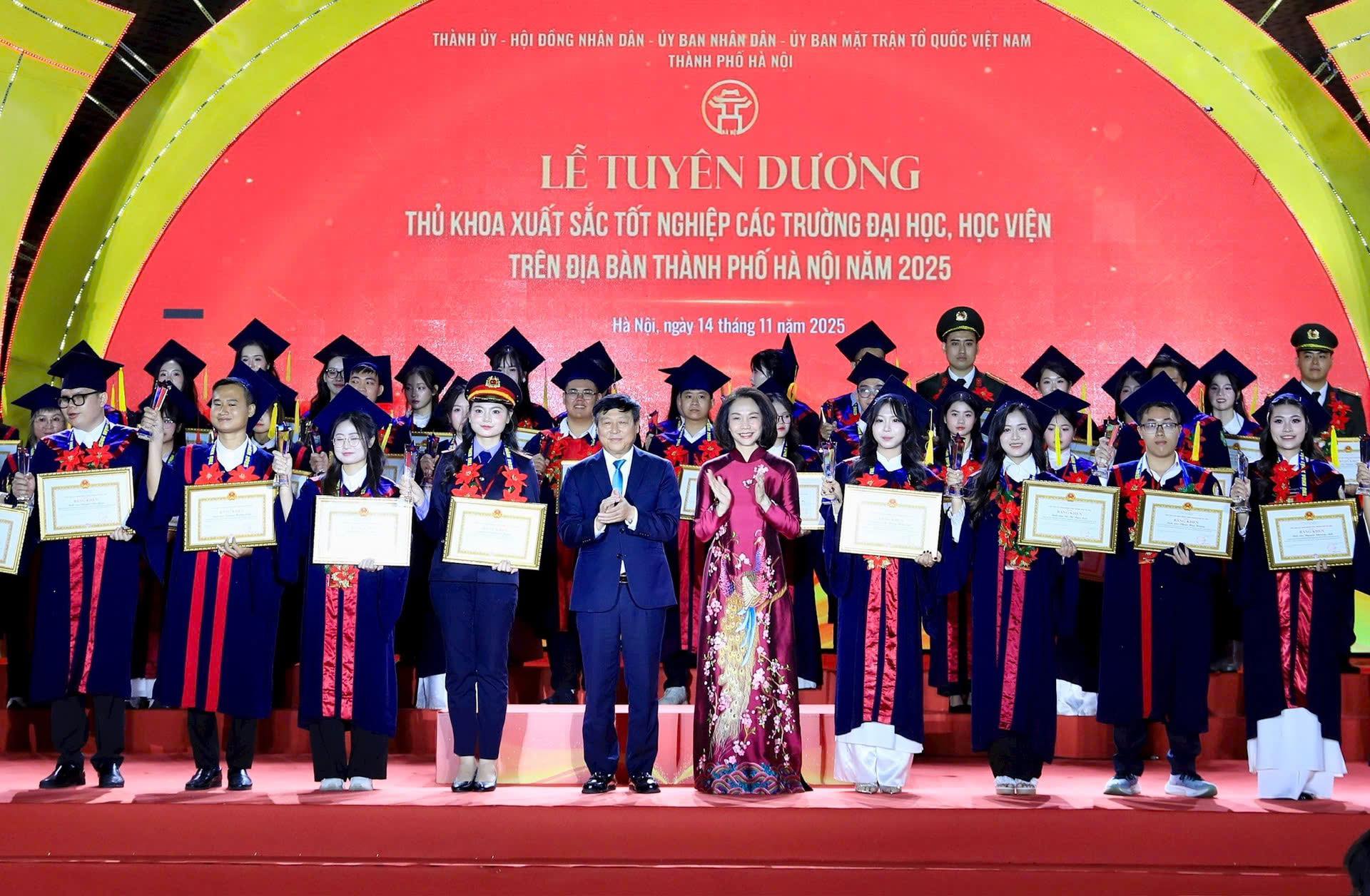 |
Hanoi has implemented various policies to attract and utilize talent, including an annual ceremony to honor outstanding valedictorians. Photo: Hoang Phong |
Selection criteria for PhD candidates
The draft outlines the selection criteria for PhD candidates to receive financial support: they must be Vietnamese citizens, not older than 47 years old in the year of selection, possess good political qualities and ethics, be healthy enough to study, meet the admission requirements of the training program, and have not received or committed to receiving a full scholarship from the State budget or other funding sources for their studies at the proposed level up to the point of selection.
Furthermore, the research content must address specific bottlenecks, major challenges, or research programs announced by decisions of the City People's Committee or the Department of Science and Technology. Candidates must also have a written commitment from a city unit or local enterprise to accept and utilize the research results, or a co-supervision letter from a professor who is a full-time lecturer at an international training institution ranked in the top 200 of reputable university rankings.
Supported PhD candidates are required to meet specific scientific publication output standards. For natural sciences, engineering, and technology fields: They must have at least two articles published in prestigious international journals listed in Q1 or Q2 (according to Scopus/Web of Science rankings). Of these, the PhD candidate must be the principal author (first author or corresponding author) for at least one article.
For social sciences and humanities fields, the draft requires at least one article published in prestigious international journals listed in Q1 or Q2 (according to Scopus/Web of Science rankings), or the publication of a book chapter with a prestigious international publisher. Additionally, candidates must present their research findings at least two times per year at specialized workshops at their workplace, or at conferences/workshops organized by the city for knowledge transfer, or at scientific conferences both domestically and internationally.
In addition, PhD candidates must produce research results that meet practical applicability standards, demonstrate foreign language proficiency equivalent to level 5/6 of the six-level Vietnamese Foreign Language Competency Framework at the time of thesis defense, and complete the training program and be awarded a PhD degree within the training institution's stipulated timeframe (not exceeding four years).
Anticipated grounds for termination of support
The draft resolution of the City People's Council also establishes regulations for the termination of support and financial compensation. It specifies cases where support will be terminated without requiring compensation: PhD candidates unable to continue the training program due to health issues (accident, illness, death confirmed by a competent authority); candidates assessed by the training institution as unlikely to complete the doctoral program during periodic evaluations; failure to complete the doctoral training program within the stipulated timeframe; or a change in research direction that is no longer directly related to the city's major challenges, data, models, policies, or development space.
According to the submission from the City People's Committee, Hanoi concentrates about 70% of the country's major science and technology organizations, universities, and research institutes, with over 60% of the nation's scientists living and working there. However, the number of leading experts with international qualifications in some strategic technology sectors remains limited, and there is a shortage of successors in several fields.
Specifically, the proportion of experts and scientists capable of becoming chief engineers or chief architects in some important sectors and fields, possessing both deep professional competence and a macro, strategic vision and planning ability to solve complex issues and bottlenecks in the socio-economic development of the capital in particular, and the country in general, is still insufficient to meet demand.
Arising from practical needs, the City Party Committee Steering Committee 57 issued Action Plan No. 20 on 19/1/2026, focusing on breakthroughs in science, technology, innovation, and digital transformation in the area for 2026. This plan sets the goal of developing elite human resources for the city, including the task of training 1,000 PhD candidates between 2026 and 2030, linked to the capital's major challenges and bottlenecks.
To achieve this goal, the city is developing and submitting a resolution to the City People's Council for consideration and approval, which will stipulate the PhD training support policy. The City People's Committee believes that the enacted resolution will be a strategic, proactive, and necessary step, helping the city shift its development model from quantity to quality, ensuring the capital's position as the nation's intellectual center.
Vo Hai