The Hanoi People's Committee recently submitted feedback on the pre-feasibility study report for the Capital Region ring road 5 construction investment project, which the Ministry of Construction prepared. The city largely agreed with the study's plan but requested adjustments to specific aspects regarding the investment scale, traffic organization, and implementation plan.
For expressway sections and interchanges within areas with a planned cross-section of 120 meters, Hanoi proposed that the central budget fund the main expressway portion. This funding would cover site clearance and construction to an 8-lane scale. The city would then be responsible for site clearance and investment in parallel roads for the remaining area, from the toe of the expressway's slope to the end of the planned scope, using local funds.
According to a leader from the Hanoi Department of Construction, the 6-lane option in the study's report generally aligns with current plans. However, the section passing through Hanoi is crucial for connecting the Hanoi - Lao Cai and Cau Gie - Ninh Binh expressways. It also links with the framework transport system accessing the inner city. Therefore, the city proposed to increase the route's scale from 6 to 8 lanes.
Hanoi also proposed not constructing overpasses across the expressway. Following development guidelines, ring road 5 is designed as a transport route combined with an urban railway. Therefore, it is necessary to study a system of local underpasses to connect both sides of the route, with at least a 1-meter sidewalk for pedestrians. Additionally, underpasses for heavy vehicles would ensure smooth traffic flow and efficient use of land along the route.
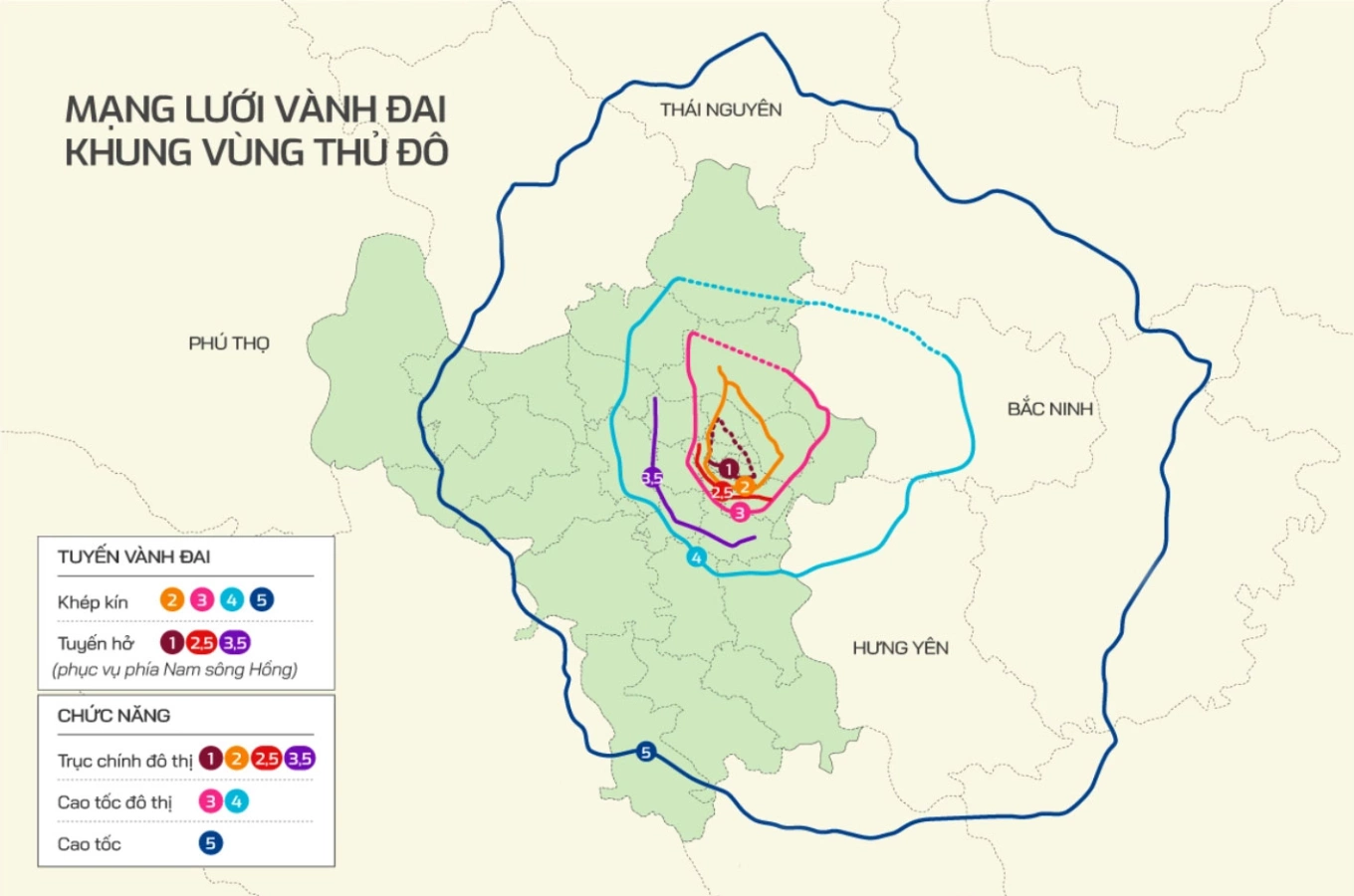 |
Hanoi's ring road system. *Graphic: Tien Thanh*
Regarding the interchange between ring road 5 and the Ho Tay - Ba Vi axis, as well as the Hoa Lac - Hoa Binh expressway, the city proposed that local authorities invest in it as a separate project. This recommendation stems from its complexity, involving multiple routes.
Additionally, Hanoi suggested studying a plan to combine the interchange between ring road 5 and the southern development axis within the city, and the interchange with National Highway 38 in Ninh Binh province, into a single interchange. This consolidation would facilitate traffic organization and enhance the operational efficiency of the route.
According to the pre-feasibility study report prepared by the Ministry of Construction, Capital Region ring road 5 will span approximately 340 kilometers. It will start at Yen Bai commune, connect with kilometer 367+100 of Ho Chi Minh Road, and form a complete loop. The route does not include about 33 kilometers that overlap with the Hanoi - Thai Nguyen and Hanoi - Lao Cai expressways.
The section of the route passing through Hanoi is approximately 51 kilometers long. It traverses Yen Bai, Yen Xuan, Phu Cat, Xuan Mai, Hong Son, My Duc, Huong Son, Hoa Xa, Son Tay, and Tung Thien communes and wards.
As per the plan, the route will have a cross-section of 120 meters, featuring an expressway in the middle and parallel roads on both sides. The expressway portion is designed with a roadbed 33 meters wide, comprising 6 lanes and 2 emergency shoulders. The total estimated investment for the entire project is approximately 261,688 billion VND.
Doan Loan