This initiative is part of a plan to implement a project to enhance public passenger transport, combined with personal vehicle control for the 2026-2030 period, recently issued by the Ho Chi Minh City People's Committee.
The city expects public officials, civil servants, employees, and workers prioritizing buses and metro will create a ripple effect, gradually changing residents' commuting habits.
Previously, Ho Chi Minh City encouraged this group to use buses, bicycles, and green vehicles, but this was primarily voluntary. This time, the use of public transport is linked to annual performance evaluations and rewards.
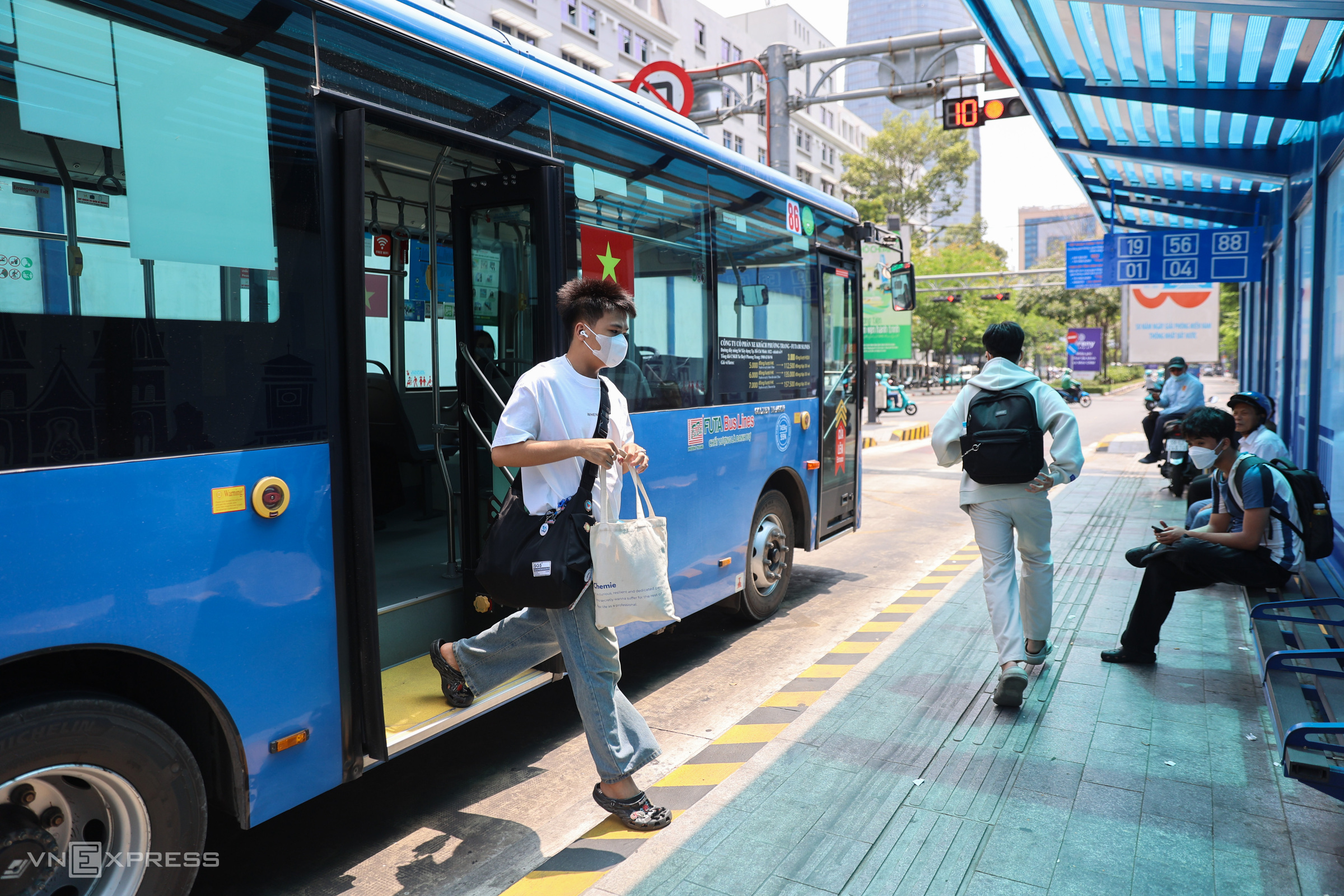 |
Passengers on a bus in Ho Chi Minh City, 4/2026. *Quynh Tran*
Ho Chi Minh City currently has about 180 inter-provincial and intra-provincial bus routes with over 2,400 vehicles, along with the Ben Thanh - Suoi Tien metro line. Other modes include river buses and public bicycles.
To attract passengers, the city has waived fares on 134 bus routes, while also upgrading vehicles, terminals, stops, shelters, and transfer points, prioritizing areas connected to the metro. According to the roadmap, all intra-provincial buses will use electricity or green energy from 2027.
The city is also studying exempting or reducing personal vehicle parking fees for bus and metro users; implementing integrated tickets across different public transport modes; and launching additional incentive programs.
Following the expansion of administrative boundaries, the bus network will be restructured. Electric buses and smaller buses will be added to penetrate residential areas to improve accessibility for residents. Many new routes will also connect Long Thanh airport with the former Binh Duong and Ba Ria - Vung Tau areas.
The demand-responsive transport (DRT) model using small buses is expected to be implemented to collect passengers within residential areas and transport them to main bus routes and the metro.
By 2030, Ho Chi Minh City plans to build 5 large bus terminals, develop smart parking lots, and upgrade transfer stations and shelters. The city is also studying dedicated bus lanes and opening more pedestrian streets in the city center.
Regarding personal vehicles, Ho Chi Minh City will develop a roadmap for emission control, transition to green transport, and implement low-emission zones in the city center, Can Gio, and Con Dao. Restrictions on personal vehicles on certain roads and at appropriate times are also being studied.
A network of charging stations and battery swapping cabinets will be developed at bus terminals, public offices, schools, hospitals, industrial parks, and parking lots to support residents in switching to electric and green energy vehicles.
*Giang Anh*