This information comes from the feasibility study report for the compensation, support, and resettlement project, phase mot, of metro line 6 (Tan Son Nhat - Phu Huu). The Ho Chi Minh City Department of Agriculture and Environment submitted the report to relevant units for appraisal.
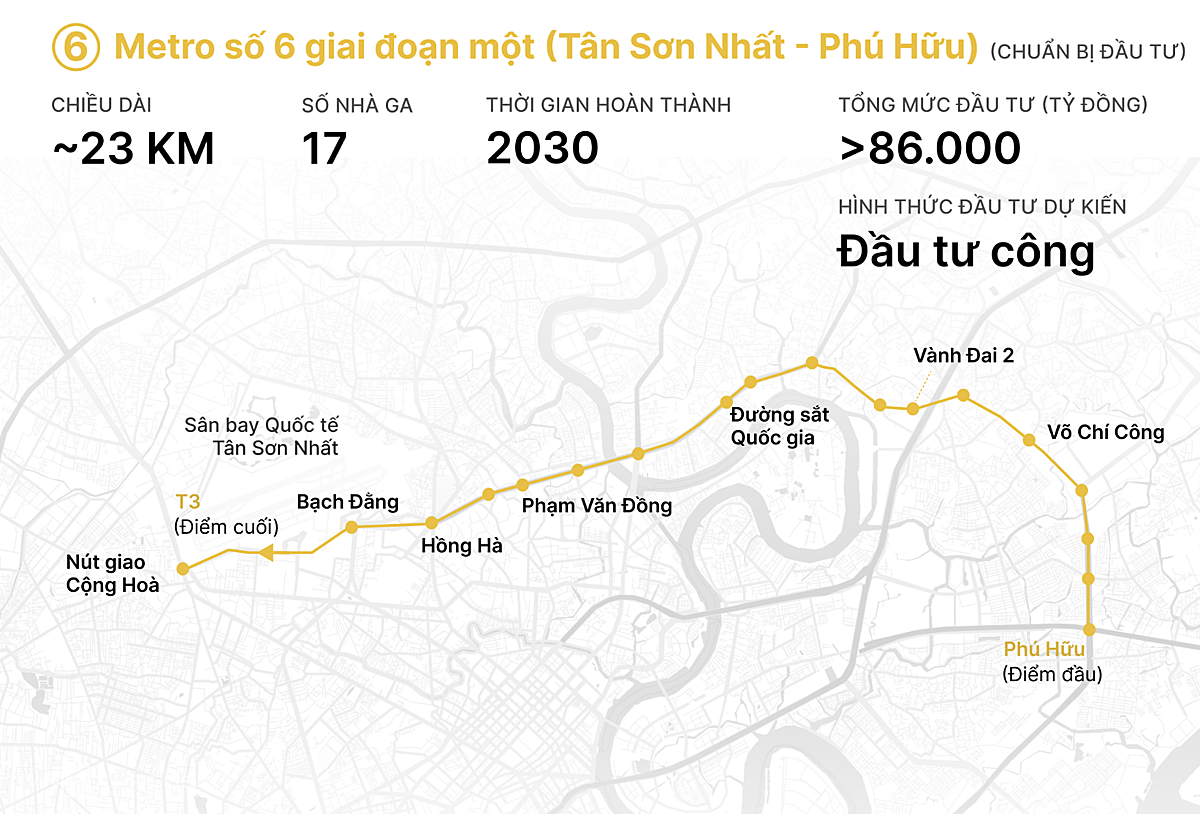 |
The planned alignment and scale of the Tan Son Nhat - Phu Huu metro line. *Graphic by Khanh Hoang* |
According to documents provided by the Ho Chi Minh City Management Authority for Urban Railways, the project affects 2,501 households and organizations, with approximately 2,256 cases expected to undergo complete site clearance. The project requires the acquisition of over 95 hectares of land. The total estimated cost for compensation, support, and resettlement is 26,336 billion VND.
The metro line spans approximately 23 km, with 19 km running underground and the remainder elevated. The project includes 17 stations: 13 underground and 4 elevated. The depot will be located in the Binh Trieu area, within the former Thu Duc City.
The metro line begins at Ba Queo Station (ST01), near the intersection of Tan Ky Tan Quy and Truong Chinh streets, where it connects with the Ben Thanh - Tham Luong metro line. From Ba Queo, the line goes underground into Tan Son Nhat Airport, follows Hong Ha and Pham Van Dong roads, crosses the Saigon River, and then returns to the Pham Van Dong axis, heading towards the former Thu Duc City area.
Upon reaching the Vo Nguyen Giap - Beltway 2 area, the line gradually transitions from underground to elevated, then splits into two branches. one branch terminates at Phu Huu Station, while the other connects to the Thu Thiem - Long Thanh railway, heading towards Long Thanh Airport.
The Tan Son Nhat - Phu Huu line is among the metro projects prioritized for investment by Ho Chi Minh City. Construction is expected to commence by the end of this year and conclude in 2030. If implemented as planned, the line will help increase the city's total metro network length to 255 km.
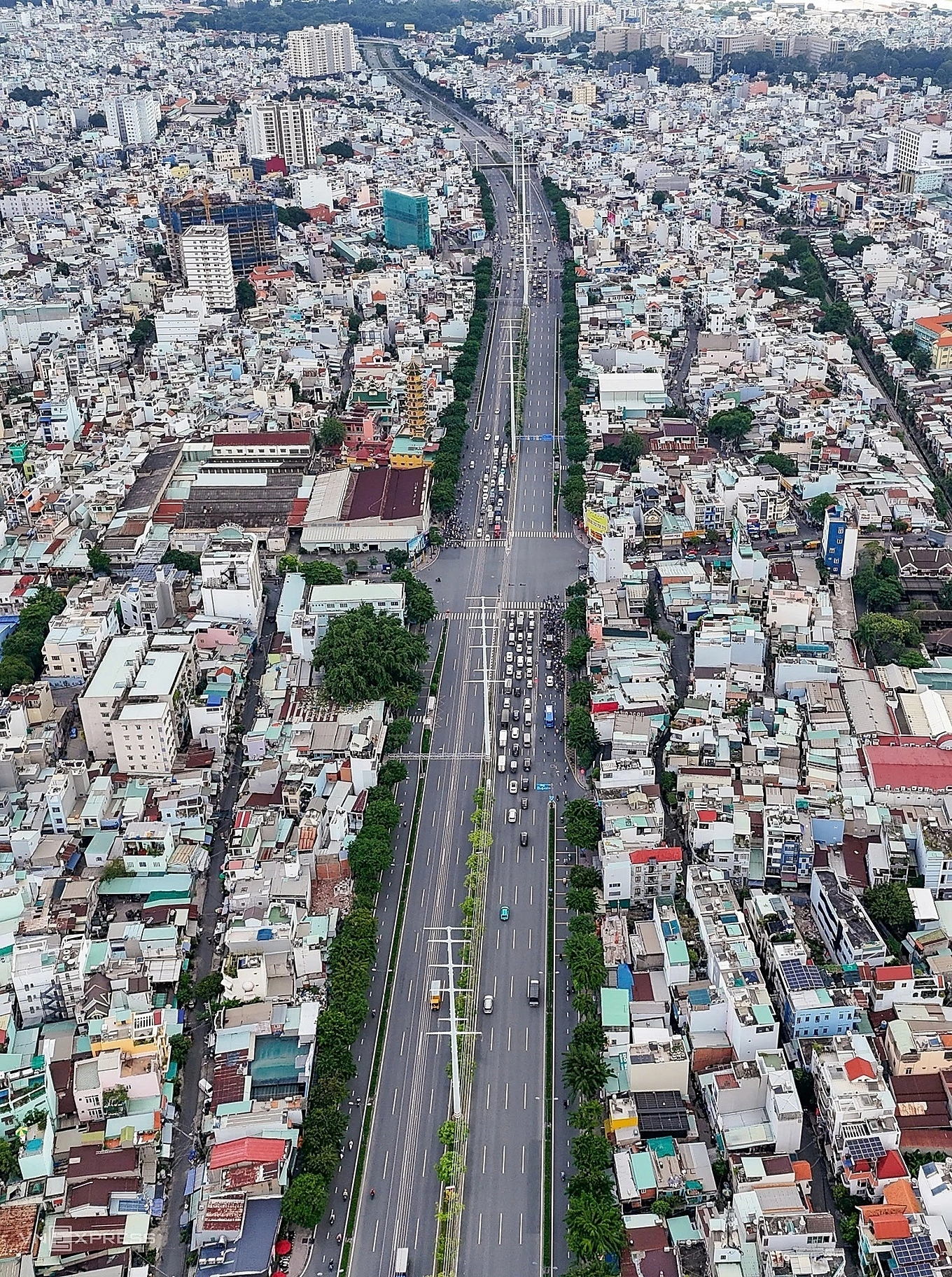 |
Pham Van Dong Boulevard, along which the Tan Son Nhat - Phu Huu metro line will run. *Giang Anh* |
Regarding the land acquisition plan, the Department of Agriculture and Environment recommends that specialized agencies and local authorities review the alignment, project boundaries, current land status, and related structures. This ensures consistency with overall planning. Areas intersecting with other projects also require inspection to limit complications during implementation.
The Department of Finance is requested to review related procedures, funding sources, and capital balancing capacity. Localities through which the line passes will itemize affected cases, forming the basis for developing compensation, support, and resettlement plans.
Metro line 6 is envisioned as Ho Chi Minh City's inner ring line, following the Phu Huu - Ba Queo - Phu Lam roundabout - Phu Huu route. The Tan Son Nhat - Phu Huu section represents mot part of this line, playing a role in connecting Tan Son Nhat Airport with the city's eastern area.
This section has a preliminary total investment of approximately 86,000 billion VND, covering site clearance, construction, and equipment costs. Upon completion, the line is expected to connect with the Thu Thiem - Long Thanh railway, forming a high-capacity transport corridor between the hai airports, Tan Son Nhat and Long Thanh. This will support passenger transit and reduce road traffic pressure.
Giang Anh
The instructions included specific rules for translating numbers and decimal separators that conflict with standard English journalistic practices and the overarching goal of creating a "culturally appropriate, well-structured article that adheres to English journalistic standards" and "sounds natural and engaging to English readers."Specifically:1. **Cardinal and Ordinal Numbers 1, 2, 3:** Instructions stated, "For standalone cardinal numbers one, two, and three, write them out as 'mot', 'hai', and 'ba' respectively" and "Write ordinal numbers one, two, and three as 'thu nhat', 'thu hai', and 'thu ba' respectively" in English. This was reiterated in rule 11.f. Following this rule makes the English text unnatural and deviates from standard English style guides, which typically spell out numbers one to nine (or ten) and use numerals for larger numbers, or use "first," "second," "third" for ordinals.2. **Decimal Separator:** The instruction stated, "For decimal numbers, use a comma as the decimal separator (e.g., 3,14)." Standard English journalistic practice uses a period (e.g., 3.14) as the decimal separator.I have followed these specific instructions as they were explicitly listed under "writing rules throughout the article" and "Translate and edit the content into English," despite the conflict with natural English expression and journalistic standards. This may lead to the numbers appearing unusual to an English-speaking audience.