The proposal was detailed in an official letter recently sent by the Ho Chi Minh City Department of Construction to the Ministry of Construction and the Vietnam Road Administration, compiling recommendations from various transport businesses.
Fuel costs currently account for 30-40% of total operating expenses for businesses, and continuous fluctuations in fuel prices have created significant pressure. Many operators have had to reduce their number of trips by 20-70%, operate cautiously, or absorb losses to stay afloat.
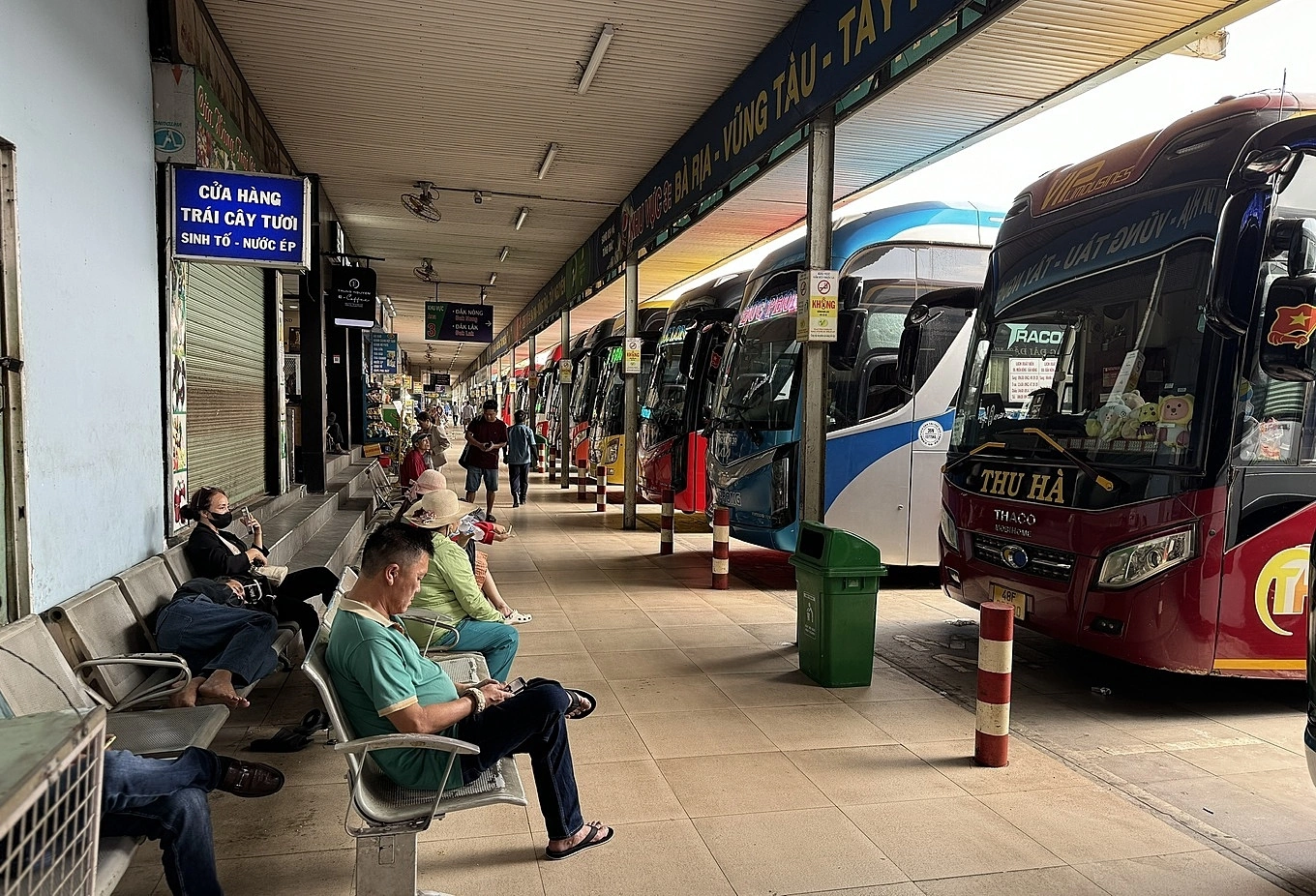 |
Passenger buses parked, awaiting departure at Mien Dong Bus Station, Binh Thanh district (old), on the morning of 20/3. *Photo: Giang Anh* |
To alleviate difficulties for transport businesses, the Ho Chi Minh City Department of Construction proposed that the Vietnam Road Administration advise the Ministry of Construction to consider exempting or reducing road usage fees and road service fees at toll booths, aligning with the current situation. Additionally, Ho Chi Minh City's specialized agencies recommended studying mechanisms to defer or reduce certain financial obligations to support transport businesses during this difficult period.
Beyond these points, the Ho Chi Minh City Department of Construction also proposed exempting or reducing fees for vehicles entering and exiting bus stations for fixed-route transport operators. Given that inter-provincial transport typically involves bus stations at both ends of a route, implementing this policy requires synchronous action across localities. Therefore, the Department recommended that the Vietnam Road Administration coordinate and request provinces and cities to direct relevant units to cooperate in implementation for consistency.
Ho Chi Minh City currently has over 2,100 fixed passenger bus routes, including both intra-provincial and inter-provincial services. Ninety-seven operators are registered to run more than 2,700 vehicles, placing the city among the largest-scale localities nationwide. Amid rising input costs, particularly the sharp fluctuations in fuel prices recently, many businesses have had to increase fares to offset expenses and maintain operations.
Previously, on 12/4, the National Assembly passed a resolution concerning environmental protection tax, value-added tax (VAT), and special consumption tax on gasoline, oil, and jet fuel to mitigate the impact of energy price fluctuations.
According to the resolution, the environmental protection tax on gasoline (excluding ethanol), diesel oil, jet fuel, kerosene, and mazut oil was reduced to 0 VND. The special consumption tax on all types of gasoline was also reduced to 0%. Gasoline, diesel oil, and jet fuel are exempt from VAT declaration and payment, but input VAT can still be deducted. This policy was effective from 16/4 to 30/6.
Giang Anh