Ho Chi Minh City's Department of Construction is currently seeking feedback on a draft proposal for traffic emission control. The city suggests dividing the area into four zones to implement emission control roadmaps and vehicle conversion support policies.
Under this proposal, poor and near-poor households across the city are slated to receive 20 million VND and 14 million VND, respectively, when they switch from gasoline motorbikes to electric motorbikes.
General households and businesses will receive varying support levels depending on the zone and conversion time. Those who convert earlier will receive higher benefits.
In Thanh An island commune, part of the former Can Gio area, residents are proposed to receive 20 million VND in support when converting to electric, green energy motorbikes before 2028.
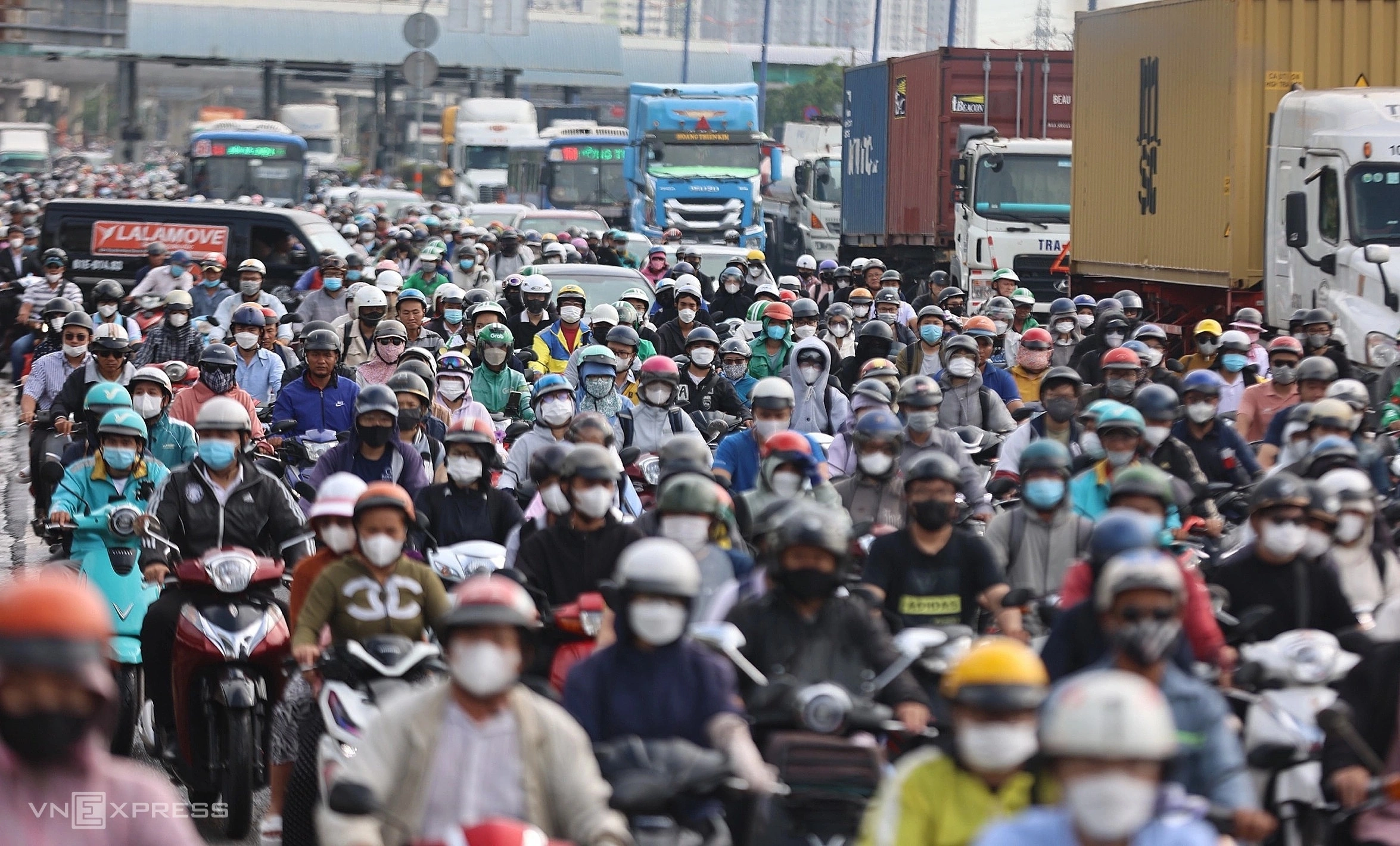 |
Heavy traffic on a Ho Chi Minh City street. Photo: Quynh Tran |
In Con Dao, individuals and households converting vehicles before 2028 will receive nearly 19 million VND per motorbike. For cars with fewer than 9 seats, the support is nearly 106 million VND if converted during this period, decreasing to nearly 53 million VND if done before 2029.
Taxis and contract vehicles with fewer than 9 seats operated by transport businesses in Con Dao are proposed to receive over 132 million VND per vehicle if converted before 2028. Passenger buses and contract vehicles with 10 seats or more will receive 250 million VND, while trucks will receive approximately 162 million VND. These amounts will gradually decrease for later conversions.
In the remaining areas of the former Can Gio and the low emission zone (LEZ) in the city center, individuals and general households converting motorbikes before 2030 will receive support for registration fees, registration, and license plate issuance, equivalent to approximately 1,77 million VND per vehicle.
For cars with fewer than 9 seats, the proposed support is 14 million VND; plug-in hybrid vehicles will receive approximately 7 million VND.
Transport businesses, including taxis, trucks, contract vehicles, and passenger buses, converting before 2030 will receive 10-14 million VND per vehicle, depending on the type.
Over 19,400 billion VND allocated for green transition
The proposal also outlines Ho Chi Minh City's plan to invest in infrastructure, enabling residents to use electric vehicles. The city aims to establish at least 19,000 electric charging stations and 33,000 battery swap cabinets for electric motorbikes citywide.
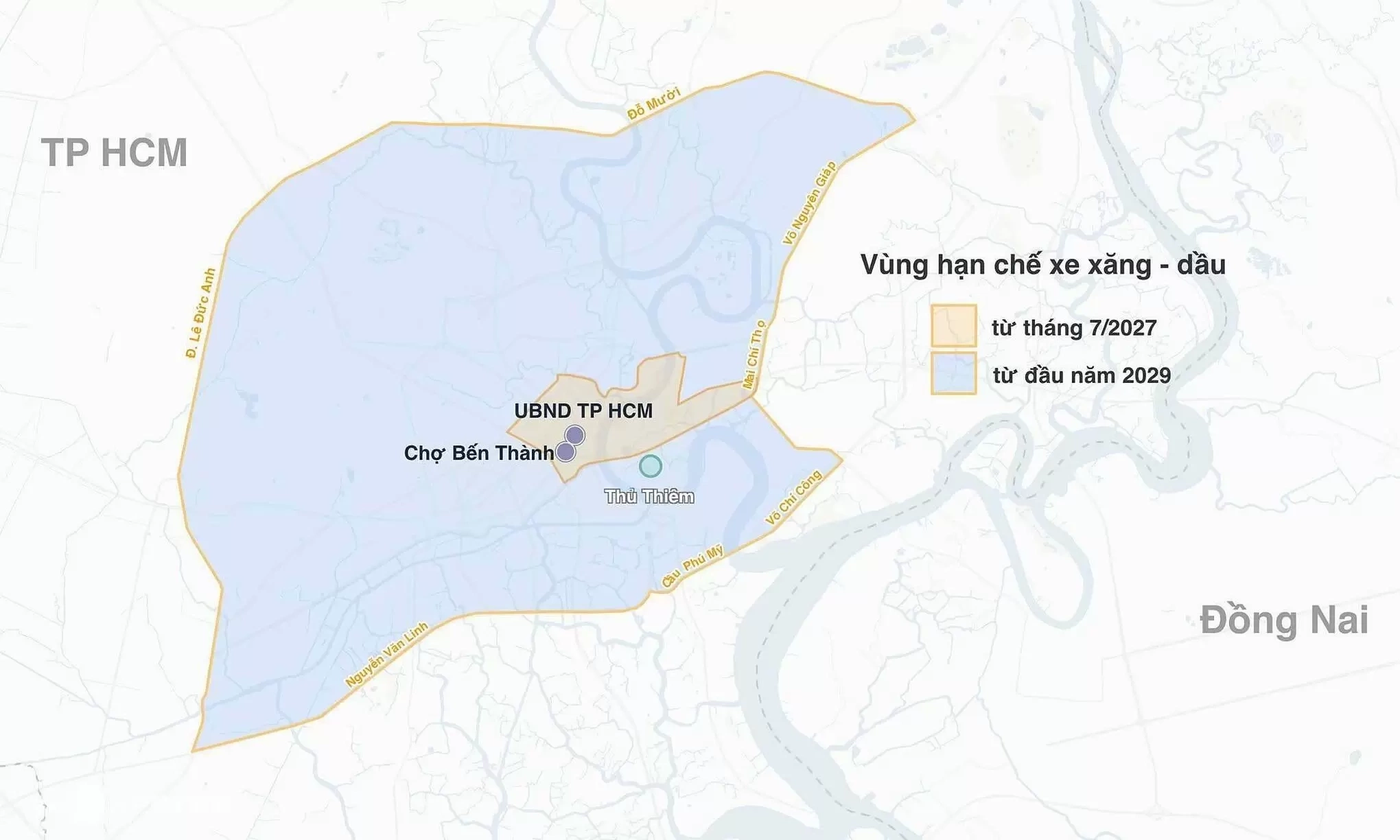 |
The LEZ in central Ho Chi Minh City will gradually restrict gasoline vehicles over two timelines. Graphic: Hoang Thanh |
The bus network will also be reorganized to enhance connectivity. Approximately 7,300 public bicycles are expected to be deployed in high-demand areas, around the LEZ, and connected to bus and metro stations.
Around the LEZ, the city plans to install over 300 automatic number plate recognition (ANPR) cameras. These cameras will connect to a data processing software system and relevant units to control vehicle entry and exit.
The preliminary capital requirement for conversion support policies and infrastructure investment is proposed to be over 19,400 billion VND. Of this, nearly 10,300 billion VND falls within the scope of the proposal and is expected to be funded by the city budget; the remainder will come from specialized programs, projects, loan interest support mechanisms, and socialized capital.
Ho Chi Minh City, after incorporating Binh Duong and Ba Ria - Vung Tau, has over 14 million people and nearly 13 million vehicles, not including transient vehicles. Road traffic is estimated to contribute approximately 88% of fine dust from transportation activities, causing over 3,000 billion VND in economic damage annually.
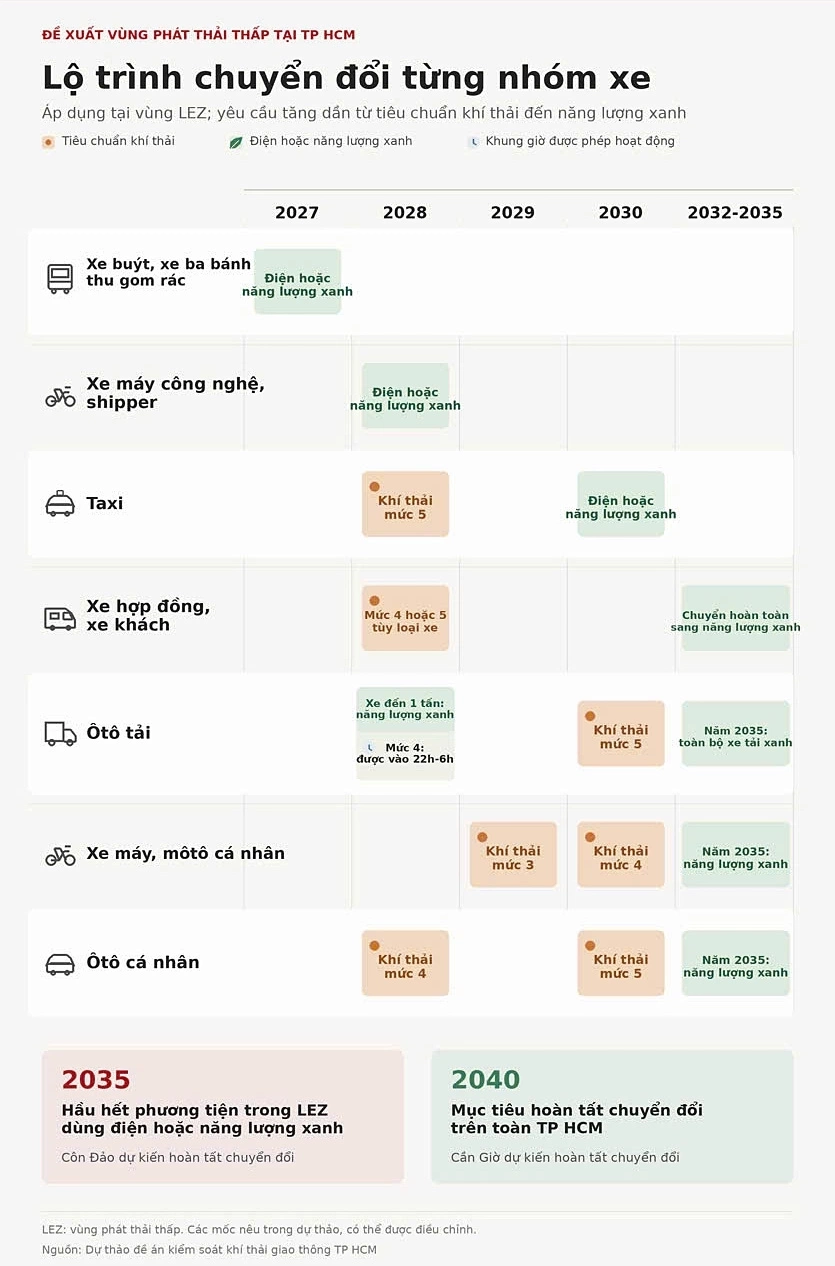 |
Conversion roadmap by vehicle group. Graphic supported by AI |
Giang Anh