Vietnam faces significant risks in technological advancement and institutional bottlenecks, potentially hindering its economic growth. During a national assembly discussion on the afternoon of 20/4, Tran Van Khai, Vice Chairman of the Committee for Science, Technology and Environment, emphasized the need for faster and smarter public investment, particularly in digital, energy, and innovation infrastructure. This foundational investment is crucial for sustainable growth, especially given the unpredictable trade and geopolitical landscape.
According to Khai, the greatest risk lies in technology. The lifecycle of technology is shrinking, yet investment processes remain lengthy. Falling behind by one step could result in a loss of competitive advantage and missed development opportunities for the nation.
Khai also highlighted institutional gaps concerning investment in intangible assets such as data, core software, algorithms, and intellectual property. Without clear mechanisms for order placement, expenditure contracting, and results-based procurement, digital transformation efforts will be delayed, failing to achieve expected productivity gains. Cybersecurity and data sovereignty present another risk. As digitalization deepens, the attack surface expands, and cyber incidents could disrupt public services, production, and business operations.
Energy and environmental constraints also pose significant challenges. Data centers and artificial intelligence consume substantial amounts of electricity. If not coupled with energy security and green standards, digital growth could be hampered by power infrastructure limitations and emission pressures.
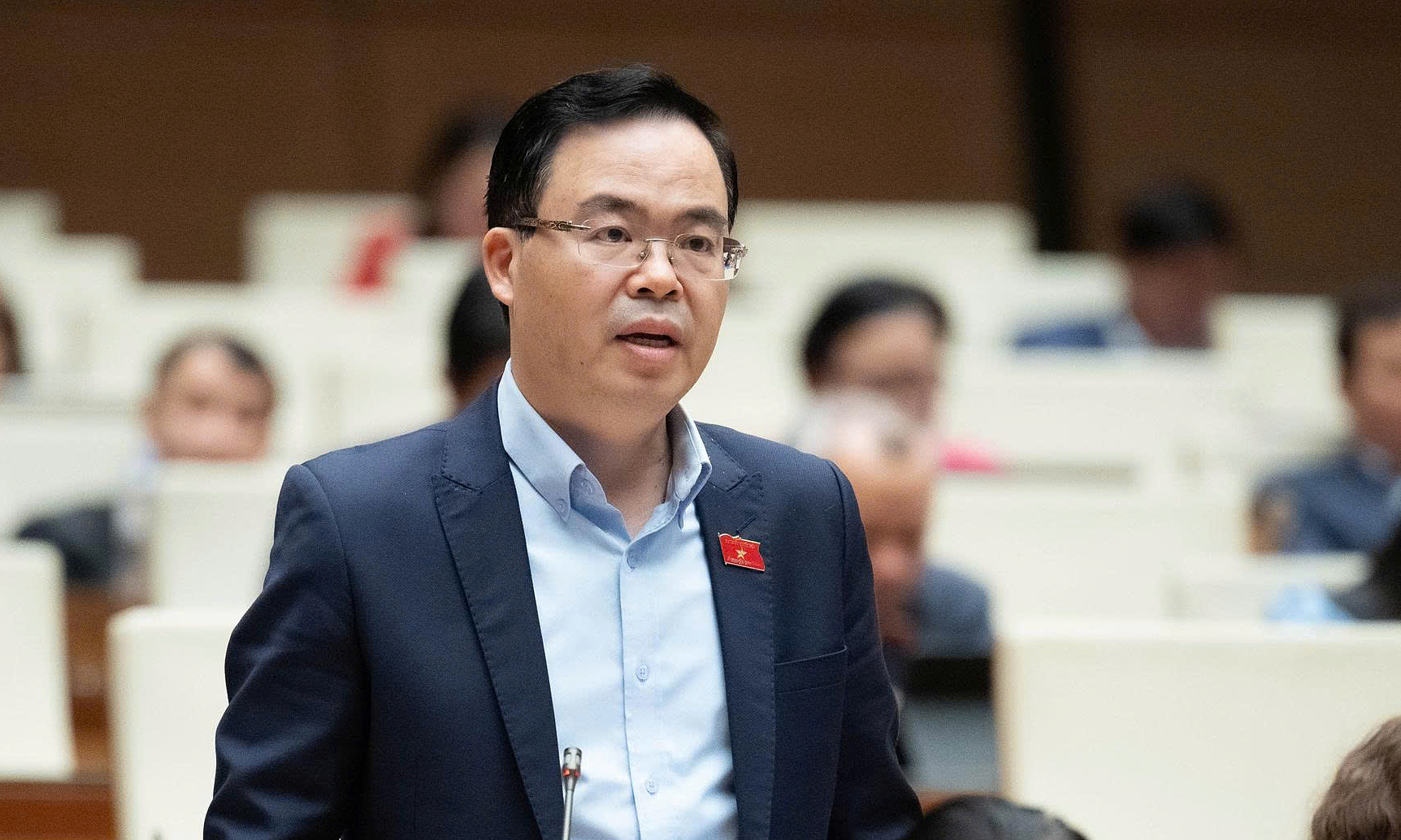 |
Deputy Tran Van Khai, Vice Chairman of the Committee for Science, Technology and Environment, at the national assembly. Photo: Hoang Phong |
To overcome these challenges, Khai proposed that the government reform institutions, develop infrastructure, enhance human resource quality, and strengthen results-based monitoring. Ministries and agencies should establish project portfolio management mechanisms under Resolution 57, avoiding widespread and overlapping investments.
He also recommended allowing the application of order placement, expenditure contracting, and controlled experimentation for science and technology tasks, data, and digital platforms. Additionally, he called for clear regulations on risk governance, accountability, and mechanisms to protect officials who innovate for the common good.
Khai stressed that cybersecurity must be a mandatory component in all digital projects utilizing state budgets, ensuring safety from the design phase. Adequate funding is needed for monitoring, backup, recovery, and independent data testing. Investment in identity data platforms, logistics, healthcare, and education should be prioritized.
"It is necessary to increase investment in STEM education and digital project management, attract experts, and mobilize the private sector to participate in investment through appropriate public-private partnership models," he said.
Startup funding and policy gaps impede breakthroughs
Nguyen Van Huy, Deputy Head of the Hung Yen delegation, echoed these concerns, stating that as traditional growth drivers decline, the startup and innovation ecosystem becomes a key factor. However, it is currently hampered by several bottlenecks.
According to Huy, entrepreneurship is no longer just a trend but a critical driver for enhancing national competitiveness. Yet, Vietnam's startup ecosystem lacks policy synchronization, with overlaps and inconsistencies among laws and sub-laws. Regulations related to venture capital, tax incentives, and policy experimentation are incomplete, making it difficult for many ideas to be implemented.
Connections among stakeholders in the ecosystem remain weak, and a "go-it-alone" mentality is prevalent. Many scientific research outcomes are not effectively commercialized. Startups struggle to access technology, while investors lack information and confidence to provide capital.
 |
Deputy Nguyen Van Huy (Deputy Head of Hung Yen delegation). Photo: Hoang Phong |
Another significant bottleneck is capital. Despite the involvement of some domestic and foreign investment funds, their scale and diversity remain limited. Startups, especially in early stages, find it difficult to access capital due to a lack of collateral. Many potential projects must seek foreign funding, scale down, or even cease operations.
According to the Hung Yen deputy, these limitations not only reduce the effectiveness of the startup ecosystem but also cause Vietnam to miss development opportunities amid fierce regional competition. He therefore proposed that the government review and refine innovation laws, and include the development of the startup ecosystem in the Resolution on the socio-economic development plan for the 2026-2030 period.
Concurring, Nguyen Dai Thang, Vice Chairman of the Committee for Deputy Affairs, asserted that achieving double-digit growth requires a strong shift from extensive to intensive growth, with productivity, science and technology, and innovation as central drivers.
He proposed increasing investment in research and development to at least 1,5% of GDP, encouraging businesses to contribute to the Science and Technology Fund, and offering tax exemptions for applied research activities. He also suggested establishing a National Innovation Support Fund to aid technology companies, supporting industries, and digital transformation initiatives.
"Attracting foreign investment needs to shift from quantity to quality, prioritizing projects committed to technology transfer, utilizing domestic human resources, and linking with local businesses," Thang said. He proposed developing breakthrough policies to attract domestic and international experts to participate in science, technology, and innovation development in Vietnam.
Son Ha