Olympic Sports Urban Area
The Olympic sports-urban complex, with a total area of over 9,000 ha and an anticipated population of about 751,000 people, commenced on 19/12. This marks it as Hanoi's largest urban development project to date.
The project spans 11 communes: Dai Thanh, Ngoc Hoi, Nam Phu, Thuong Tin, Hong Van, Chuong Duong, Thuong Phuc, Binh Minh, Tam Hung, Thanh Oai, and Dan Hoa, all within Hanoi.
This significant undertaking is planned to be divided into four component projects, each corresponding to a main sub-area. Component project sub-area A focuses on new urban development integrated with the transit-oriented development (TOD) model. It also considers its role as a transportation hub, connecting and supporting the sports complex located in sub-area B.
Component project sub-area B is dedicated to developing a sports urban area and service urban area, integrated with the sports complex, which includes the international-standard Trong Dong Stadium.
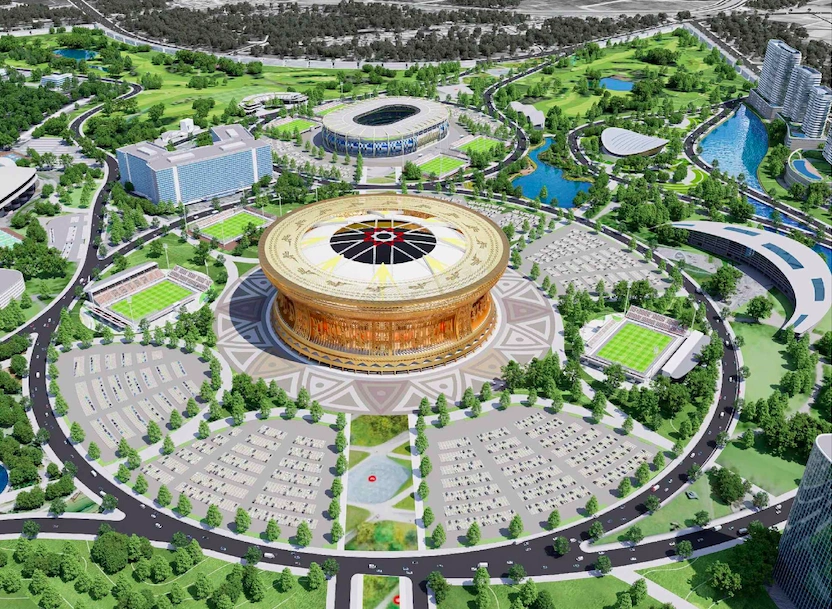 |
Perspective of the Olympic sports urban area.
Component project sub-area C involves the development of a sports urban area and service urban area, linked to the sports complex. Component project sub-area D focuses on developing a sports urban area and service urban area.
The preliminary total investment exceeds 925 trillion VND, with completion expected in 2035.
According to Hanoi city leaders, the Olympic sports urban area is being built to enable the capital to host major continental and international sports events, such as the Asian Games (ASIAD) and the Olympic Games.
Beyond its sporting purpose, the project is envisioned as a catalyst for new urban development. It aims to synchronize the social and technical infrastructure of the research area with neighboring projects, ensuring a modern and cohesive architectural and landscape design.
Red River Landscape Boulevard Axis
The Red River Landscape Boulevard project also broke ground on 19/12. It covers a research area of approximately 11,000 ha, featuring an 80 km traffic boulevard along both riverbanks, about 3,300 ha for landscape parks and entertainment, and approximately 2,100 ha designated for site clearance to facilitate urban redevelopment.
The project encompasses a research area of about 11,000 ha. This includes an 80 km long traffic boulevard along both riverbanks, a system of landscape parks and entertainment areas covering approximately 3,300 ha, and about 2,100 ha of cleared land for the redevelopment of existing urban areas.
The project spans from Hong Ha Bridge to Me So Bridge, passing through 19 communes and wards of Hanoi. On the right bank of the Red River, it includes 12 communes and wards such as O Dien, Thuong Cat, Dong Ngac, Phu Thuong, Hong Ha, Vinh Tuy, Vinh Hung, Linh Nam, Hoang Mai, Thanh Tri, Nam Phu, and Hong Van. On the left bank, it crosses seven communes and wards in Me Linh, Dong Anh, and Long Bien, including Thien Loc, Vinh Thanh, Dong Anh, Bo De, and Bat Trang.
The project is expected to comprise four component projects. Component project one, on the left bank of the Red River, includes the traffic boulevard, landscape parks, entertainment areas, and land clearance for urban redevelopment.
Component project two, on the right bank of the Red River, includes the traffic boulevard, landscape parks, entertainment areas, and land clearance for urban redevelopment.
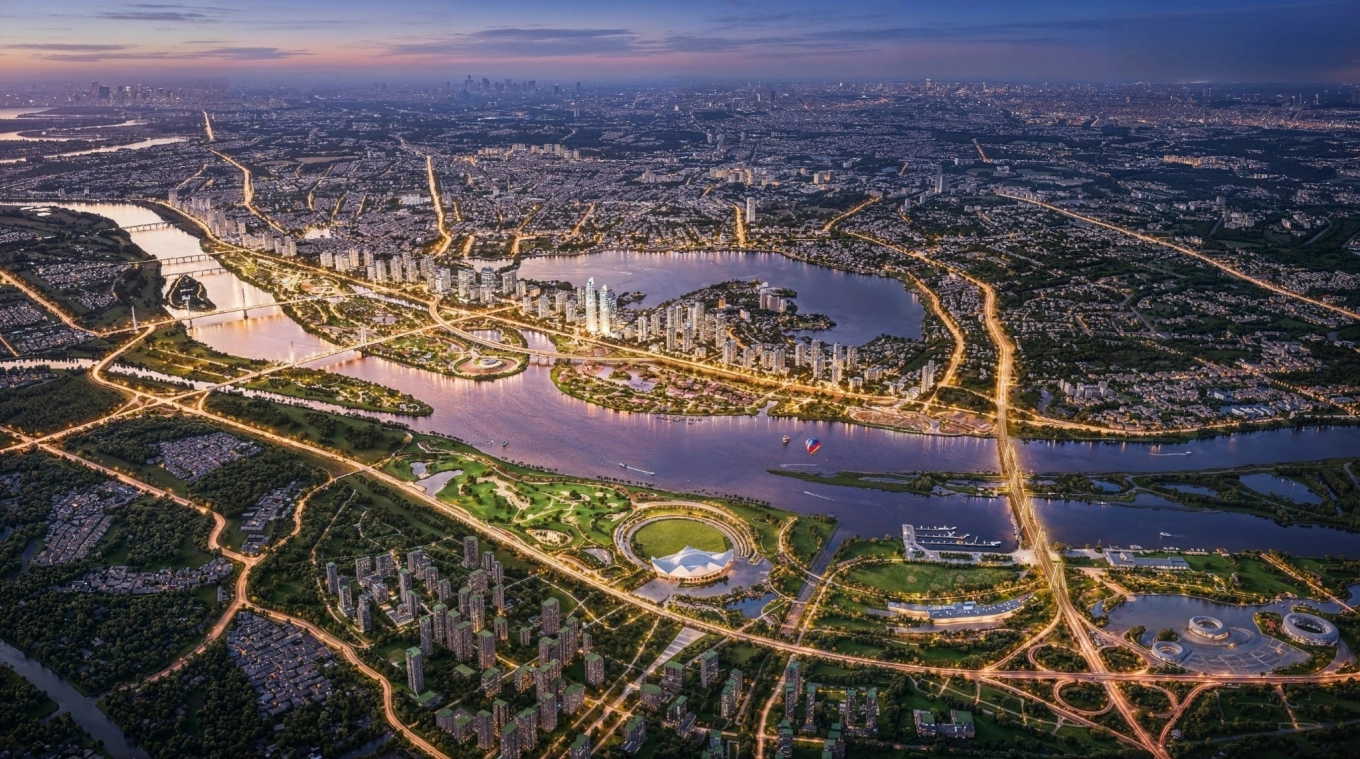 |
Perspective of the Red River landscape boulevard project.
Component project three involves investing in an underground metro line on the right bank of the Red River, spanning about 45 km, to connect seamlessly with the city's urban railway system.
Component project four, a resettlement urban area, will be developed on-site as high-rise apartment buildings within the investment project's scope. Consideration may also be given to implementation on land funds used for investor payments.
The preliminary total investment for the project is approximately 855 trillion VND, with completion anticipated in 2030. Once finished, the Red River Landscape Boulevard Axis is expected to create a modern, sustainable riverside urban space, enhancing the quality of life for the capital's core area.
North Hanoi Smart City Project
The North Hanoi Smart City project, spanning over 270 ha with a total investment of 4,2 billion USD, began implementation in late 2023. It is located in Vinh Ngoc, Hai Boi, and Kim No communes in the former Dong Anh district, at the foot of Nhat Tan Bridge on the north bank of the Red River, along Vo Nguyen Giap street, connecting the city center and West Lake area to Noi Bai International Airport.
The project will be executed over 9 years, divided into five stages. The initial four stages, spanning about 7 years, will involve the development of green spaces, public facilities, housing, schools, transportation infrastructure, parking lots, historical and religious sites, and individual projects.
Stage five, from late 2030 to late 2032, will see the implementation of numerous landmark architectural structures, including a 108-story financial and mixed-use commercial center.
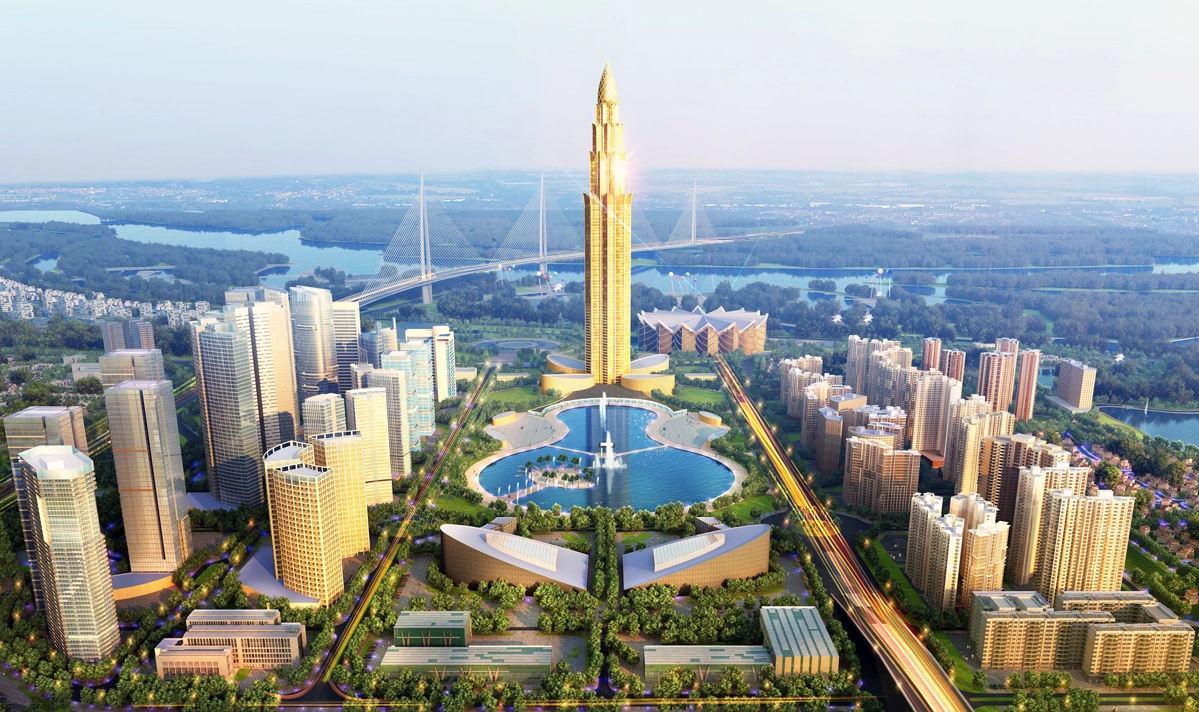 |
Perspective of the 108-story financial tower in the smart city project. Photo: Investor provided
The financial and mixed-use commercial center is considered the highlight and heart of the smart city. This 639 m tall tower is situated on parcel 3.3.4, covering an area of over 133,000 m2, with a construction density of nearly 23%. Upon completion, the smart city project is expected to accommodate a population of over 25,740 people.
According to Hanoi leaders, the financial tower features a large-scale design that embodies international-level ideas and innovative technology. It is part of a comprehensive, modern master plan, researched by Japanese and Vietnamese investors.
The North Hanoi Smart City project contributes to addressing major current infrastructure challenges in the capital, such as traffic, energy, education, healthcare, and environment. It is envisioned to form the future northern city of Hanoi.
Hoa Lac Urban Area
The government has approved the general plan for the Hoa Lac Urban Area, aiming to develop it into a modern urban center with synchronized social and technical infrastructure. Its role is to alleviate functional and population pressures on the central urban area and to drive socio-economic development in the suburban region.
Accordingly, the future Hoa Lac urban area is oriented as a science and technology hub, concentrating advanced intellect and technology. It will serve as a national center for high-quality human resource training, scientific research, and high technology. Additionally, it will host a national university and vocational colleges, along with medical, treatment, and nursing facilities.
Hoa Lac is also poised to become an ecological and resort urban area, a science and technology urban area focused on green and smart urban development, energy efficiency, and a regional center for western Hanoi.
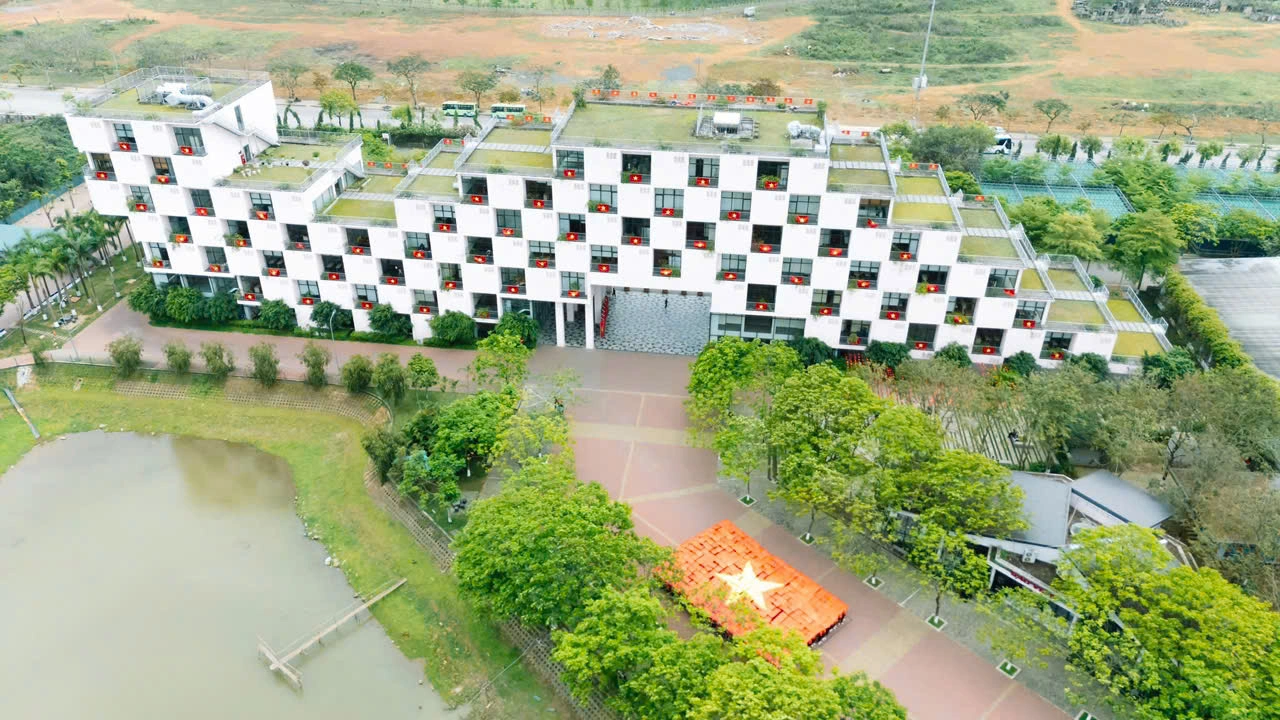 |
FPT University at Hoa Lac High-Tech Park. Photo: FPTU
The Hoa Lac Urban Area features a development model comprising two distinct zones. The urban core zone will be developed according to an urban model, consolidating functional areas and new urban zones with regional and local centers. The green belt surrounding the urban area will be developed following a new rural model.
The population of Hoa Lac urban area is projected to be about 150,000 people by 2025. By 2030 and beyond, the population is expected to reach approximately 600,000 people, with an urban population ratio of about 85%.
Currently, numerous projects are underway in the Hoa Lac urban area, including Hoa Lac High-Tech Park, Vietnam National University, Hanoi campus, and several ecological urban areas and residential projects.
Under the general plan for Hanoi, the government envisions Hoa Lac as a leading hub for high-tech science and engineering, a center for high-quality training and education, and a smart city. It aims to concentrate advanced intellect and technology, absorbing international scientific and technological advancements.
The western area of Hanoi will develop as a city comprising Hoa Lac and Xuan Mai, covering an area of approximately 251 km2. Its population is projected to reach 0,8–1,2 million people by 2045, making it a national center for science, education, and high technology.
Doan Loan - Vo Hai